Acad. Yordan Ivanov Regional History Museum
Founded in 1897
Dating stated in the sources: 1897
Your visit at a glance
- Address
- 55 Bulgaria Blvd. (main building, Asclepius Hall)
- Approximate time at the site
- about 1 hour
- Opening hours
- Visit details
- Admission
- Visit details
The image could not load. Its caption and source remain available.

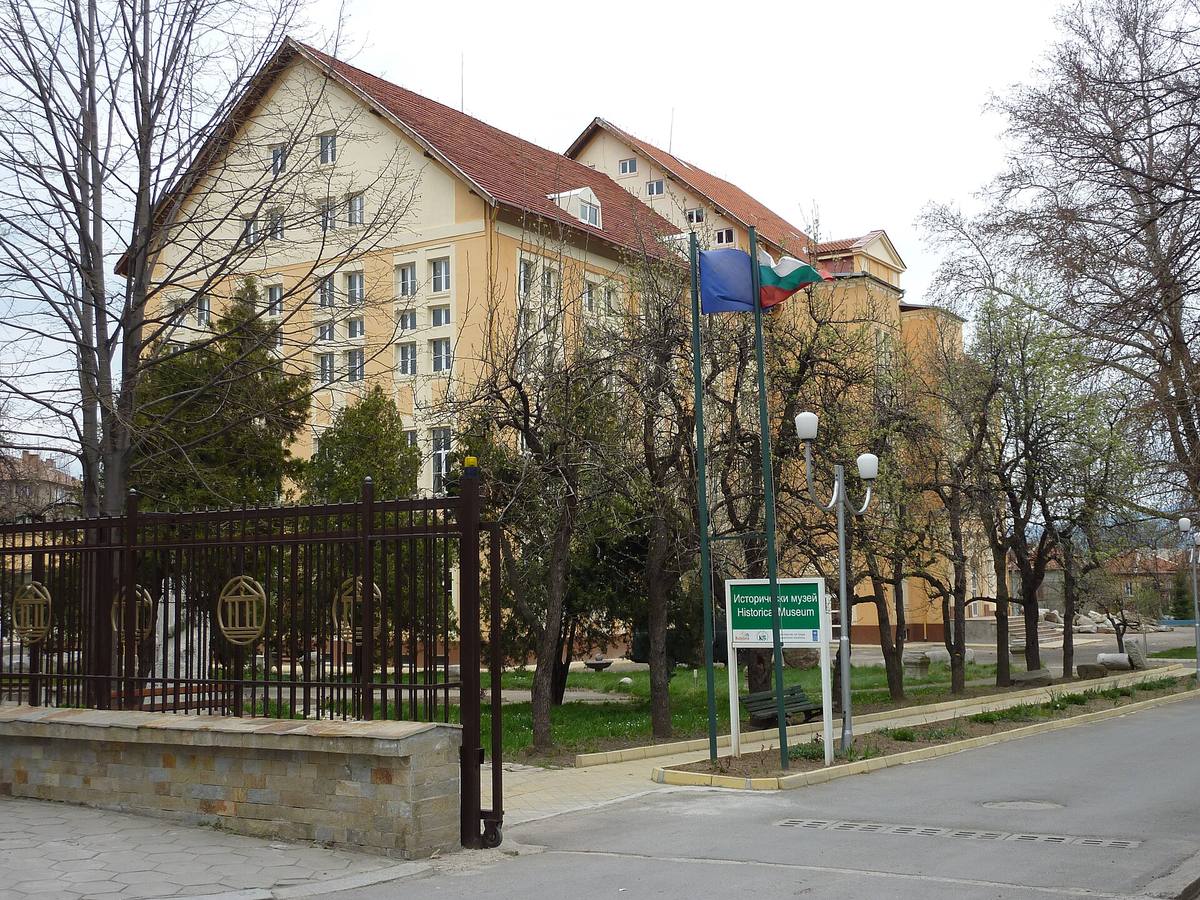
The museum was founded on November 3, 1897, as a school collection at the Kyustendil Pedagogical School, which the museum itself calls the first museum collection in southwestern Bulgaria. Its main building is at 55 Bulgaria Blvd. There, in Asclepius Hall, are the archaeological and coin exhibitions, covering the 7th-6th millennium BC to the 17th century.
Hours, admission, and directions ↓
The large building at 55 Bulgaria Blvd. is the headquarters of the Regional History Museum. Inside, in Asclepius Hall, is the museum’s archaeological exhibition: clay models and pots from prehistory, Thracian jewelry, votive reliefs from Pautalia, a Thracian-Roman four-wheeled wagon, and coins. The museum’s other sites are spread across town: a medieval church, three house museums, an exhibition hall in an old mosque, and the Pirgova Tower.
A collection in a school
↗The story begins before the museum. As early as the 1860s, Georgi Angelov Drumoharski, Petar Tsvetanov Lyubenov, Efrem Karanov, and others of the town’s National Revival intelligentsia began collecting antiquities and studying Kyustendil’s past, the museum writes. Toward the end of the century they were joined by Stoyan Zaimov, Zinovi Poppetrov, and Georgi Kolushki.
On November 3, 1897, a museum collection opened in the Pedagogical School, today’s Town Hall. The Ministry of Education approved it by order No. 17 323 of December 1, 1897. The museum describes it as:
- the first museum collection in southwestern Bulgaria;
- the third school museum in the country, after those of the Aprilov High School in Gabrovo and the Stara Zagora boys’ school;
- one of the early local museums outside Sofia after the Liberation, alongside those in Stara Zagora (1880), Gabrovo (1883), Varna (1888), Lovech (1895), and Vidin (1897).
The main credit goes to the school’s director, Iliya Grigoriev, and to the teacher Efrem Karanov, who became the first curator. Teachers and students collected minerals, fossils, and seeds, more than 100 ancient coins, jewelry, old manuscript books, and manuscripts of National Revival figures. The museum’s own newspaper, Muzeen Vestnik (2022), adds the donors: Archimandrite Zinovi Poppetrov gave coins and manuscript books, and the Higher School in Sofia sent 55 stuffed birds and animals.
A second museum, in the community center
↗In October 1907 the new building of the Bratstvo chitalishte (community center) opened. In its new statute the chitalishte wrote that it would “collect and keep antiquities.” Karanov noted at the time: “The museum at the Kyustendil chitalishte is a new venture.” The rules of the chitalishte museum were adopted on December 29, 1907, and it opened on January 1, 1908. So the town now had two museums.
The curators of the chitalishte museum until 1944 were Gavril Zlatevski, Vladimir Migev, Efrem Karanov, Dimitar Stoimenov, Yordan Zahariev, Aleksandar Rozev, and Georgi Sotirov. Most were teachers, scholars, or officers who did the museum work alongside their main jobs. On October 20, 1926, the high school’s archaeological collection of 75 objects was handed over to the chitalishte museum, Muzeen Vestnik writes. By 1938 it held 2,783 exhibits.
The excavations
↗The town’s interest in its past grew with the excavations of Yordan Ivanov: near the village of Nevestino, at the Moshteni site (1904-1906), and above all on Hisarlaka hill, where he began the first systematic excavations in 1906. The same year his book Northern Macedonia came out. In 1911-1912 Prof. Gavril Katsarov excavated the sanctuary of Zeus and Hera near the village of Kopilovtsi. In 1911 an Archaeological Society was founded in town, led by Efrem Karanov.
The town museum
↗In 1943 the municipality repaired the Ahmed Bey Mosque beside the Roman baths, and on August 6, 1944, it opened a Town Archaeological Museum with a picture gallery there. It showed the chitalishte collections and nearly 60 paintings by Vladimir Dimitrov-Maystora and other Kyustendil artists. This joint museum later grew into two separate institutions: the history museum and the art gallery.
In 1960 the museum became the District People’s Museum, and from 1965 it was called the District History Museum. In 1979-1988, as the Directorate for Cultural and Historical Heritage, it also supervised the restoration of monuments across the whole of what was then Kyustendil District.
A new building and a new name
↗Ilya Prokopov, who had been in charge of the coin collection since 1980 and was the museum’s director in 1988-1998, organized its move to a new building, a new exhibition, and purpose-built storerooms, Muzeen Vestnik (2022) writes. He also started the museum’s scholarly series, Izvestia na Istoricheski Muzey Kyustendil.
Since 1992 the museum has borne the name of Yordan Ivanov (1872-1947), a native of Kyustendil and a historian, archaeologist, and folklorist. By Council of Ministers decree No. 153 of July 28, 2000, it became a regional museum.
Asclepius Hall
↗The archaeological exhibition brings together finds from the whole Kyustendil region, from the 7th-6th millennia BC to the 17th century.
Prehistory. Among the exhibits is a clay model of an oven from the 5th millennium BC with an incised table of a calendar system. It “is considered the earliest known in Europe,” the museum writes. Next to it are clay objects from the Eneolithic settlement near the village of Slatino, each with 16 small pits arranged in four rows of four. Their discoverer, Stefan Chohadzhiev, thinks they were a game, Muzeen Vestnik writes, and the museum compares them to today’s mancala. There is also a spindle whorl from Slatino with incised signs that the museum reads as constellations: Pisces, Taurus, Leo, Scorpio, the Great Bear, and Cygnus.
Iron Age. At that time the Thracian tribe of the Dentheletae lived here. From the necropolis near the village of Katrishte come bronze fibulae, bracelets, and necklaces, a rare piece of electrum jewelry, and an amber necklace, from the late 7th and early 6th centuries BC.
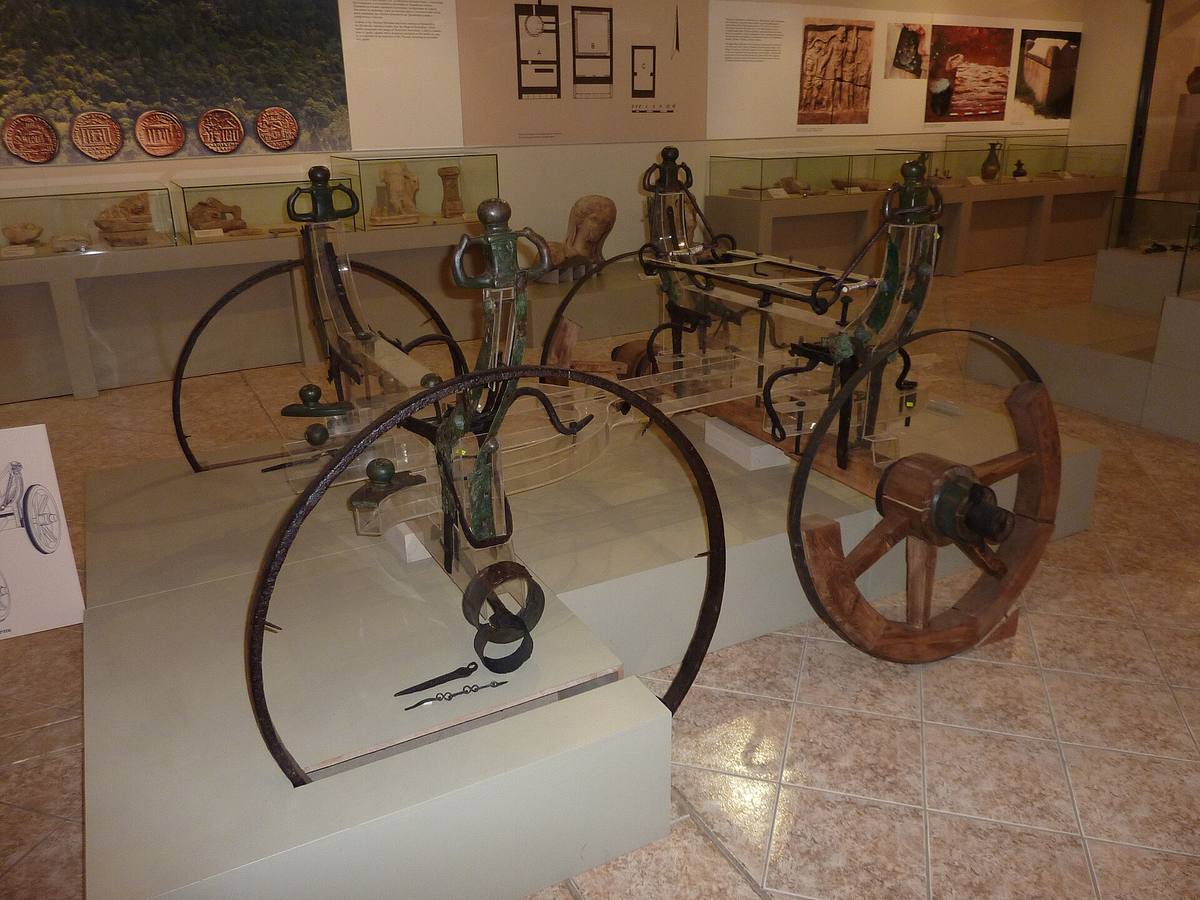
Antiquity. From a tumulus grave near the village of Dolna Koznitsa come silver and gilded appliqués for horse harness, with scenes such as “Heracles fighting the Nemean lion.” Five glass gaming pieces from the same grave are also on display in the hall. From Pautalia and its surroundings there are pottery, chariot appliqués, busts and statuettes of gods, and marble votive reliefs of the Thracian Horseman, Zeus and Hera, Asclepius, Hygieia, Telesphorus, and Mithras. The busts of Zeus and Hera come from the sanctuary near Kopilovtsi (2nd century). A Thracian-Roman four-wheeled wagon from the village of Radlovtsi (3rd century) is also on show. For the coins of Pautalia and the cult of Asclepius, see the page on the Roman Thermae.
Middle Ages. Medieval Velbazhd is represented by pottery, some of it in the sgraffito technique, arrowheads, silver and painted glass bracelets, spindle whorls, bone awls, and pectoral crosses (encolpia) from the 10th-11th centuries. The Razhdavitsa Miscellany is also among the medieval exhibits. The Ottoman period is represented by the Razhdavitsa Hoard: Western European and Ottoman coins and jewelry from the 16th-17th centuries.
Since May 17, 2008, the same hall has also held the coin exhibition: coins of the Macedonian kings and of ancient cities in the Balkans and Asia Minor, Roman denarii, Byzantine and Bulgarian cup-shaped coins, Venetian matapans and ducats, Western European thalers, and Ottoman coins. Its maps show how money circulated in the Kyustendil area.
In 2013 a Special Corner for Children and Curious Adults opened next to the hall, Mirena Legurska and Miroslava Taskova of Sofia University write in Society, Memory, Education (2026). There the museum offers permanent educational games. Its game “Unlock the History of Your Town,” held for the Night of Museums, began in 2009 and had run 15 times by 2025.
Most of it is in storage
↗The museum’s holdings number more than 118,000 objects, among them 58,879 movable cultural assets. The museum itself writes: “Unfortunately, most of this wealth is ‘locked away’ in the vaults, for lack of a modern museum building for a general history exhibition.” In 2022 Muzeen Vestnik wrote that the question of a main building and of a representative permanent exhibition had been unresolved for decades.
The museum’s other sites
↗- The medieval Church of St. George in the Kolusha quarter;
- The Dimitar Peshev House Museum;
- The Ilyo Voyvoda House Museum;
- The Emfiedzhieva House;
- the exhibition hall in the Ahmed Bey Mosque;
- the Pirgova Tower, where the museum stages temporary exhibitions.
Asclepius Hall is open every day. A ticket covers one exhibition, and there is a combined price for three or more.
Photos and related images
The image could not load. Its caption and source remain available.

Sources
(9)
A date may refer to construction, renewal, or another stated stage. Legends are accounts recorded in sources, rather than established events. Bibliography links help locate the named author; no automatic reference is added where the match is ambiguous.
- История на музея, РИМ „Акад. Йордан Иванов“, КюстендилInstitutional page · Bulgarian · kyustendilmuseum.bg
Source address
https://kyustendilmuseum.bg/za-muzeya/istoriya-na-muzeya.html
If a link does not open, use its title, author, and address to search, or consult another listed source.
- Археологическа експозиция, РИМ, КюстендилInstitutional page · Bulgarian · kyustendilmuseum.bg
Source address
https://kyustendilmuseum.bg/muzeyni-obekti-na-rim-kyustendil/arheologicheska-ekspoziciya.html
If a link does not open, use its title, author, and address to search, or consult another listed source.
- Нумизматична експозиция, РИМ, КюстендилInstitutional page · Bulgarian · kyustendilmuseum.bg
Source address
https://kyustendilmuseum.bg/muzeyni-obekti-na-rim-kyustendil/numizmatichna-ekspoziciya.html
If a link does not open, use its title, author, and address to search, or consult another listed source.
- Цени и работно време, РИМ, КюстендилInstitutional page · Bulgarian · kyustendilmuseum.bg
Source address
https://kyustendilmuseum.bg/za-muzeya/ceni-i-rabotno-vreme.html
If a link does not open, use its title, author, and address to search, or consult another listed source.
- Prices and opening hours, Regional History Museum, KyustendilInstitutional page · English · en.kyustendilmuseum.bg
Source address
https://en.kyustendilmuseum.bg/about-the-museum/prices-and-opening-hours.html
If a link does not open, use its title, author, and address to search, or consult another listed source.
- Музеен вестник, бр. 23 (125 години Регионален исторически музей), РИМ, Кюстендил, 2022PDF document · Bulgarian · kyustendilmuseum.bg
Source address
https://kyustendilmuseum.bg/uploads/%D0%9C%D1%83%D0%B7%D0%B5%D0%B5%D0%BD_%D0%B2%D0%B5%D1%81%D1%82%D0%BD%D0%B8%D0%BA%2C_%D0%B1%D1%80._23_(2022_%D0%B3.).pdf
If a link does not open, use its title, author, and address to search, or consult another listed source.
- Мирена Легурска, Мирослава Таскова. Образователните игри в музейната педагогика (по примера на РИМ „Акад. Йордан Иванов“, Кюстендил). Общество, памет, образование 9, СУ, 2026, 45-60Research publication · Bulgarian · periodicals.uni-sofia.bg
Source address
https://periodicals.uni-sofia.bg/index.php/opo/bg/article/view/opo-09-03
If a link does not open, use its title, author, and address to search, or consult another listed source.
- Регионален исторически музей (Кюстендил), УикипедияEncyclopedia article · Bulgarian · bg.wikipedia.org
Source address
https://bg.wikipedia.org/wiki/Регионален_исторически_музей_(Кюстендил)
If a link does not open, use its title, author, and address to search, or consult another listed source.
- OpenStreetMap: Регионален исторически музей „Акад. Йордан Иванов“Map record · Bulgarian · openstreetmap.org
Source address
https://www.openstreetmap.org/way/412148078
If a link does not open, use its title, author, and address to search, or consult another listed source.