01History
Hisarlaka Fortress
Late 4th or early 5th century (dating disputed); rebuilt in the 6th century
Dating stated in the sources: 4th-5th c.
Your visit at a glance
- Address
- Hisarlaka Hill, in Hisarlaka Park, south of the town center
- Approximate time at the site
- about 1 hour
- Visiting conditions
- No verified information found
- Admission
- No verified information found
The image could not load. Its caption and source remain available.

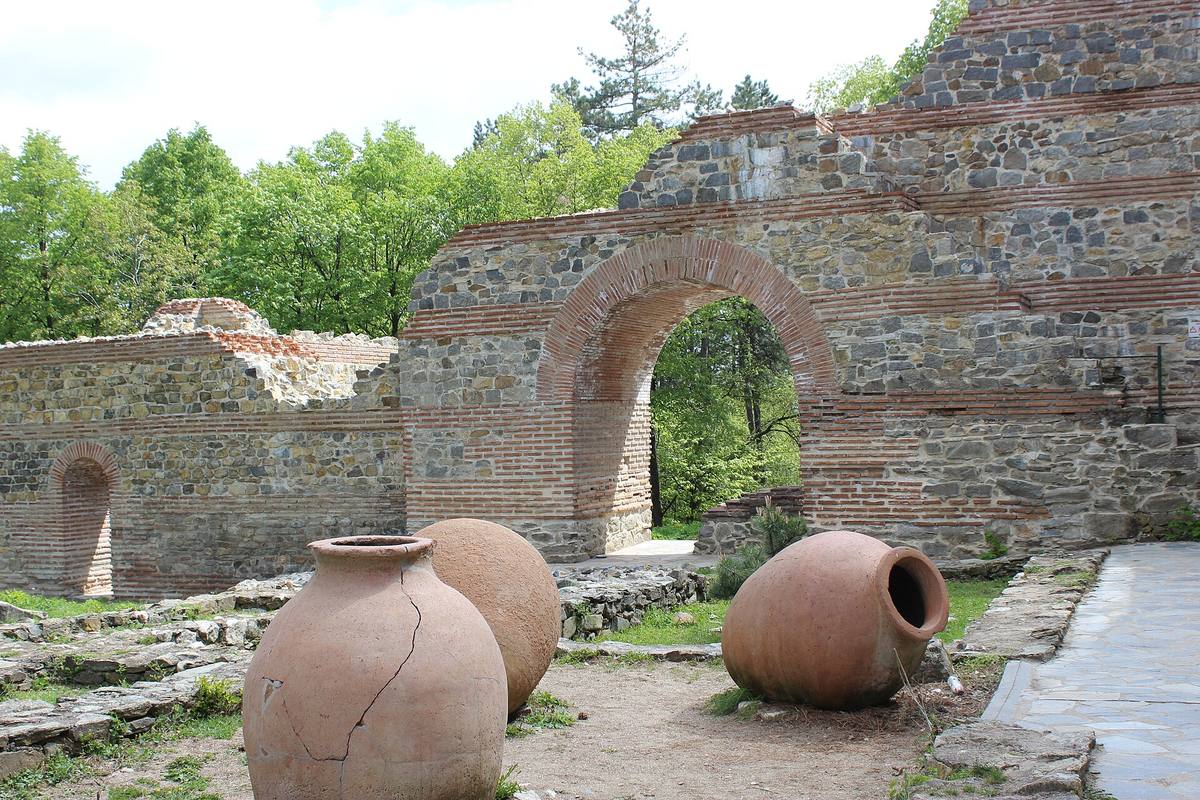
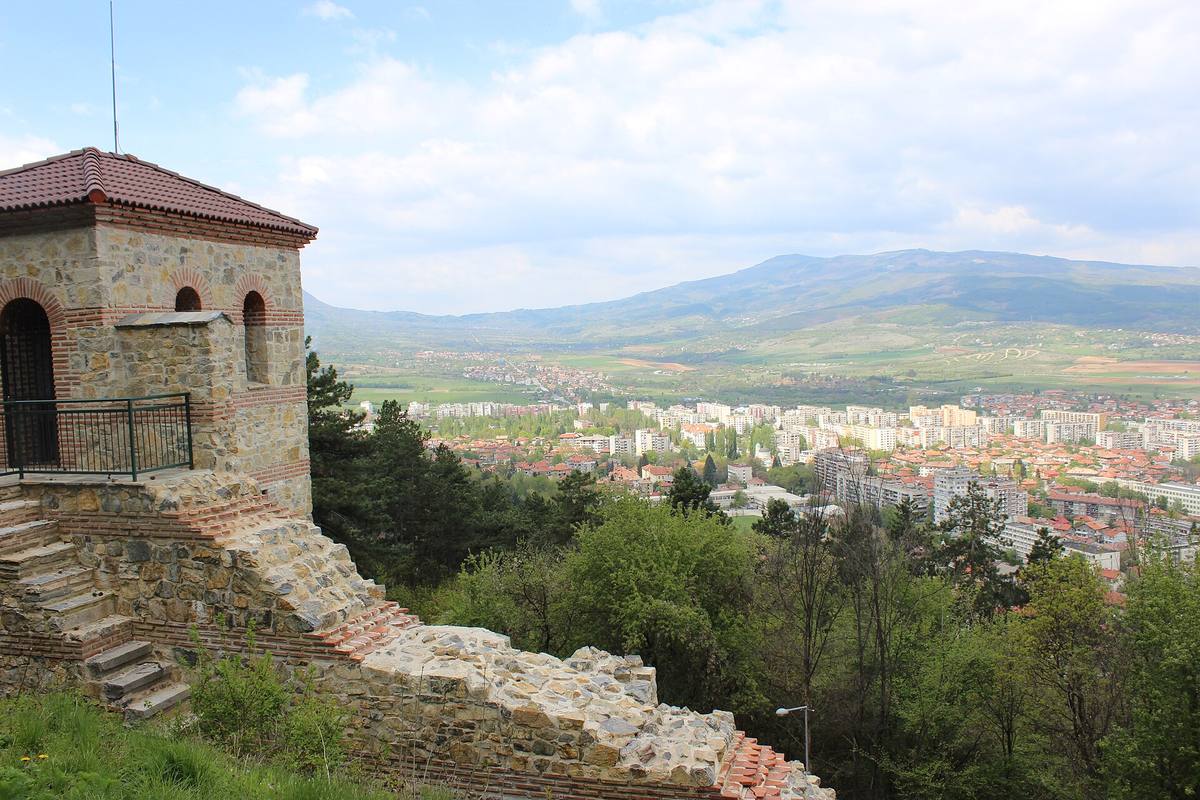
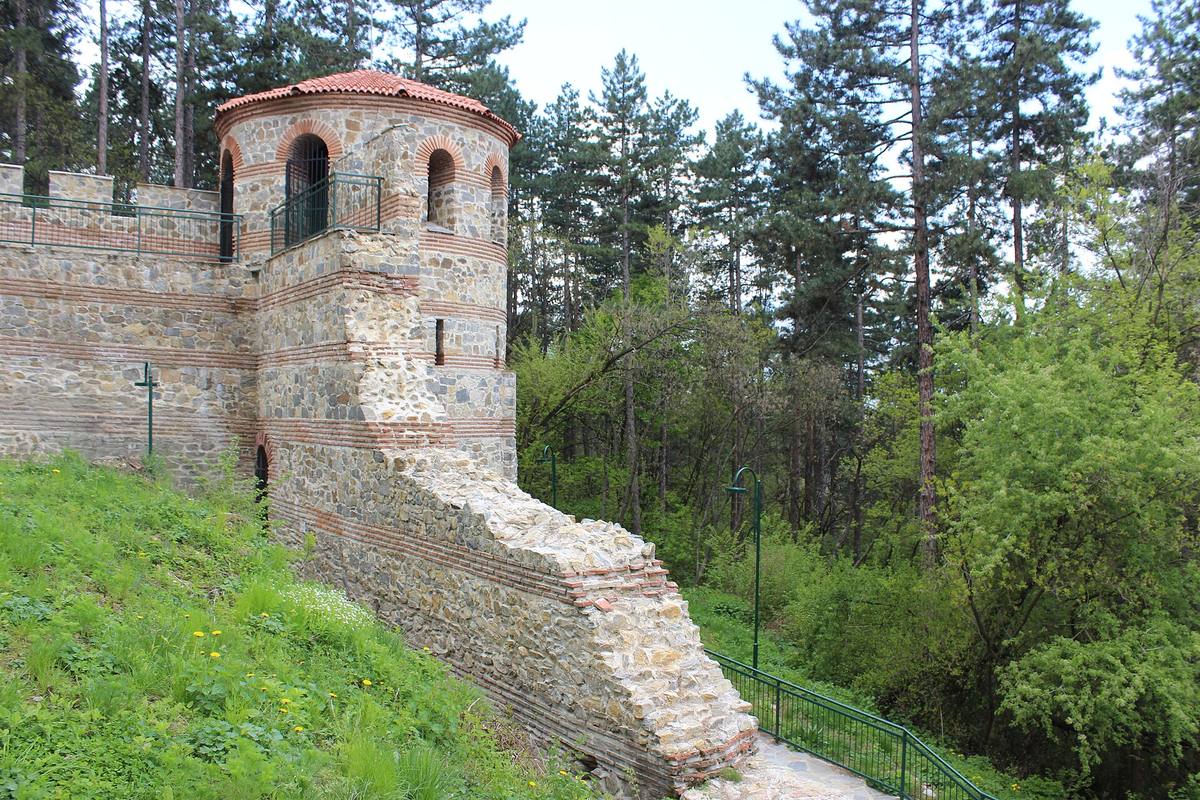
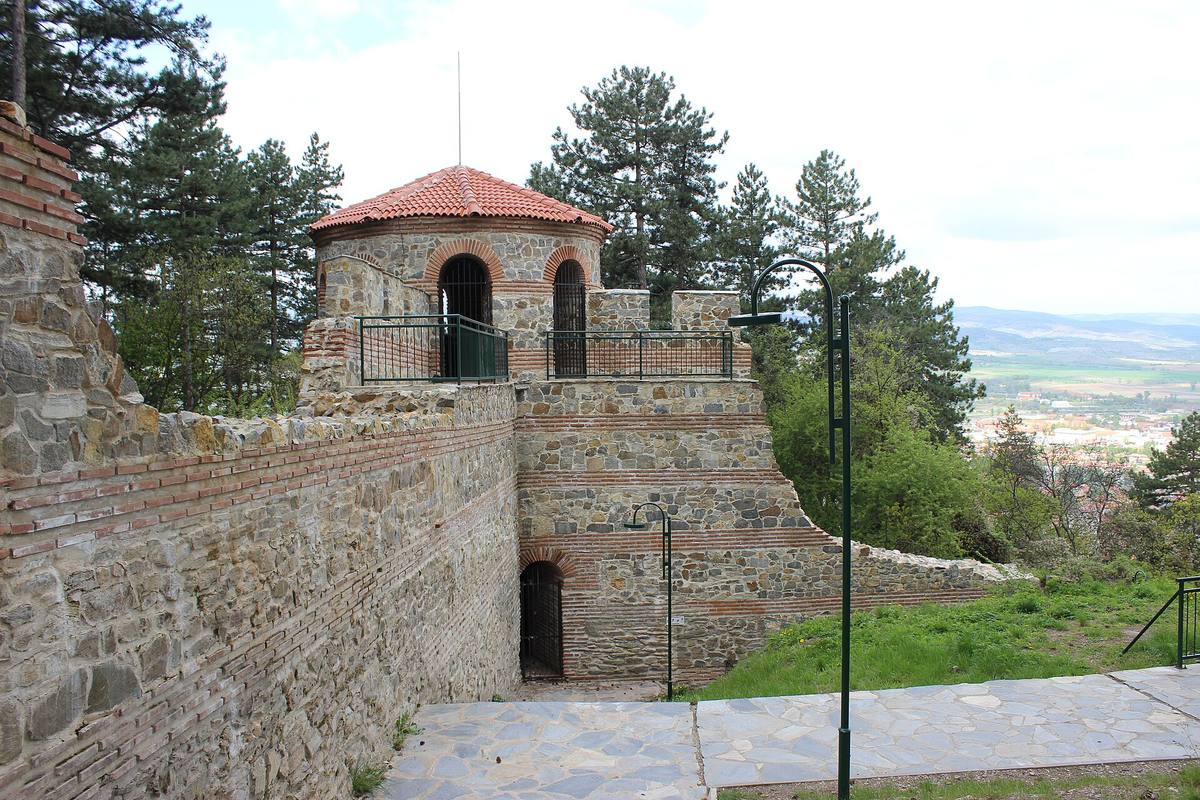
The late Roman fortress on the hill above Kyustendil, usually dated to the late 4th or early 5th century, although its construction chronology is disputed. It stands on the sacred hill of Pautalia, where temples of Asclepius and other gods once stood. Parts of the walls and three towers were rebuilt in 2014-2015. Around it grows a pine forest planted from 1891, and every March 21 the town welcomes spring in front of its east gate.
Hours, admission, and directions ↓
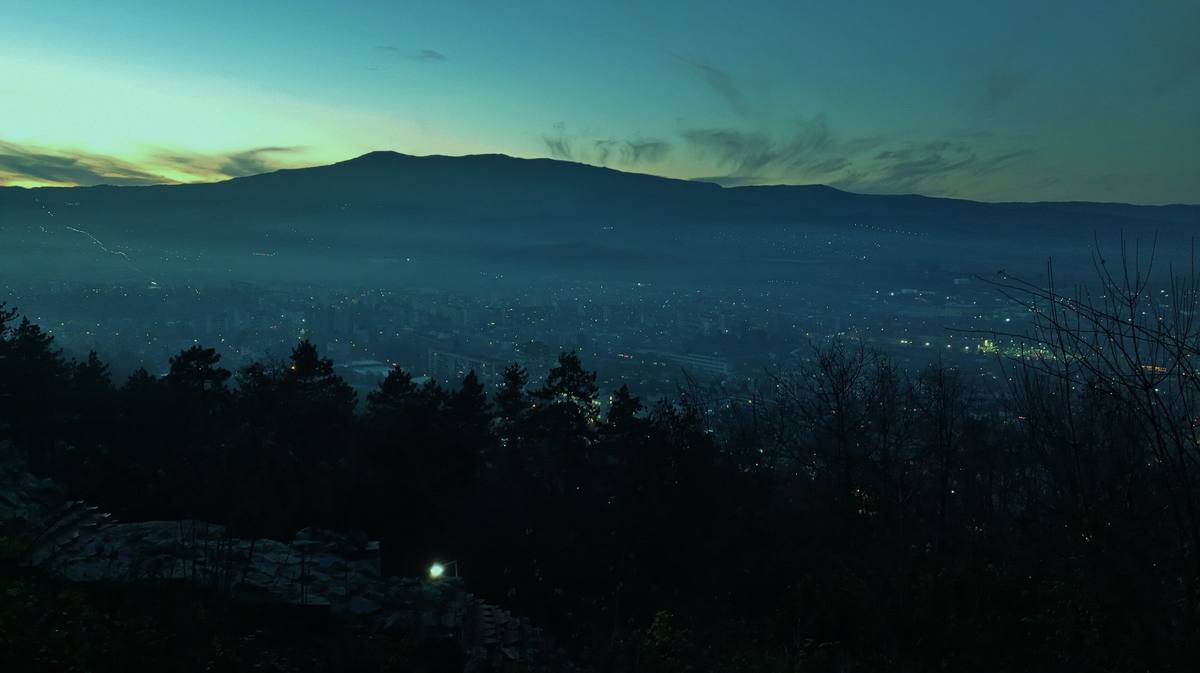
Hisarlaka is Kyustendil’s favorite walk. You climb through the pine forest, and at the top the fortress walls look out over the whole town, the valley, and the mountains around it. The place was sacred long before it was a fortress: people in Kyustendil still call it “the Sacred Hill.”
The name comes from hisar, the Turkish word for fortress.
The sacred hill of Pautalia
↗Roman Pautalia lay at the very foot of the hill. Bronze coins of the town from the Severan period show a temple of Asclepius, and one of them shows five temples: “two at the foot of the Hisarlaka height, one on the ridge, and two on its flanks below the ridge.” In the words of an international research team that includes the National Archaeological Institute (Bulgarian Academy of Sciences), “sanctuaries and temples of the gods of the Greco-Roman pantheon stood among the trees on the hill.”
The historian Nikolay Dimitrov of Sofia University describes the most detailed of these coins, one of Caracalla, in the journal Jubilaeus (2021). It shows “a hill covered with vegetation,” with a four-column temple and a statue on top, and four more temples with statues on the slopes. The middle one is in front and clearly the largest, with a statue of Asclepius and three figures beside it. The numismatist Leon Ružička identified the statue on the summit as Apollo and the three figures as nymphs. Yordan Ivanov had already recognized Hisarlaka on these coins. Dimitrov still cautions that how faithful the temples on the coins are remains disputed until other evidence turns up. [3]
Altars, columns, and capitals later built into the fortress walls and the basilica carry dedications to Asclepius, to Zeus and Hera, and to Sabazios. Two of the three known inscriptions from Pautalia to the “Olympian gods” also come from the hill, Dimitrov writes. Which god was worshiped in the temple on the summit is unclear: Ružička saw Apollo, Zlatozara Gocheva suggested Zeus and Hera (according to Valchev, 2021), and in Dimitrov’s view (summary of his dissertation, Sofia University, 2022) the Pautalian coins also allow for a cult place of Pan.
Digging on the northern slopes, on the town side, Yordan Ivanov found a fragment of a staff with a coiled snake, whose size suggests that it came from a large statue of Asclepius; a granite egg, another emblem of the god; and a mosaic of river pebbles showing an animal. Ivanov saw a snake in it, and T. Ivanov (1960) a dolphin (according to Dimitrov, 2021). In 2026 the same team studied six marble objects from the sanctuary: votive plaques showing Asclepius and Hygieia, and a fragment of a door frame, from the 2nd to 4th centuries. Five of them are of marble from Asenovgrad.
The cult of “Pautalian Asclepius” was known far away: a priest named Heraclianus made an offering “to Pautalian Asclepius and Hygieia” as far off as Epidaurus in Greece.
The fortress
↗Hypothesis or unconfirmed claim The sanctuary was destroyed before or during construction of the late Roman fortress, whose dating is disputed. Katsarova writes in her monograph on Pautalia (National Archaeological Institute, Bulgarian Academy of Sciences, 2005) that a military garrison lived in the fortress permanently, and that when it was built, the eastern gate of the town wall in the valley below was narrowed. So late Roman Pautalia had a fortified lower town and, as Anani Antonov puts it (summary of his dissertation, Sofia University, 2021), “a kind of acropolis” on the hill. [6]
When exactly it was built is debated:
- L. Ruseva-Slokoska (2016) dates it from the last quarter of the 4th to the first quarter of the 5th century, because coins of the 4th century prevail and those of the 5th are missing.
- The historian Ivan Valchev of Sofia University (Jubilaeus, 2021) finds a 4th-century date “rather doubtful.” The two triangular towers in the southern sector were built together with the wall. Similar towers at Serdica, Philippopolis, and Augusta Traiana are dated after the middle of the 5th century, so the parallels “point, after all, to a date after the middle of the fifth century.”
- The only certainty, according to Valchev, is that the temple or temples on the summit were destroyed before the middle of the 5th century.
Under Emperor Justinian I (527-565) the fortress was repaired, as the historian Procopius of Caesarea records. Further repairs followed in the 6th century and in the 9th-12th centuries.
The fortress was in use throughout late antiquity and the Middle Ages; the pottery, fittings, and metal vessels from the excavations show it. In the Middle Ages it was the seat of local power over the town of Velbazhd:
- 1019: a bishop of Velbazhd is mentioned in Emperor Basil II’s charter on the Bulgarian dioceses.
- July 28, 1330: near Velbazhd, the Serbian King Stefan Dečanski defeated Tsar Mihail III Shishman.
- 14th century: according to Dr. Yavor Mitov of the Regional History Museum, the fortress was “a kind of residence” of Despot Konstantin Dragaš. The Ottomans called his lands Konstantin-ili, “the land of Constantine,” and that gave the town its present name, Kyustendil.
- 15th century: the fortress was pulled down by the Ottoman conquerors.
How it was built
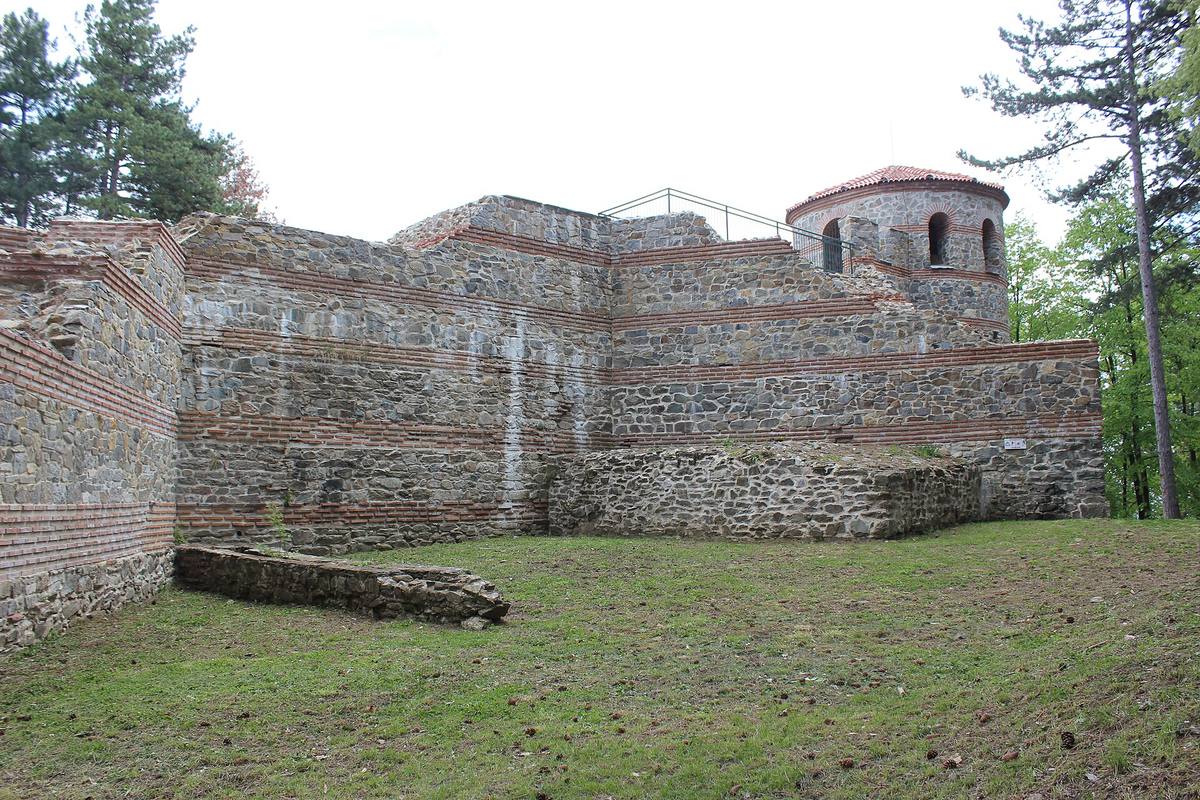
↗The fortress is an irregular polygon. One set of figures gives 117 by 175 m and about 2.1 hectares. Another gives 225 m north to south and 90 m east to west, an area of 2.225 hectares, and walls 616.5 m long.
- Walls: from 1.60 to 3 m thick, depending on the ground; their original height is estimated at about 10 m.
- Towers: fourteen (round, triangular, and rectangular), originally about 12 m tall.
- Gates: two main gates and five small ones, called posterns. The main and widest gate is in the east wall.
- Masonry: mixed, with bands of stone and brick alternating, laid in mortar mixed with crushed brick that kept out the damp.
The basilica
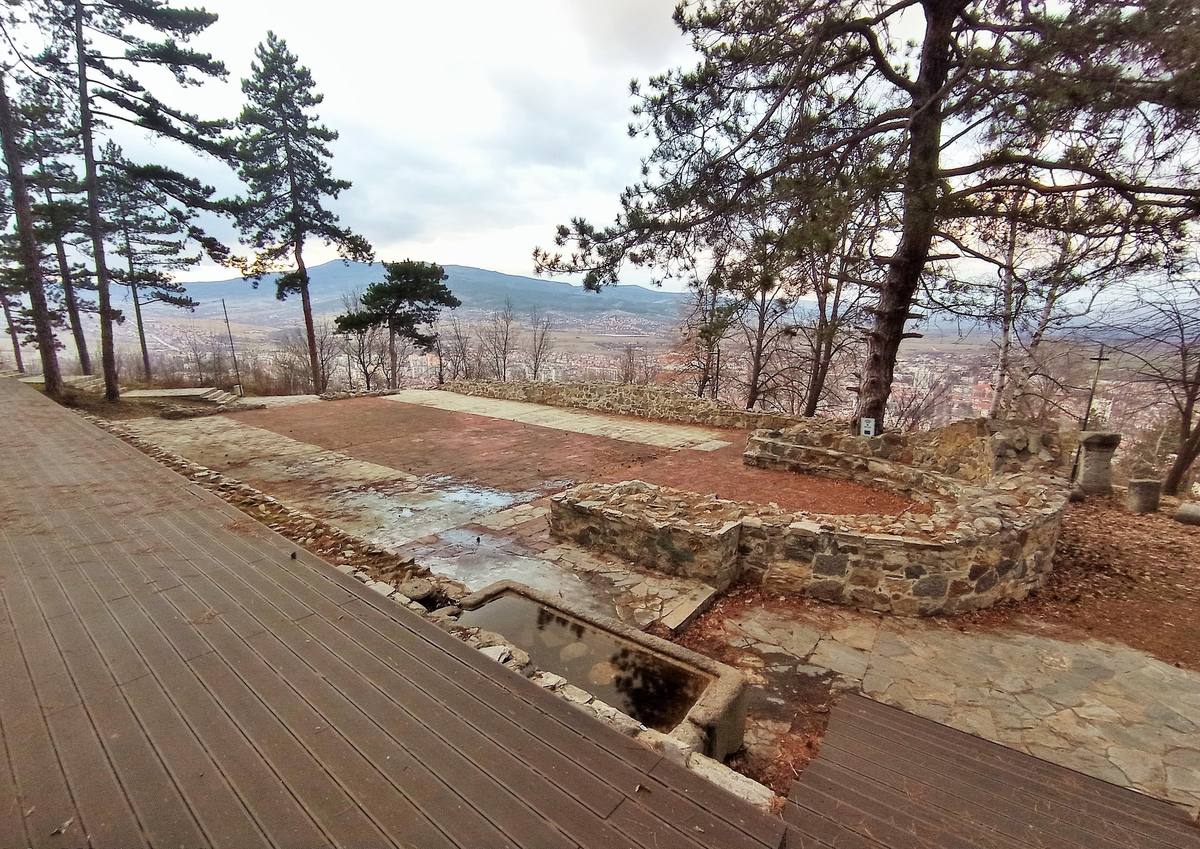
↗On the summit stands an early Christian basilica with three aisles. It has a narthex on the west and a deep horseshoe-shaped apse with a synthronon, a bench for the clergy, which marks it as a bishop’s church. It is 29.5 m long without the apse and 17 m wide. On the southeast a room is attached, probably a baptistery.
Its builders used material from a destroyed pagan temple. Yordan Ivanov dated it to the first half of the 6th century. The 2014 excavations, led by Doychin Grozdanov (Regional History Museum) and Dr. Galina Grozdanova (National Archaeological Institute), allow an earlier date, the late 4th or early 5th century. Its floor has been restored, and today it serves as a stage.
The lime kilns
↗Much of the fortress’s marble and limestone detail is gone for a prosaic reason: in the 17th-19th centuries it was burned in lime kilns to make lime.
The forest
↗At the end of the 19th century the hill was bare and eroded. In the spring of 1891 the forester Yordan Mitrev began planting it. The first attempt, with chestnuts and acorns, failed, so the foresters switched to Scots and black pine, with a little spruce. By 1898 more than 1,200 decares (120 hectares) had been planted with pine.
A. Milenkova and K. Petkova write in the journal Management and Sustainable Development (2016), following Afforestation in Bulgaria (1977), that the seedlings were planted at two spacings: first 1.2 by 1.3 m on a smaller area, then 2 by 2 m everywhere. The sparser planting, 2 by 2 m, proved especially suitable. “These plantations are still in good condition today and protect the town of Kyustendil from torrential rains.”
The forest soon became a place for holidays. Ekaterina Keremidarska and Mihal Nikolov write in Sofia University’s Kyustendil Readings (1996) that after the Liberation the townspeople celebrated St. George’s Day at Karadzhabunar on Hisarlaka, and that on Sundays the military brass band played there.
The general’s villa
↗During World War I a villa was built on Hisarlaka for the commander-in-chief, Gen. Nikola Zhekov. Angel Dzhonev of the Kyustendil history museum dates it more precisely in Kyustendil Readings (2018): it was built in 1917, when the General Headquarters of the Active Army was in the town. He draws on archival documents and on the memoirs of the general’s wife, his aide Captain Luka Maleev, and Colonel Vladimir Kotsev. Its guests included Tsar Ferdinand I, Crown Prince Boris, Prime Minister Aleksandar Malinov, Emperor Karl I of Austria-Hungary, and King Ludwig III of Bavaria. The villa burned down in the late 1940s. Only the bunker and half of the pond survive, and on the site today stands the restaurant “The General’s Villa.” [8]
Excavation and restoration
↗- 1906-1912: Prof. Yordan Ivanov led the first systematic excavations on the hill, with the help of the Sofia Archaeological Society and the town council. In 1908 a coin of Anchialos, of Emperor Gordian III, was found. He published the results in 1919-1920 as The Kyustendil Hisarlak and Its Antiquities.
- 1961 and 1966-1978: Lyudmila Slokoska and Zl. Gocheva uncovered the circuit of walls and a small part of the interior.
- 1968: the fortress was declared a cultural monument of national importance.
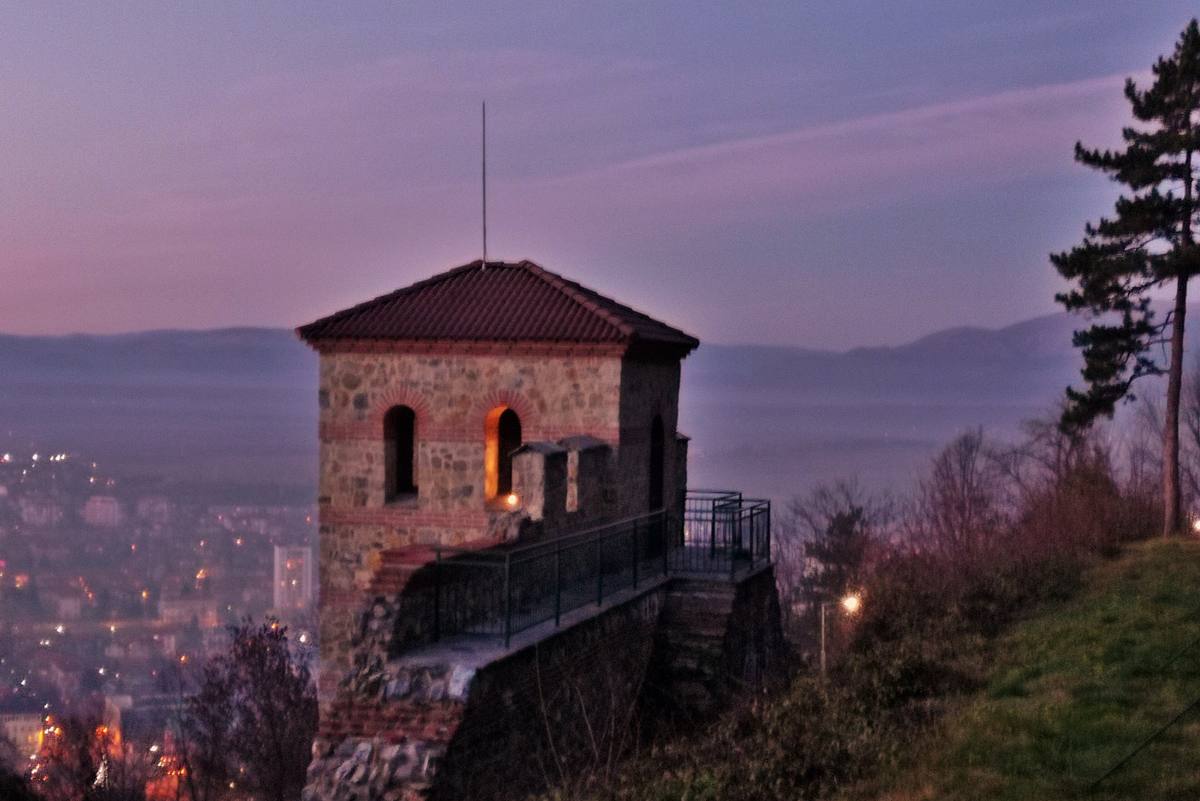
- 2014-2015: the major restoration, designed by the architect Yuliy Farkov and funded by the government program Growth and Sustainable Development of the Regions, for 4,230,264 leva excluding VAT. Work began on July 20, 2014. Parts of the walls and three towers, 14 m tall, were rebuilt. A lapidarium, a display of stone artifacts, and a 300-seat open-air theater were added.
- 2026: Dr. Yavor Mitov published the bilingual book Hisarlaka: The Fortress above Kyustendil, presented on October 1, 2026, at the Kiliyno School. He writes that the fortress “has still not been fully explored.”
“Kyustendil Spring”
↗Every March 21 Kyustendil welcomes spring on Hisarlaka, in front of the fortress’s main east gate. There the former “Maidens of Kyustendil Spring” hand the town’s symbols to the new one. The festival began in 1966. According to the museum, the beauty contest held that year at the initiative of Kiril Poromanski was “the first official beauty contest in the country.” The first “Maiden of Kyustendil Spring,” in 1967, was Fidanka Nikolova.
The ethnologist S. Kazalarska of the Bulgarian Academy of Sciences shows that the modern festival was “invented” in the socialist years, by stripping the religious elements from older spring customs. Its link with the folk feast of the Forty Martyrs, or even with sun cults, is more interpretation than established fact.
The park also holds the chapel of the Holy Forty Martyrs, and not far away, the House of Baba Yaga.
Photos and related images
The image could not load. Its caption and source remain available.

The image could not load. Its caption and source remain available.

The image could not load. Its caption and source remain available.

The image could not load. Its caption and source remain available.

The image could not load. Its caption and source remain available.

The image could not load. Its caption and source remain available.

The image could not load. Its caption and source remain available.

Sources
(24)
A date may refer to construction, renewal, or another stated stage. Legends are accounts recorded in sources, rather than established events. Bibliography links help locate the named author; no automatic reference is added where the match is ambiguous.
- V. Anevlavi et al. White Marble Votive Reliefs from Pautalia in Roman Thrace, Heritage 9(3), 2026Online source · Language not specified · doi.org
Source address
https://doi.org/10.3390/heritage9030104
If a link does not open, use its title, author, and address to search, or consult another listed source.
- Веселка Кацарова. Пауталия и нейната територия през I-VI век, НАИМ, БАН, 2005 (откъс)Research publication · Bulgarian · naim.bg
Source address
https://naim.bg/issuesFiles/Pautalia.pdf
If a link does not open, use its title, author, and address to search, or consult another listed source.
- Николай Димитров. Бележки към почитането на Асклепий в Пауталия през II-III в. Jubilaeus 8/2, Исторически факултет на СУ, 2021, 71-80Research publication · Bulgarian · periodicals.uni-sofia.bg↑1
Source address
https://periodicals.uni-sofia.bg/index.php/Jubilaeus/article/view/jblae-08-2-06
If a link does not open, use its title, author, and address to search, or consult another listed source.
- Иван Вълчев. Градските храмове в двете Дакии през късноримската епоха. Jubilaeus 8/2, Исторически факултет на СУ, 2021, 49-62Research publication · Bulgarian · periodicals.uni-sofia.bg
Source address
https://periodicals.uni-sofia.bg/index.php/Jubilaeus/article/view/jblae-08-2-04
If a link does not open, use its title, author, and address to search, or consult another listed source.
- Николай Димитров. Религиозен живот в Пауталия и Сердика през римската епоха. Автореферат на дисертация, СУ, 2022PDF document · Bulgarian · uni-sofia.bg
Source address
https://www.uni-sofia.bg/index.php/bul/content/download/276781/1810200/version/1/file/BG_Summary_Nikolay_bulgarian.pdf
If a link does not open, use its title, author, and address to search, or consult another listed source.
- Анани Антонов. Селищно и икономическо развитие на провинция Вътрешна Дакия през късната античност. Автореферат на дисертация, СУ, 2021PDF document · Bulgarian · uni-sofia.bg↑1
Source address
https://www.uni-sofia.bg/index.php/bul/content/download/250475/1651687/version/1/file/Avtoreferat_Anani_Antonov.pdf
If a link does not open, use its title, author, and address to search, or consult another listed source.
- Екатерина Керемидарска, Михал Николов. Отдихът и развлеченията на кюстендилци след Освобождението. Кюстендилски четения 3, СУ, 1996, 38-47Research publication · Bulgarian · periodicals.uni-sofia.bg
Source address
https://periodicals.uni-sofia.bg/index.php/KRe/bg/article/view/kre-1996a-06
If a link does not open, use its title, author, and address to search, or consult another listed source.
- Ангел Джонев. Вилата на генерал-лейтенант Никола Жеков. Кюстендилски четения 14, СУ, 2018, 188-202Research publication · Bulgarian · periodicals.uni-sofia.bg↑1
Source address
https://periodicals.uni-sofia.bg/index.php/KRe/article/view/kre-2016-17
If a link does not open, use its title, author, and address to search, or consult another listed source.
- С. Филипова. Монети от проучването на обект „Стефан Караджа“ № 1 в Кюстендил, Нумизматика, сфрагистика и епиграфика 18, НАИМ, БАН, 2022Research publication · Bulgarian · publications.naim.bg
Source address
https://www.publications.naim.bg/index.php/NSE/article/view/314
If a link does not open, use its title, author, and address to search, or consult another listed source.
- А. Миленкова, К. Петкова. Характеристика на иглолистни горски култури в Осогово, Лесотехнически университет, 2016PDF document · Bulgarian · jmsd.bg
Source address
https://jmsd.bg/files/articles/61/61-02_A_Milenkova_K_Petkova.pdf
If a link does not open, use its title, author, and address to search, or consult another listed source.
- С. Казаларска. Празникът „Кюстендилска пролет“ и социалистическата празничност, Български фолклор, ИЕФЕМ, БАН, 2022Online source · Bulgarian · ceeol.com
Source address
https://www.ceeol.com/search/article-detail?id=1072513
If a link does not open, use its title, author, and address to search, or consult another listed source.
- Музеен вестник, бр. 28, 2026, РИМ, КюстендилPDF document · Bulgarian · kyustendilmuseum.bg
Source address
https://kyustendilmuseum.bg/uploads/MUZEEN_VESTNIK_2026_cveten_3.pdf
If a link does not open, use its title, author, and address to search, or consult another listed source.
- Проучване Хисарлъка, Кюстендилска търговско-промишлена палата (Interreg IPA)Online source · Bulgarian · tour.cci-kn.org
Source address
https://tour.cci-kn.org/проучване-хисарлъка/
If a link does not open, use its title, author, and address to search, or consult another listed source.
- Крепостта Хисарлъка край Кюстендил, БНТ, „10 000 крачки“, 2019Online source · Bulgarian · bnt.bg
Source address
https://bnt.bg/bg/a/krepostta-khisarlka-kray-kyustendil
If a link does not open, use its title, author, and address to search, or consult another listed source.
- В Кюстендил бе представена книгата „Хисарлъка: крепостта над Кюстендил“, БТА, 2026Online source · Bulgarian · bta.bg
Source address
https://www.bta.bg/bg/news/lik/1215932-v-kyustendil-be-predstavena-knigata-hisarlaka-krepostta-nad-kyustendil-
If a link does not open, use its title, author, and address to search, or consult another listed source.
- Книга разкрива тайните на крепостта Хисарлъка, Фокус, 2026Online source · Bulgarian · focus-news.net
Source address
https://www.focus-news.net/novini/regioni/Kniga-razkriva-tainite-na-krepostta-Hisarluka-krai-Kyustendil-2951342
If a link does not open, use its title, author, and address to search, or consult another listed source.
- Стари фотоси върнаха спомените на кюстендилци за празника на пролетта, Струма, 2023Online source · Bulgarian · struma.bg
Source address
https://struma.bg/%d1%81%d1%82%d0%b0%d1%80%d0%b8-%d1%84%d0%be%d1%82%d0%be%d1%81%d0%b8-%d0%b2%d1%8a%d1%80%d0%bd%d0%b0%d1%85%d0%b0-%d1%81%d0%bf%d0%be%d0%bc%d0%b5%d0%bd%d0%b8%d1%82%d0%b5-%d0%bd%d0%b0-%d0%ba%d1%8e%d1%81/
If a link does not open, use its title, author, and address to search, or consult another listed source.
- Кюстендил (история), УикипедияEncyclopedia article · Bulgarian · bg.wikipedia.org
Source address
https://bg.wikipedia.org/wiki/Кюстендил#История
If a link does not open, use its title, author, and address to search, or consult another listed source.
- Хисарлъка (крепост), УикипедияEncyclopedia article · Bulgarian · bg.wikipedia.org
Source address
https://bg.wikipedia.org/wiki/Хисарлъка_(крепост)
If a link does not open, use its title, author, and address to search, or consult another listed source.
- Хисарлъка (лесопарк), УикипедияEncyclopedia article · Bulgarian · bg.wikipedia.org
Source address
https://bg.wikipedia.org/wiki/Хисарлъка_(лесопарк)
If a link does not open, use its title, author, and address to search, or consult another listed source.
- Кюстендилска пролет, УикипедияEncyclopedia article · Bulgarian · bg.wikipedia.org
Source address
https://bg.wikipedia.org/wiki/Кюстендилска_пролет
If a link does not open, use its title, author, and address to search, or consult another listed source.
- OpenStreetMap: ХисарлъкаMap record · Bulgarian · openstreetmap.org
Source address
https://www.openstreetmap.org/relation/20339741
If a link does not open, use its title, author, and address to search, or consult another listed source.
- Хисарлъка, римското бижу на Кюстендил, LittleBG, 2016Online source · Bulgarian · littlebg.com
Source address
https://littlebg.com/hisarluka-rimskoto-biju-na-kustendil/
If a link does not open, use its title, author, and address to search, or consult another listed source.
- Базилика в крепостта „Хисарлъка“, гр. Кюстендил, СветиместаOnline source · Bulgarian · svetimesta.com
Source address
https://svetimesta.com/%D0%A0%D0%B0%D0%BD%D0%BD%D0%BE%D1%85%D1%80%D0%B8%D1%81%D1%82%D0%B8%D1%8F%D0%BD%D1%81%D0%BA%D0%B8-%D1%86%D1%8A%D1%80%D0%BA%D0%B2%D0%B8/%D0%91%D0%B0%D0%B7%D0%B8%D0%BB%D0%B8%D0%BA%D0%B0%20-%20%D0%BA%D1%80%D0%B5%D0%BF%D0%BE%D1%81%D1%82%20-%20%D0%A5%D0%B8%D1%81%D0%B0%D1%80%D0%BB%D1%8A%D0%BA%D0%B0%20-%20%D0%B3%D1%80.%20%D0%9A%D1%8E%D1%81%D1%82%D0%B5%D0%BD%D0%B4%D0%B8%D0%BB
If a link does not open, use its title, author, and address to search, or consult another listed source.