Kyustendil Town Hall
1889-1894, the former Pedagogical School
Dating stated in the sources: 1889-1894
Your visit at a glance
- Address
- 1 Velbazhd Square
- Approximate time at the site
- about 20 minutes
- Opening hours
- No verified information found
- Admission
- No verified information found
The image could not load. Its caption and source remain available.

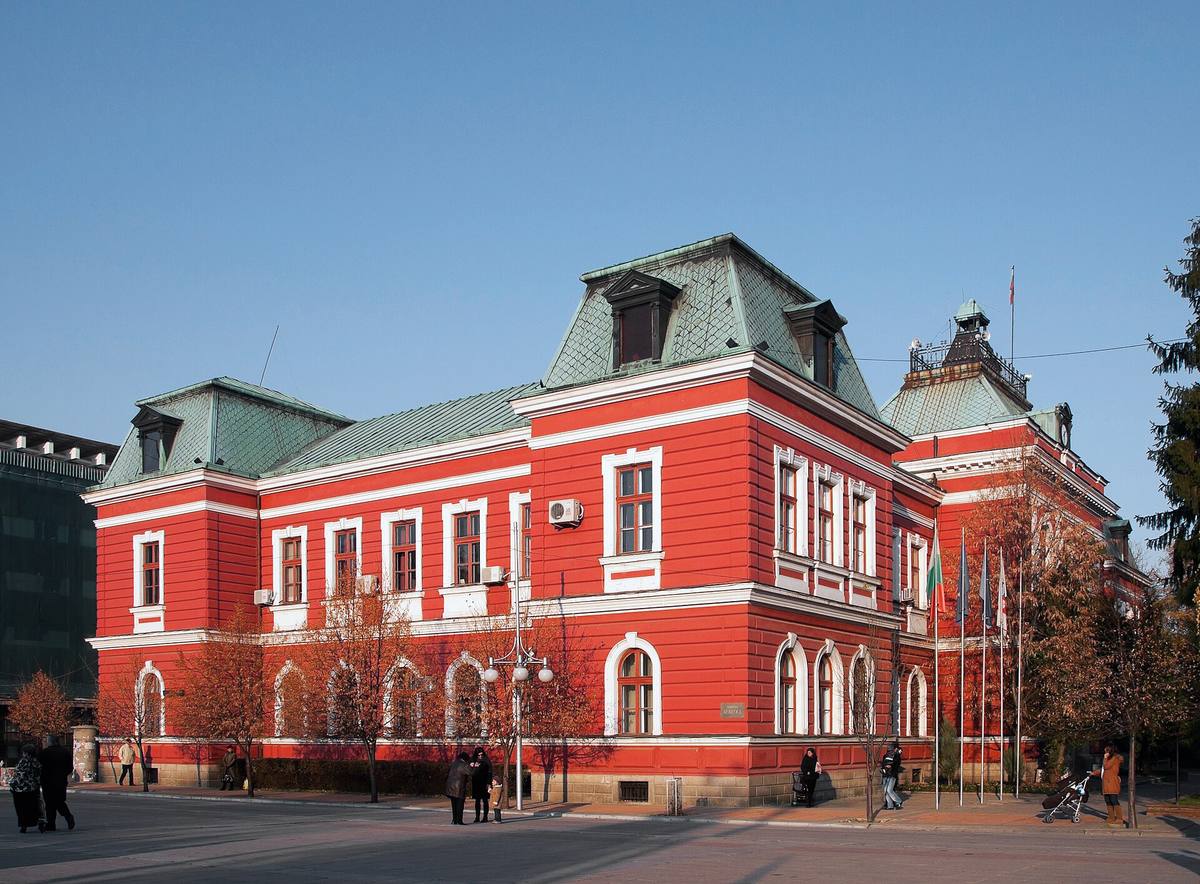
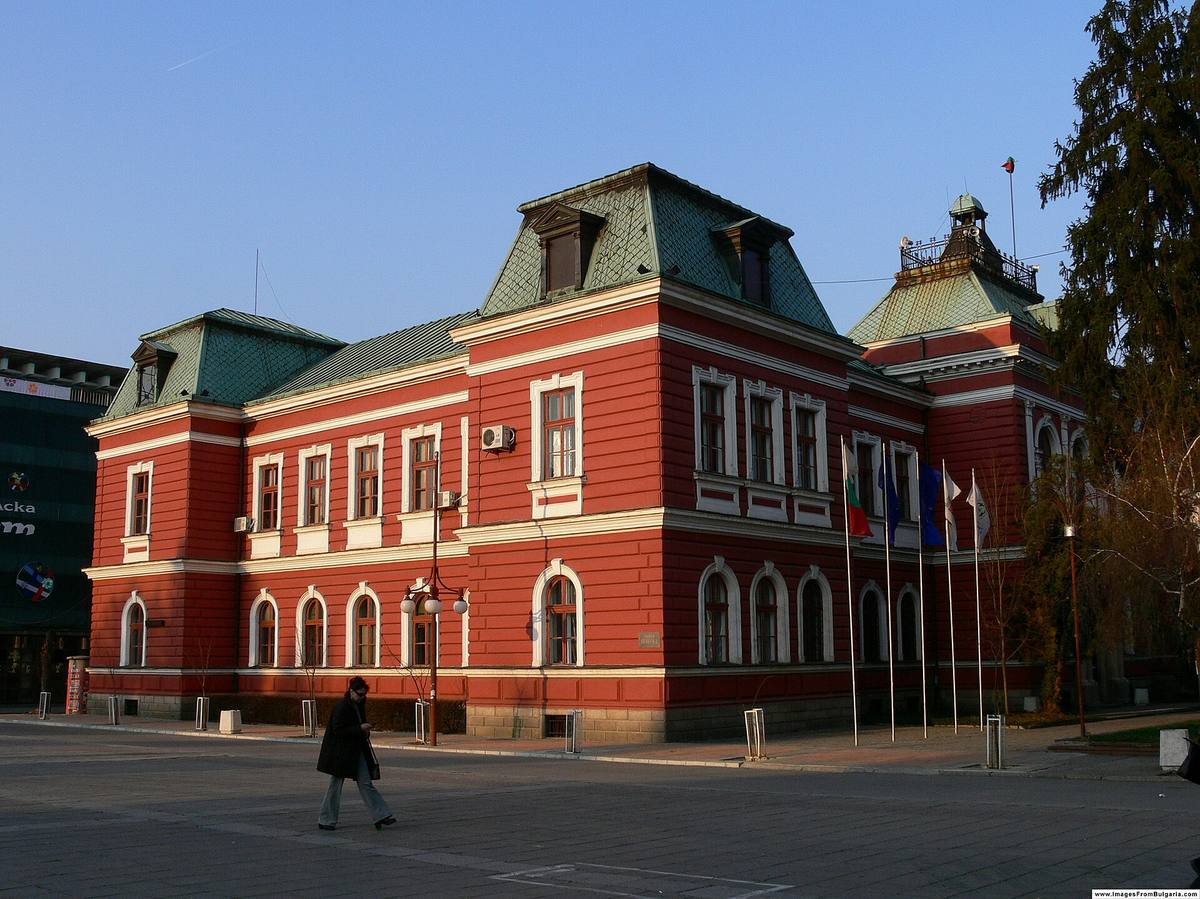
The red building with the clock on Velbazhd Square was built in 1889-1894 as the Pedagogical School, Kyustendil’s “alma mater.” It went on to serve as the Army’s General Headquarters in World War I and as Bulgaria’s first court palace, and today it is the Town Hall. The clock’s bell was cast in 1429 and still strikes every hour.
Hours, admission, and directions ↓
The building looks like a town hall, but it has seen much more. Future professors and revolutionaries studied here, the army’s General Headquarters sat here in World War I, and the region’s courtrooms were here. And above its entrance, every hour, rings a bell older than the fall of Constantinople.
On the site of the konaks
↗The building stands where the mansions (konaks) of Ottoman notables once stood, Zeynel Bey among them; they left for Macedonia in 1878. The Pedagogical School was founded in 1885, by decision of the Fourth National Assembly (Ekaterina Keremidarska and Mihal Nikolov, Kyustendil Readings, Sofia University, 1996). From September 1, 1885, a two-year teacher-training course was added on top of the three-grade school, and in 1886 a third year was added. At first the students were taught in two of the buildings of Zeynel Bey’s former konaks.
The building
↗The foundation stone was laid on May 11, 1889, the feast of Saints Cyril and Methodius, at the initiative of the town council under Mayor Hristo Lekarski. The design was by the architect Friedrich Grünanger (1856-1929). Born in Schässburg (today’s Sighișoara) and a pupil of Friedrich von Schmidt in Vienna, he came to Bulgaria in 1879 and later became court architect.
- Builders: the main contractors were the Kyustendil brothers Ivan, Vasil, and Grigor Grebenarov. Italian craftsmen cut the granite for the foundations, and the carpenters came from the Tran region.
- Cost: the total came to 326,533 leva in 1889, of which 151,000 leva came in installments from the Ministry of Education.
- Opening: the building, covering 1,516 m², was solemnly opened with a blessing on October 10, 1894. In the 1894/95 school year it had 1,104 students.
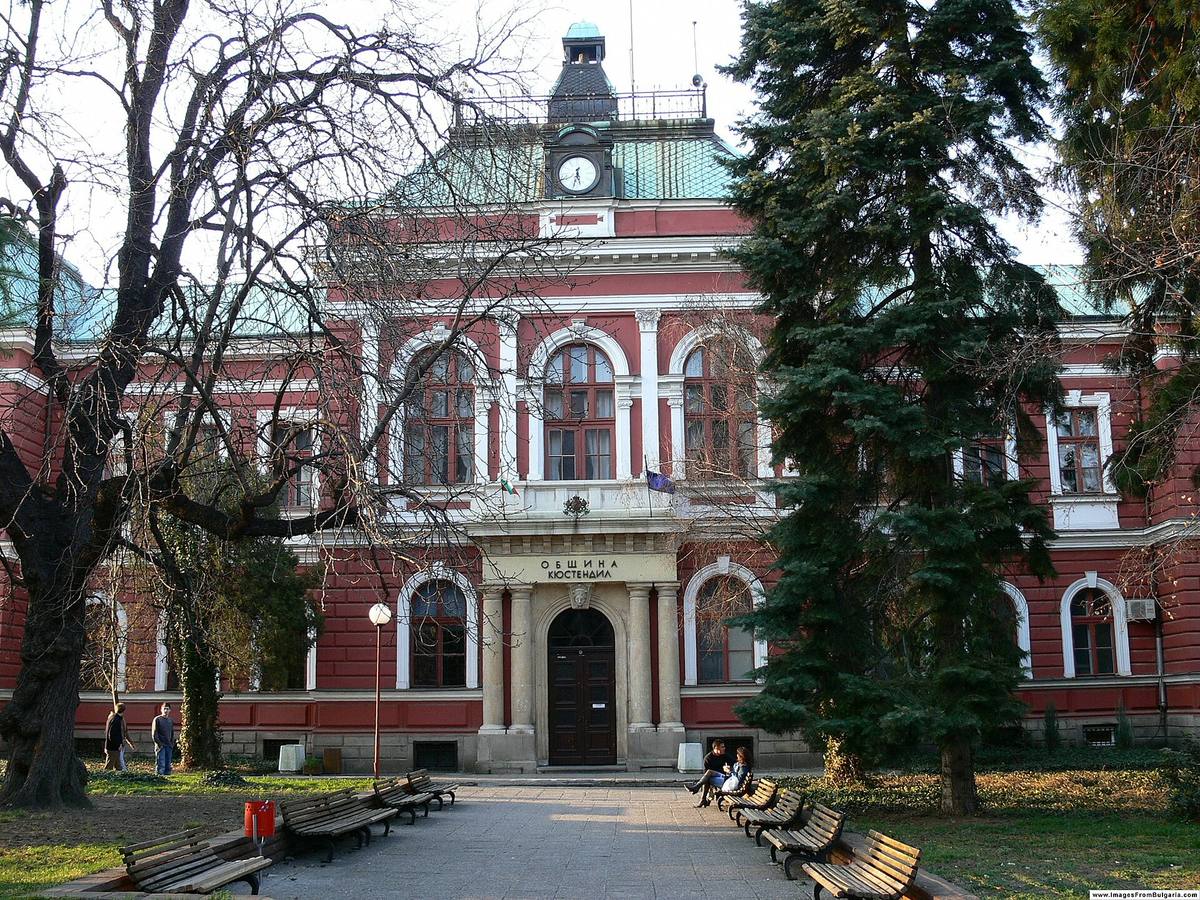
It is large and symmetrical, built around an inner courtyard, on two floors: 15 classrooms downstairs and 10 upstairs. The style is Neo-Renaissance. Four Ionic columns carry the open gallery above the entrance.
“Alma mater”
↗The people of Kyustendil call the school their “alma mater”:
- Teachers: Efrem Karanov, Stoyan Zaimov, and Zinovi Poppetrov.
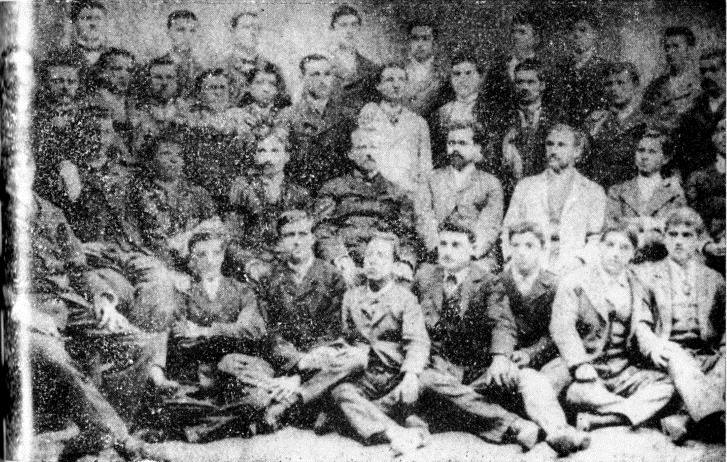
- Students: Yordan Zahariev, historian of the Kyustendil region (graduated 1895); the poet and philosopher Emanuil Popdimitrov (1904); and the revolutionary Mishe Razvigorov (1896).
In 1894 Grigor Anastasov of Kavadarci founded a Youth Macedonian Society here among the students from Macedonia. “Almost all the members of the Society did go to Macedonia as teachers and revolutionaries.” They even had their own theater troupe.
In 1897 the teacher Doncho Strezov laid out the school garden, a full 9 decares (9,000 m²). On November 3, 1897, the school founded a museum collection, “the first museum collection in southwestern Bulgaria and the third school museum in the country,” with Efrem Karanov as its curator. Today’s Regional History Museum grew out of it.
In 1903, in the school’s gymnasium, a young court clerk named Vladimir Dimitrov held his first exhibition. Years later the world would know him as Maystora.
In the school library, Yordan Ivanov, a pupil of Efrem Karanov, saw part of the archive of the Revival-era teacher Averkiy Popstoyanov, Dimitar Tsanev writes in Kyustendil Readings (2006). [3]
The clock and the bell
↗In 1898 the small clock turret was built above the entrance. The mechanism is the work of the Sofia craftsman Georgi Mihaylov. The bell is much older: it was cast in 1429 in the mining town of Novo Brdo. Its inscription reads: “This bell of St. Nicholas, in the year 6937, by the will of God, I, Radoslav, donated.” The year 6937 from the Creation of the World is 1429, which is why it’s known as “Radoslav’s bell.”
- An older clock tower. Before 1898 it rang on the Ottoman clock tower of 1665.
- Bronze. The bell is bronze, with walls 5 cm thick. Over the centuries, the national broadcaster BNT reports, it “has struck more than 7 million times.”
- Still working. It still strikes every hour. The historian Yavor Mitov says: “Our bell in Kyustendil is the only one that still keeps working.”
- A swap. According to the 1973 collection Kyustendil and the Kyustendil Region, in the early 19th century, “as a sign of friendship and at the initiative of the visiting pasha of Skopje,” Kyustendil and Skopje swapped their clock bells. So the town “acquired the oldest clock bell in Bulgaria.” The bell has marked the hours in Lyuboten, Skopje, and Kyustendil in turn.
- Its future. In 2017 historians proposed taking it down for study and displaying it in the museum.
General Headquarters
↗The Pedagogical School closed sometime between 1908 and 1912 (sources give different years), and the building became a high school (gimnaziya). During the Balkan Wars it served as a military hospital. For a time the building also housed the girls’ vocational school “Trudolyubie” of the women’s society Maychina Lyubov, later called the Girls’ Practical School, Yordanka Yancheva writes in Kyustendil Readings (2012). [4]
On October 14, 1915, the generals arrived here under Commander-in-Chief Gen. Nikola Zhekov, and the General Headquarters of the Bulgarian Army in the field moved in. Gen. Konstantin Zhostov noted in his diary: “Army headquarters installed in Kyustendil.” In 1917-1918 the editors of the Soldiers’ Field Library worked here and published 47 titles.
The building received royal guests:
- May 18, 1918: Emperor Karl I of Austria-Hungary;
- September 9, 1918: King Ludwig III of Bavaria;
- Bulgaria’s own Tsar Ferdinand I.
On September 24, 1918, leaders and participants of the Soldiers’ Uprising burst into the headquarters.
The first court palace
↗In 1926 Kyustendil was close to losing its district court to Dupnitsa. Until then the court sat in private houses. Mayor Georgi Emanuilov acted quickly and invited the Minister of Justice, Dr. Todor Kulev.
On June 21, 1928, the town sold the building to the Ministry of Justice for 6,000,000 leva. The conversion was led by the state architect Dimitar Georgiev. Steam heating was installed, and the new central entrance received a stone portico crowned with a statue of Themis by the Kyustendil artist Yordan Yovchev.
On June 28, 1931, the first court palace in Bulgaria opened. The Minister of Justice said: “In this temple only justice will be dispensed, which is spiritual food for the defense of human rights.” The courtrooms were on the ground floor, the offices upstairs, and the holding cells in the basement.
There was a garden in front of the court palace. From the late 1920s to the mid-1940s the municipality paid 10,000-24,000 leva a year for the military brass band to play on a schedule in the town garden, on Hisarlaka, and in the garden in front of the court palace, Keremidarska and Nikolov write.
After 1944
↗- After September 9, 1944: it was the headquarters of the First Army under Gen. Vladimir Stoychev.
- 1959: the regional council and the regional Communist Party committee moved in.
- 1973: the municipal council moved in.
- July 28, 2013: the prime ministers of Bulgaria and Macedonia (today North Macedonia), Plamen Oresharski and Nikola Gruevski, met here.
- May 2026: the State Archive in Kyustendil held an exhibition of the building’s original documents, plans, and photographs.
- Today: it houses the mayor’s office and the Municipal Council.
The square
↗The square in front, Velbazhd Square, was designed by the architect Hristo Kovachevski. Bulgarian Wikipedia says its proportions, 110 by 50 m, follow “the so-called golden ratio.” The numbers don’t bear this out: 110 by 50 is 2.2, while the golden ratio is about 1.618. Beneath the square, according to the register of monuments, runs the main street of Roman Pautalia, the decumanus maximus.
Photos and related images
The image could not load. Its caption and source remain available.

The image could not load. Its caption and source remain available.

The image could not load. Its caption and source remain available.

Sources
(15)
A date may refer to construction, renewal, or another stated stage. Legends are accounts recorded in sources, rather than established events. Bibliography links help locate the named author; no automatic reference is added where the match is ambiguous.
- Проучване за Сграда на Община Кюстендил, Кюстендилска търговско-промишлена палата (Interreg IPA)Online source · Bulgarian · tour.cci-kn.org
Source address
https://tour.cci-kn.org/проучване-за-сграда-на-община-кюстенд/
If a link does not open, use its title, author, and address to search, or consult another listed source.
- Екатерина Керемидарска, Михал Николов. Отдихът и развлеченията на кюстендилци след Освобождението. Кюстендилски четения 3, СУ, 1996, 38-47Research publication · Bulgarian · periodicals.uni-sofia.bg
Source address
https://periodicals.uni-sofia.bg/index.php/KRe/bg/article/view/kre-1996a-06
If a link does not open, use its title, author, and address to search, or consult another listed source.
- Димитър Цанев. Възрожденският будител Аверкий Попстоянов. Кюстендилски четения 6, СУ, 2006, 93-99Research publication · Bulgarian · periodicals.uni-sofia.bg↑1
Source address
https://periodicals.uni-sofia.bg/index.php/KRe/bg/article/view/kre-2005-11
If a link does not open, use its title, author, and address to search, or consult another listed source.
- Йорданка Янчева. Дружество „Майчина любов“, Кюстендил (1873-1945 г.). Кюстендилски четения 12, СУ, 2012, 236-244Research publication · Bulgarian · periodicals.uni-sofia.bg↑1
Source address
https://periodicals.uni-sofia.bg/index.php/KRe/bg/article/view/kre-2010-20
If a link does not open, use its title, author, and address to search, or consult another listed source.
- Списък на паметниците на културата с национално значение в област Кюстендил, Министерство на културата, 2006PDF document · Bulgarian · mc.government.bg
Source address
https://mc.government.bg/images/NPK/KUSTENDIL.pdf
If a link does not open, use its title, author, and address to search, or consult another listed source.
- История на музея, РИМ, КюстендилInstitutional page · Bulgarian · kyustendilmuseum.bg
Source address
https://kyustendilmuseum.bg/za-muzeya/istoriya-na-muzeya.html
If a link does not open, use its title, author, and address to search, or consult another listed source.
- Камбана на повече от 500 години отмерва времето в Кюстендил, БНТ, 2017Online source · Bulgarian · bntnews.bg
Source address
https://bntnews.bg/bg/a/kambana-na-poveche-ot-500-godini-otmerva-vremeto-v-kyustendil
If a link does not open, use its title, author, and address to search, or consult another listed source.
- 10 000 крачки: Сградата на община Кюстендил, БНТ, 2018Online source · Bulgarian · bnt.bg
Source address
https://bnt.bg/bg/a/10-000-krachki-kyustendil-15102018
If a link does not open, use its title, author, and address to search, or consult another listed source.
- Ден на отворените врати в Кюстендил разкри тайните на първата съдебна сграда у нас, Инфомрежа, 2026Online source · Bulgarian · infomreja.bg
Source address
https://infomreja.bg/den-na-otvorenite-vrati-v-kyustendil-razkri-tajnite-na-parvata-sadebna-sgrada-u-nas.html
If a link does not open, use its title, author, and address to search, or consult another listed source.
- Изложба разказва историята на сградата на Община Кюстендил, БТА / Утро Русе, 2026Online source · Bulgarian · utroruse.com
Source address
https://utroruse.com/article/1268303/
If a link does not open, use its title, author, and address to search, or consult another listed source.
- Дневник на ген. Константин Жостов, 1915 г., УикиизточникOnline source · Bulgarian · bg.wikisource.org
Source address
https://bg.wikisource.org/wiki/Дневник_на_ген.Константин_Жостов_%E2%80%93_1915_г.
If a link does not open, use its title, author, and address to search, or consult another listed source.
- Навършват се 160 години от рождението на арх. Фридрих Грюнангер, КАБOnline source · Bulgarian · kab-so.com
Source address
https://kab-so.com/archives/9474
If a link does not open, use its title, author, and address to search, or consult another listed source.
- Сграда на Педагогическото училище в Кюстендил, УикипедияEncyclopedia article · Bulgarian · bg.wikipedia.org
Source address
https://bg.wikipedia.org/wiki/Сграда_на_Педагогическото_училище_в_Кюстендил
If a link does not open, use its title, author, and address to search, or consult another listed source.
- Младежко македонско дружество (Кюстендил), УикипедияEncyclopedia article · Bulgarian · bg.wikipedia.org
Source address
https://bg.wikipedia.org/wiki/Младежко_македонско_дружество_(Кюстендил)
If a link does not open, use its title, author, and address to search, or consult another listed source.
- OpenStreetMap: Община КюстендилMap record · Bulgarian · openstreetmap.org
Source address
https://www.openstreetmap.org/way/372733222
If a link does not open, use its title, author, and address to search, or consult another listed source.