Bratstvo 1869 Chitalishte
founded 1869
Dating stated in the sources: 1869
Your visit at a glance
- Address
- 18 Patriarh Evtimiy St., north of Velbazhd Square
- Approximate time at the site
- about 15 minutes
- Opening hours
- No verified information found
- Admission
- No verified information found
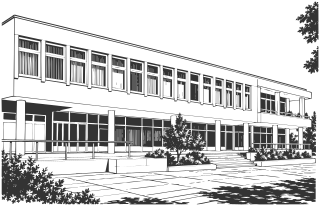
Kyustendil's chitalishte, its reading room and cultural center, was founded on July 1, 1869, in the mutual-school building. The town library, the theater, and the town's second museum collection all grew out of it. Its large building on the square, opened in 1907, was torn down in 1981; today Bratstvo 1869 works in a building north of Velbazhd Square and hosts an international classical guitar competition.
Hours, admission, and directions ↓
The chitalishte is in a building north of Velbazhd Square, but its history is spread across the whole center. It was founded in the mutual school in the churchyard of the Church of the Assumption, had no home of its own for decades, and its large building on the square is long gone. It has changed its name several times, but the people of Kyustendil still call it simply “Bratstvo” (“Brotherhood”).
The founding
↗On July 1, 1869, a “Bulgarian Chitalishte” was founded in the building of the Sts. Cyril and Methodius mutual school. Its first board included the chairman Georgi Drumoharski, the treasurer V. Ivanov, and the secretary Hr. Popmanchov, and it had 36 members (Wikipedia, drawing on the Encyclopedic Dictionary Kyustendil, Bulgarian Academy of Sciences Press, 1988).
- Georgi Angelov Drumoharski. The first chairman. The Regional Library writes that the chitalishte was founded on his initiative. Dimitar Tsanev notes in Kyustendil Readings (Sofia University, 2006) that Georgi Angelov was also a member of the Kyustendil revolutionary committee from 1872, and that in 1900 he published a book on the town’s history. He later served as mayor of Kyustendil (1879-1880 and 1893-1899, according to Wikipedia).
- Vasil Ivanchev Lekarski. One of the founders and the first treasurer, chairman from 1872. He drew up the statutes and rules, including those for the library, and at his insistence the first seal was made, reading “Bulgarian Chitalishte 1869 in Kyustendil” (Regional Library). The chitalishte’s first talk, “On the Importance of the Chitalishte,” was his, given in 1869 (Wikipedia).
Under its statutes of 1879, the chitalishte’s aim was to raise the education of the people of Kyustendil, of the Kyustendil region, and if possible of Macedonia, to help poor pupils, and to build a library. With its help chitalishtes were founded in Kriva Palanka (1869), Tsaribrod and Kochani (1892), and Bosilegrad (1911) (Wikipedia).
The names
↗Wikipedia lists its names: “Tsvyat” (“Blossom,” 1879), “Bulgarian Chitalishte” (late 1879 to 1882), “Razvitie” (“Progress,” 1883), “Cyril and Methodius Chitalishte” (1886), “Bratstvo” (1891), “Vasil Kolarov” (1950), and “Bratstvo” again after 1990. Today it is the Bratstvo 1869 People’s Chitalishte.
No home of its own
↗The Regional Library writes that for a long time the chitalishte and its library had no home of their own. They moved from place to place: the church, the Bulgarian or the Turkish school, the metropolitan’s residence, the old Turkish konak (government house), or a private building.
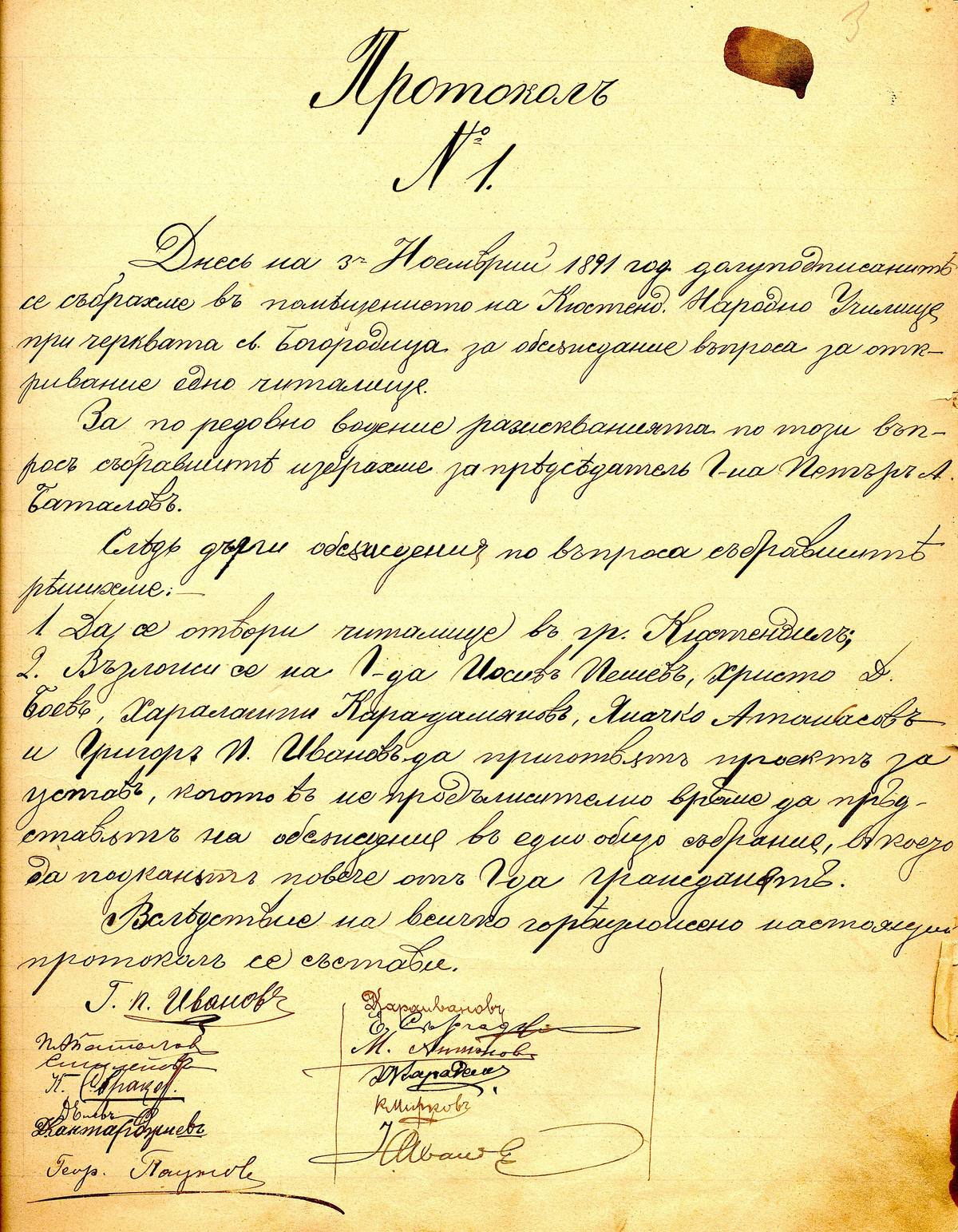
There was also a break. Ekaterina Keremidarska and Mihal Nikolov write in Kyustendil Readings (1996) that on November 3, 1891, “after a break of more than ten years,” the chitalishte resumed its work. The name Bratstvo dates from the same year. The founding minutes of 1891 have survived. The two authors studied the leisure of Kyustendil’s people largely from the minute books of the chitalishte’s board.
The building on the square
↗The chitalishte got a building of its own in 1907. The Regional Library gives November 8, 1907, for its formal opening; the Regional History Museum says “in October 1907.” It was designed by the architect Hristo Kovachevski. In 1914 it was rebuilt to a design by the architect Balkandzhiev, and in the 1930s it was extended. It stood in a park on the west side of Velbazhd Square (Wikipedia). During World War I it was turned into a warehouse.
In 1930 Georgi Gizdov wrote in the newspaper Kyustendil that everything in town was still “in a ‘God-given state,’ if we don’t count the semi-modern baths, the electric lighting, the fine chitalishte, and the convenient theater stage, rare for a provincial town.” Violeta Kotseva quotes him in Seminar_BG (Sofia University, 2024). [7]
In 1981, by decision of the district committee of the Bulgarian Communist Party, the building was torn down “despite the protests of the citizens,” Wikipedia says. Only part of its east façade was kept, and it still rises on the square (according to the State Archives in Kyustendil, 2019). The chitalishte moved to the former District Court building at 43 Gorotsvetna St., and in 1992 to the Youth House building.
Under the old park
↗Under the park where the old building stood runs the main street of Roman Pautalia, the decumanus maximus. In the Ministry of Culture’s list of monuments of national importance (2006), one of its sections is recorded as “park setting / former chitalishte Bratstvo.” Svetoslava Filipova of the Regional History Museum writes in Muzeen vestnik (2026) that coins minted in Serdica were found in the excavations at the “Chitalishte” site. In May 2025 the museum’s archaeologists carried out rescue archaeological monitoring at the “Chitalishte Bratstvo” site.
The library
↗Library work in the town began with the chitalishte in 1869, the Regional Library writes. The first collection was books, newspapers, and magazines “carefully collected and kept in the schools, private houses, or coffeehouses.” In 1886 the library had 205 volumes, and in 1893 its first librarian was appointed, as a volunteer (Wikipedia).
In 1959, under the decree on the new administrative division of the country, a “District Methodological Library” was created out of the chitalishte’s library. It took up the west wing of the chitalishte building and had a staff of five. Today it is the Emanuil Popdimitrov Regional Library.
The theater
↗The first play on the chitalishte’s stage was Zla zhena (“An Evil Woman”), on February 8, 1873, in the hall of the Cyril and Methodius school (Wikipedia). The troupe included Stoyan Zaimov, T. Ivanov, Efrem Karanov, Georgi Drumoharski, Vasil Lekarski, and others. From 1873 to 1907 it staged 47 plays, and after 1907 the amateur company grew to 120 people. Today’s Krum Kyulyavkov Drama Theater grew out of the chitalishte’s troupe.
Women acted too. Yordanka Yancheva writes in Kyustendil Readings (2012) that members of the women’s society Maychina Lyubov (“Motherly Love”) took part in the theater troupe of the Bratstvo chitalishte. [6]
Keremidarska and Nikolov write that the chitalishte was among the most frequent organizers of evening parties in town after the Liberation, along with Maychina Lyubov, the students of the Pedagogical School, and other societies. The income from the parties and from theater shows was a separate line in its budget. For the New Year’s party on the eve of 1904 the program promised “a post office with picture postcards, a telegram post, fortunes with witty sayings, a stereoscope, pictures shown with a cinematograph,” as well as a choral society, a mandolin orchestra, a lottery of 300 tickets, and a horo dance. Wikipedia says the first records of chitalishte cinema date from 1900.
The museum and the music
↗On December 29, 1907, the rules of the chitalishte’s museum were adopted, and it opened on January 1, 1908. It was the town’s second museum collection, after the one at the Pedagogical School (Regional History Museum). Its curators until 1944 were Gavril Zlatevski, Vladimir Migev, Efrem Karanov, Dimitar Stoimenov, Yordan Zahariev, Aleksandar Rozev, and Georgi Sotirov. How the chitalishte’s museum grew into today’s museum is told on the page for the Regional History Museum.
The town’s musical ensembles were also born in the chitalishte (Wikipedia):
- 1902: the Kaval men’s choir, conducted by Konstantin Ramadanov;
- 1915: G. Semerdzhiev’s mandolin orchestra joined the chitalishte and also played in its theater productions;
- 1918: the beginnings of opera in the town;
- after 1944: a symphony orchestra, a children’s music school (1954), a brass band (1957), a folk choir (1960), a dance company (1961), and an ensemble for folk songs and dances (1964).
In 1955 the chitalishte received the Order of Cyril and Methodius, First Class, and in 1959 it was named a “Model People’s Chitalishte.”
Today
↗The chitalishte works in its building north of the square. Its music school teaches percussion, clarinet, folk and pop singing, piano, solfège, violin, accordion, and guitar. Its groups include the Bratstvo choir, the Strumski Polah folk ensemble, the Nova Generatsia children’s dance company, and others.
Every year the chitalishte organizes the International Classical Guitar Competition, under the patronage of the mayor. The 30th edition has been announced for April 8-10, 2027. Its halls also host lectures: on January 28, 2025, Dr. Anton Venev of the Regional History Museum spoke here on the 147th anniversary of the liberation of Kyustendil.
The building is not a museum and has no published visiting hours. The program is on the chitalishte’s website.
Photos and related images
Document or artwork related to this sight
The image could not load. Its caption and source remain available.

Document or artwork related to this sight
The image could not load. Its caption and source remain available.

Sources
(16)
A date may refer to construction, renewal, or another stated stage. Legends are accounts recorded in sources, rather than established events. Bibliography links help locate the named author; no automatic reference is added where the match is ambiguous.
- История, Регионална библиотека „Емануил Попдимитров“, КюстендилOnline source · Bulgarian · libkn.bg
Source address
https://www.libkn.bg/istoriya/
If a link does not open, use its title, author, and address to search, or consult another listed source.
- Народно читалище „Братство 1869“, Уикипедия (по Енциклопедичен речник Кюстендил, Изд. на БАН, 1988, с. 95-96)Encyclopedia article · Bulgarian · bg.wikipedia.org
Source address
https://bg.wikipedia.org/wiki/Читалище_Братство_(Кюстендил)
If a link does not open, use its title, author, and address to search, or consult another listed source.
- Георги Друмохарски, Уикипедия (по Енциклопедичен речник Кюстендил, 1988, с. 204-205)Encyclopedia article · Bulgarian · bg.wikipedia.org
Source address
https://bg.wikipedia.org/wiki/Георги_Друмохарски
If a link does not open, use its title, author, and address to search, or consult another listed source.
- Димитър Цанев. Възрожденският будител Аверкий Попстоянов. Кюстендилски четения 6, СУ, 2006, 93-99Research publication · Bulgarian · periodicals.uni-sofia.bg
Source address
https://periodicals.uni-sofia.bg/index.php/KRe/bg/article/view/kre-2005-11
If a link does not open, use its title, author, and address to search, or consult another listed source.
- Екатерина Керемидарска, Михал Николов. Отдихът и развлеченията на кюстендилци след Освобождението. Кюстендилски четения 3, СУ, 1996, 38-47Research publication · Bulgarian · periodicals.uni-sofia.bg
Source address
https://periodicals.uni-sofia.bg/index.php/KRe/bg/article/view/kre-1996a-06
If a link does not open, use its title, author, and address to search, or consult another listed source.
- Йорданка Янчева. Дружество „Майчина любов“, Кюстендил (1873-1945 г.). Кюстендилски четения 12, СУ, 2012, 236-244Research publication · Bulgarian · periodicals.uni-sofia.bg↑1
Source address
https://periodicals.uni-sofia.bg/index.php/KRe/bg/article/view/kre-2010-20
If a link does not open, use its title, author, and address to search, or consult another listed source.
- Виолета Коцева. Развитие на балнеолечението в гр. Кюстендил в началото на ХХ в. Семинар_BG 27, СУ, 2024, 260-276Research publication · Bulgarian · periodicals.uni-sofia.bg↑1
Source address
https://periodicals.uni-sofia.bg/index.php/seminar_bg/bg/article/view/6050
If a link does not open, use its title, author, and address to search, or consult another listed source.
- История на музея, Регионален исторически музей, КюстендилInstitutional page · Bulgarian · kyustendilmuseum.bg
Source address
https://kyustendilmuseum.bg/za-muzeya/istoriya-na-muzeya.html
If a link does not open, use its title, author, and address to search, or consult another listed source.
- Отчет за дейността на РИМ „Акад. Йордан Иванов“, Кюстендил, през 2025 г.; Светослава Филипова. Монети на Сердика от нумизматичния фонд на РИМ. Музеен вестник, бр. 28, 2026PDF document · Bulgarian · kyustendilmuseum.bg
Source address
https://kyustendilmuseum.bg/uploads/MUZEEN_VESTNIK_2026_cveten_3.pdf
If a link does not open, use its title, author, and address to search, or consult another listed source.
- Списък на паметниците на културата с национално значение в област Кюстендил, Министерство на културата, 2006PDF document · Bulgarian · mc.government.bg
Source address
https://mc.government.bg/images/NPK/KUSTENDIL.pdf
If a link does not open, use its title, author, and address to search, or consult another listed source.
- Показаха общия градоустройствен план на Кюстендил от 1924 г., Инфомрежа, 2019Online source · Bulgarian · infomreja.bg
Source address
https://infomreja.bg/pokazaha-obshtiq-gradoustrojstven-plan-na-kiustendil-ot-1924-g-69714.html
If a link does not open, use its title, author, and address to search, or consult another listed source.
- За контакти, читалище „Братство 1869“Online source · Bulgarian · bratstvokn.org
Source address
https://www.bratstvokn.org/index.php?option=com_contact&view=contact&id=2&Itemid=56&lang=bg
If a link does not open, use its title, author, and address to search, or consult another listed source.
- 30 години Китарен конкурс в Кюстендил, читалище „Братство 1869“, 2026Online source · Bulgarian · bratstvokn.org
Source address
https://www.bratstvokn.org/index.php?option=com_content&view=article&id=2045&catid=34&Itemid=54&lang=bg
If a link does not open, use its title, author, and address to search, or consult another listed source.
- Музикална школа, читалище „Братство 1869“Online source · Bulgarian · bratstvokn.org
Source address
https://www.bratstvokn.org/index.php?option=com_content&view=category&layout=blog&id=41&Itemid=65&lang=bg
If a link does not open, use its title, author, and address to search, or consult another listed source.
- Формации и състави, читалище „Братство 1869“Online source · Bulgarian · bratstvokn.org
Source address
https://www.bratstvokn.org/index.php?option=com_content&view=category&layout=blog&id=42&Itemid=66&lang=bg
If a link does not open, use its title, author, and address to search, or consult another listed source.
- OpenStreetMap: Читалище БратствоMap record · Bulgarian · openstreetmap.org
Source address
https://www.openstreetmap.org/way/154606409
If a link does not open, use its title, author, and address to search, or consult another listed source.