Sts. Cyril and Methodius Mutual School
1849; additions in the 1850s and 1890s
Dating stated in the sources: 1849
Your visit at a glance
- Address
- In the churchyard of the Church of the Assumption, on the Ilarion Lovchanski St. side
- Approximate time at the site
- about 15 minutes
- Opening hours
- No verified information found
- Admission
- No verified information found
The image could not load. Its caption and source remain available.

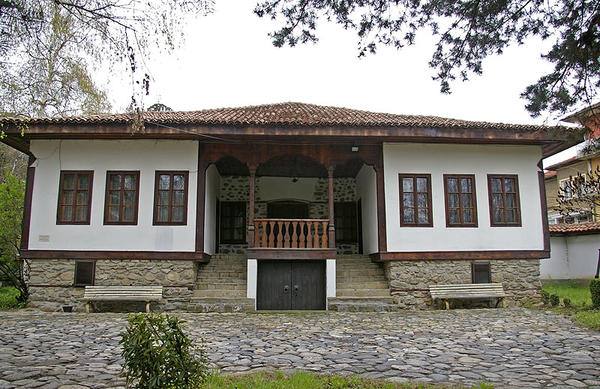
The low building in the churchyard of the Church of the Assumption is Kyustendil's mutual school, built in 1849. Locals call it the Cell School (Kiliynoto uchilishte), although the earlier church school from the early 1820s was pulled down. The town's chitalishte was founded here in 1869, and today the hall with its painted ceiling opens for exhibitions and book launches.
Hours, admission, and directions ↓
In the southwest corner of the churchyard of the Church of the Assumption stands a one-story building with a long hall. Locals call it the Cell School (Килийното училище). In fact it is the Sts. Cyril and Methodius mutual school, a solid building of 1849 that served as a school until 1888.
The earlier church school
↗The first Bulgarian school in Kyustendil opened in the churchyard in 1820, Bulgarian Wikipedia says, drawing on the Encyclopedic Dictionary Kyustendil (Bulgarian Academy of Sciences Press, 1988). The text for the church’s 210th anniversary (2026) gives 1821. It was a traditional church school housed in a single room beside the church:
- it was housed in a half-timbered wooden building north of the church;
- 20 to 30 boys studied there, the sons of the better-off Bulgarians;
- its first teacher is not known, but in 1825 the teacher and cantor was Zahari dedo Stoitsov of Samokov;
- he was followed as teacher by Pop Stoyan, Vasil Abadzhiyata (“the tailor of woolen clothes”) from Sapareva Banya, and others.
That building has not survived. In 1883 the church’s bell tower was built on its site. The name “Cell School” is now carried by the newer building.
The decision of March 3, 1846
↗In 1844-1846 the teacher Hristo Ivanov Hristov of Samokov brought the Bell-Lancaster, or monitorial, method to Kyustendil. In it the more advanced pupils teach the younger ones. In his time, on March 3, 1846, it was decided to build a new, separate school building (Wikipedia).
Yavor Mitov has devoted an article in the Proceedings of the History Museum Kyustendil (2022) to the rules written on that date in the school’s kondika, the register of its decisions and accounts. Among the donors in the kondika is the chorbadzhi Davitko Yakovich, the owner of the Prokopieva House, writes Veska Spasova of the Regional History Museum (2026).
The real reformer of the school was Nikola Tondzhorov. He taught in Kyustendil in 1847-1848 and 1849-1850. Under him money was raised from the whole kaza, the district, and in 1849 the new solid building went up in the southwest corner of the churchyard. For the first time the school had desks and a blackboard, and it taught history, geography, and “the study of everyday life.” The old church-school building was pulled down. In 1850 Tondzhorov also opened the town’s first class school, that is, a school with separate grades.
The hall
↗The solid body of the schoolroom was built first: a hall 15 by 10 m, divided by columns into three aisles. Wikipedia, drawing on the encyclopedic dictionary, describes it this way:
- The ceiling. Six wooden columns carry a “sunburst” ceiling with deep painted coves. They are decorated with polychrome paintings: plant motifs and teaching aids, a globe, a calendar, a crystal, and a solid-geometry figure.
- The inscription. Above the north entrance survives a painted panel with plant ornaments and the words “Common People’s Bulgarian Boys’ School, dedicated to Sts. Cyril and Methodius.”
- The additions. In the 1850s two rooms were added on the north, with a double staircase and a kyoshk, a small room projecting forward. In the 1890s two more rooms and a corridor were added on the south, in connection with the building of the new Pedagogical School.
The three building stages were identified during the conservation and restoration of 1977-1981. The municipality says more generally that the building dates from the second half of the 19th century and is “in the Revival style.”
Teachers
↗- Averkiy Popstoyanov. From 1851 to 1858 Averkiy Popstoyanov of Dupnitsa taught in Kyustendil, writes Dimitar Tsanev in Kyustendil Readings (Sofia University, 2006). Like Neofit Rilski, he learned the monitorial method in Bucharest and introduced it in the schools where he taught. Efrem Karanov, his first biographer, found and used a copy of the school kondika for 1851 made by Averkiy himself, Tsanev writes.
- Girls. From 1860 girls studied at the school as well (Wikipedia).
- Local teachers. The first teachers from Kyustendil itself were Anton Karpachev and Dimitar Lyubenov. Most teachers before the Liberation came from elsewhere, most often from the Samokov area.
- Cyril and Methodius. On May 11, 1867, under the teacher Mihail K. Bubotinov, the feast of the two brothers was celebrated with ceremony for the first time, and the school was named after them. After Bubotinov, Todor Peev became head teacher.
- Daskal Dimitri. From 1871 to 1874 Dimitar Stoyanov, Daskal Dimitri, also taught here. He was the man behind the Church of St. Demetrius and the town’s second school.
The chitalishte and the first play
↗On July 1, 1869, the Kyustendil chitalishte, the town’s reading room and cultural center, was founded in the mutual-school building. It is today’s Bratstvo 1869. Its first chairman was Georgi Angelov, Tsanev writes. On February 8, 1873, the first play of the chitalishte’s stage, Zla zhena (“An Evil Woman”), was performed in the school’s hall (Wikipedia).
Under the floor: Pautalia
↗The school stands in the middle of Roman Pautalia. Svetoslava Filipova of the Regional History Museum writes in Muzeen vestnik (2026) that coins minted in Serdica have been found in excavations at several sites in town, among them the “Mutual School.” Most of those coins date from the reign of Emperor Caracalla (198-217). [7]
Today
↗The building was a school until 1888. Its successor as an institution is today’s First Primary School “Sts. Cyril and Methodius.” The building belongs to the municipality. In the 1980s it was adapted for the Banner of Peace (Знаме на мира) center (Wikipedia), and the municipality says cultural events have been held in it since 1981.
They still are. On October 1, 2026, the Regional History Museum launched Yavor Mitov’s bilingual Bulgarian and English book on Hisarlaka in the “Hall of the Cell School.” Spasova notes that the school is part of the Revival ensemble of Varosh: across from it, at the corner of Targovska St. and Ilarion Lovchanski St., stands the Haralampi Popanastasov house of 1907. [5]
Sources
(14)
A date may refer to construction, renewal, or another stated stage. Legends are accounts recorded in sources, rather than established events. Bibliography links help locate the named author; no automatic reference is added where the match is ambiguous.
- Взаимно училище Св. св. Кирил и Методий (Кюстендил), Уикипедия (по Енциклопедичен речник Кюстендил, Изд. на БАН, 1988, с. 294)Encyclopedia article · Bulgarian · bg.wikipedia.org
Source address
https://bg.wikipedia.org/wiki/Взаимно_училище_Св._св._Кирил_и_Методий_(Кюстендил)
If a link does not open, use its title, author, and address to search, or consult another listed source.
- 1 основно училище „Св. св. Кирил и Методий“ (Кюстендил), Уикипедия (по Енциклопедичен речник Кюстендил, 1988, с. 294)Encyclopedia article · Bulgarian · bg.wikipedia.org
Source address
https://bg.wikipedia.org/wiki/1_основно_училище_„Св._св._Кирил_и_Методий“_(Кюстендил)
If a link does not open, use its title, author, and address to search, or consult another listed source.
- Никола Тонджоров, Уикипедия (по Енциклопедичен речник Кюстендил, 1988, с. 647)Encyclopedia article · Bulgarian · bg.wikipedia.org
Source address
https://bg.wikipedia.org/wiki/Никола_Тонджоров
If a link does not open, use its title, author, and address to search, or consult another listed source.
- Димитър Цанев. Възрожденският будител Аверкий Попстоянов. Кюстендилски четения 6, СУ, 2006, 93-99Research publication · Bulgarian · periodicals.uni-sofia.bg
Source address
https://periodicals.uni-sofia.bg/index.php/KRe/bg/article/view/kre-2005-11
If a link does not open, use its title, author, and address to search, or consult another listed source.
- Явор Митов. Правилникът в училищната кондика на град Кюстендил от 3 март 1846 г. Известия на Исторически музей Кюстендил XXII, 2022, 49 (съдържание)PDF document · Bulgarian · kyustendilmuseum.bg↑1
Source address
https://kyustendilmuseum.bg/uploads/Известия_на_исторически_музей_Кюстендил,_том_22.pdf
If a link does not open, use its title, author, and address to search, or consult another listed source.
- Веска Спасова. За величието и духа на старите кюстендилски къщи, Музеен вестник, бр. 28, РИМ, Кюстендил, 2026PDF document · Bulgarian · kyustendilmuseum.bg
Source address
https://kyustendilmuseum.bg/uploads/MUZEEN_VESTNIK_2026_cveten_3.pdf
If a link does not open, use its title, author, and address to search, or consult another listed source.
- Светослава Филипова. Монети на Сердика от нумизматичния фонд на РИМ, Кюстендил, Музеен вестник, бр. 28, 2026PDF document · Bulgarian · kyustendilmuseum.bg↑1
Source address
https://kyustendilmuseum.bg/uploads/MUZEEN_VESTNIK_2026_cveten_3.pdf
If a link does not open, use its title, author, and address to search, or consult another listed source.
- Храм „Успение Богородично“ в Кюстендил отбелязва 210 години, pirinsko.com, 2026Online source · Bulgarian · pirinsko.com
Source address
https://pirinsko.com/hram-uspenie-bogorodichno-v-kiustendil-otbelqzva-210-godini-duhovnost-i-pamet-188332/
If a link does not open, use its title, author, and address to search, or consult another listed source.
- Успение Богородично (Кюстендил), УикипедияEncyclopedia article · Bulgarian · bg.wikipedia.org
Source address
https://bg.wikipedia.org/wiki/Успение_Богородично_(Кюстендил)
If a link does not open, use its title, author, and address to search, or consult another listed source.
- Народно читалище „Братство 1869“, Уикипедия (по Енциклопедичен речник Кюстендил, 1988, с. 95-96)Encyclopedia article · Bulgarian · bg.wikipedia.org
Source address
https://bg.wikipedia.org/wiki/Читалище_Братство_(Кюстендил)
If a link does not open, use its title, author, and address to search, or consult another listed source.
- Даскал Димитри, Уикипедия (по Енциклопедичен речник Кюстендил, 1988, с. 165)Encyclopedia article · Bulgarian · bg.wikipedia.org
Source address
https://bg.wikipedia.org/wiki/Даскал_Димитри
If a link does not open, use its title, author, and address to search, or consult another listed source.
- Представяне на книгата на гл. ас. д-р Явор Митов „Хисарлъка: крепостта над Кюстендил“, РИМ, Кюстендил, 2026Institutional page · Bulgarian · kyustendilmuseum.bg
Source address
https://kyustendilmuseum.bg/novini/kniga-hisarluka-krepostta-nad-kyustendil.html
If a link does not open, use its title, author, and address to search, or consult another listed source.
- Недвижимо културно наследство, Община КюстендилInstitutional page · Bulgarian · kyustendil.bg
Source address
https://kyustendil.bg/index.php?Itemid=273&id=119&lang=bg&option=com_content&view=article
If a link does not open, use its title, author, and address to search, or consult another listed source.
- OpenStreetMap: Взаимно училище Св. св. Кирил и МетодийMap record · Bulgarian · openstreetmap.org
Source address
https://www.openstreetmap.org/way/413315984
If a link does not open, use its title, author, and address to search, or consult another listed source.