Prokopieva House
18th century; east wing 19th century
Dating stated in the sources: 18th c.
Your visit at a glance
- Address
- 26 Konstantinova Banya St., by Velbazhd Square and the Church of the Assumption (the old Varosh quarter)
- Approximate time at the site
- about 10 minutes
- Opening hours
- No verified information found
- Admission
- No verified information found
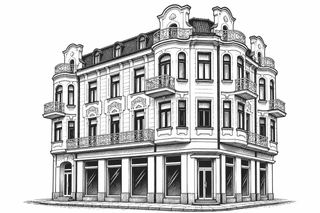
The Regional History Museum calls it the oldest surviving National Revival town house in Kyustendil, from the late 18th century. It was built for the chorbadzhi Davidko, a merchant who had moved from Sofia. It is L-shaped, with an outside staircase, a chardak (open gallery), and carved ceilings by masters from Debar, and in the 1870s its east wing housed the town's Hellenic school.
Hours, admission, and directions ↓
The house stands at 26 Konstantinova Banya St., a few steps from Velbazhd Square and the Church of the Assumption, in the old Varosh quarter. It is whitewashed, on two floors, with an outside staircase. It is not a museum and can only be seen from outside.
The chorbadzhi from Sofia
↗Bulgarian Wikipedia, drawing on the Encyclopedic Dictionary Kyustendil (Bulgarian Academy of Sciences Press, 1988), says the house was built in the 18th century and calls it the oldest Revival house in town. Its owner, the chorbadzhi Davidko Yachkov, had moved here from Sofia. A chorbadzhi was a wealthy community notable.
Veska Spasova of the Regional History Museum dates it more closely in the museum’s newsletter, Muzeen vestnik (2026): “The oldest surviving Revival town house, dated to the late 18th century, is the Prokopieva House.” She calls the owner “chorbadzhi akhtar Davitko Yakovich” and explains that he was “a dealer in small goods for the household.” His name differs between the sources: Davidko or Davitko, Yachkov or Yakovich. [2]
Spasova adds one more clue. Davitko’s name “is mentioned as a donor in the school register (kondika) of the town of Kyustendil of March 3, 1846.” On that same date, March 3, 1846, the people of Kyustendil decided to build a new school: the mutual school in the churchyard of the Church of the Assumption, very close to the house.
Why the house is called “Prokopieva,” the sources do not explain. Spasova names as the house’s direct heir a woman of the Prokopiev family, born in Kyustendil, who now lives in Sofia.
Two wings
↗The house was built in two stages. Wikipedia, again drawing on the encyclopedic dictionary, describes it this way:
- Plan. A ground floor and an upper floor, in the shape of an L.
- The ground floor. An outside staircase to the upper floor divides it in two. The west part dates from the first building stage: symmetrical, with a corridor and two rooms. The east part is from the second: a dressing room, a kitchen, and a shop.
- The upper floor. It too is split into two living areas by the staircase, which leads to a chardak on three levels. The west half is linked to the corridor below by a spiral wooden staircase and repeats its plan.
- The east wing. It has two rooms. It was built in the mid-19th century and differs from the west wing in its architecture and style.
Spasova describes the house as half-timbered, with a wooden frame. The shop on the ground floor was “for small goods,” in other words the owner’s own store. The upper floor is “with a bend” (the L), and the chardak has a kyoshk, a small room projecting forward.
The list of sights in Wikipedia’s article on the Central quarter dates the whole house to the mid-19th century. That general dating differs from the two building phases described above.
The ceilings
↗The carved wooden ceilings are the finest features inside. Spasova writes that they are “the work of masters from Debar,” with rich carved compositions. In the room facing the chardak, the carving on the ceiling takes the shape of an octagonal mirror, “a symbol of the heavenly hemisphere.” Its field is filled with plant motifs, and in the corners there are shields with double-headed eagles.
Spasova calls such carved ceilings in Kyustendil’s old houses “symbolic cosmograms, meant as protective signs against the forces of evil and misfortune in the home.”
The Hellenic school
↗In the 1870s the east wing housed Kyustendil’s Hellenic school, that is, its Greek school. Wikipedia puts it in one of the two rooms; Spasova puts it in the wing’s main hall. She writes that the school was “for the children of the Grecomans in the town,” the locals who sided with the Greek church and culture.
It is a little-known page of Kyustendil’s Revival. In the same years Bulgarian children studied at the mutual school by the Church of the Assumption and at Daskal Dimitri’s school by the Church of St. Demetrius. Some townspeople, however, still sent their children to learn in Greek.
Today
↗The house is not one of the Regional History Museum’s sites. We could not find out who manages it today or whether it can be visited, so plan to see it from outside. In OpenStreetMap the house is not yet marked by name.
Spasova ends her article on Kyustendil’s old houses with a warning: “not a few of these examples of Bulgarian architectural history are gradually vanishing before our eyes.”
Sources
(8)
A date may refer to construction, renewal, or another stated stage. Legends are accounts recorded in sources, rather than established events. Bibliography links help locate the named author; no automatic reference is added where the match is ambiguous.
- Почивка.бг, картна връзка на Прокопиевата къщаOnline source · Bulgarian · mob.pochivka.bg
Source address
https://mob.pochivka.bg/prokopieva-kashta-e1122
If a link does not open, use its title, author, and address to search, or consult another listed source.
- Веска Спасова. За величието и духа на старите кюстендилски къщи, Музеен вестник, бр. 28, РИМ, Кюстендил, 2026PDF document · Bulgarian · kyustendilmuseum.bg↑1
Source address
https://kyustendilmuseum.bg/uploads/MUZEEN_VESTNIK_2026_cveten_3.pdf
If a link does not open, use its title, author, and address to search, or consult another listed source.
- Прокопиева къща (Кюстендил), Уикипедия (по Енциклопедичен речник Кюстендил, Изд. на БАН, 1988, с. 532-533)Encyclopedia article · Bulgarian · bg.wikipedia.org
Source address
https://bg.wikipedia.org/wiki/Прокопиева_къща_(Кюстендил)
If a link does not open, use its title, author, and address to search, or consult another listed source.
- Централна градска част (квартал на Кюстендил), УикипедияEncyclopedia article · Bulgarian · bg.wikipedia.org
Source address
https://bg.wikipedia.org/wiki/Централна_градска_част_(квартал_на_Кюстендил)
If a link does not open, use its title, author, and address to search, or consult another listed source.
- 1 основно училище „Св. св. Кирил и Методий“ (Кюстендил), Уикипедия (по Енциклопедичен речник Кюстендил, 1988, с. 294)Encyclopedia article · Bulgarian · bg.wikipedia.org
Source address
https://bg.wikipedia.org/wiki/1_основно_училище_„Св._св._Кирил_и_Методий“_(Кюстендил)
If a link does not open, use its title, author, and address to search, or consult another listed source.
- Музейни обекти, Регионален исторически музей, КюстендилInstitutional page · Bulgarian · kyustendilmuseum.bg
Source address
https://kyustendilmuseum.bg/muzeyni-obekti-na-rim-kyustendil/
If a link does not open, use its title, author, and address to search, or consult another listed source.
- OpenStreetMap: ул. „Константинова баня“Map record · Bulgarian · openstreetmap.org
Source address
https://www.openstreetmap.org/way/413162296
If a link does not open, use its title, author, and address to search, or consult another listed source.
- Cultural Area, маршрут Алафранга, спирка Прокопиевата къщаOnline source · Bulgarian · culturalarea.com
Source address
https://culturalarea.com/kulturni-marshruti/kulturen-marshrut-alafranga/
If a link does not open, use its title, author, and address to search, or consult another listed source.