Ilyo Voyvoda House Museum
House from the 1870s; museum since 1981
Dating stated in the sources: 1870s
Your visit at a glance
- Address
- 189 Tsar Osvoboditel St.
- Approximate time at the site
- about 40 minutes
- Opening hours
- Visit details
- Admission
- Visit details
The image could not load. Its caption and source remain available.

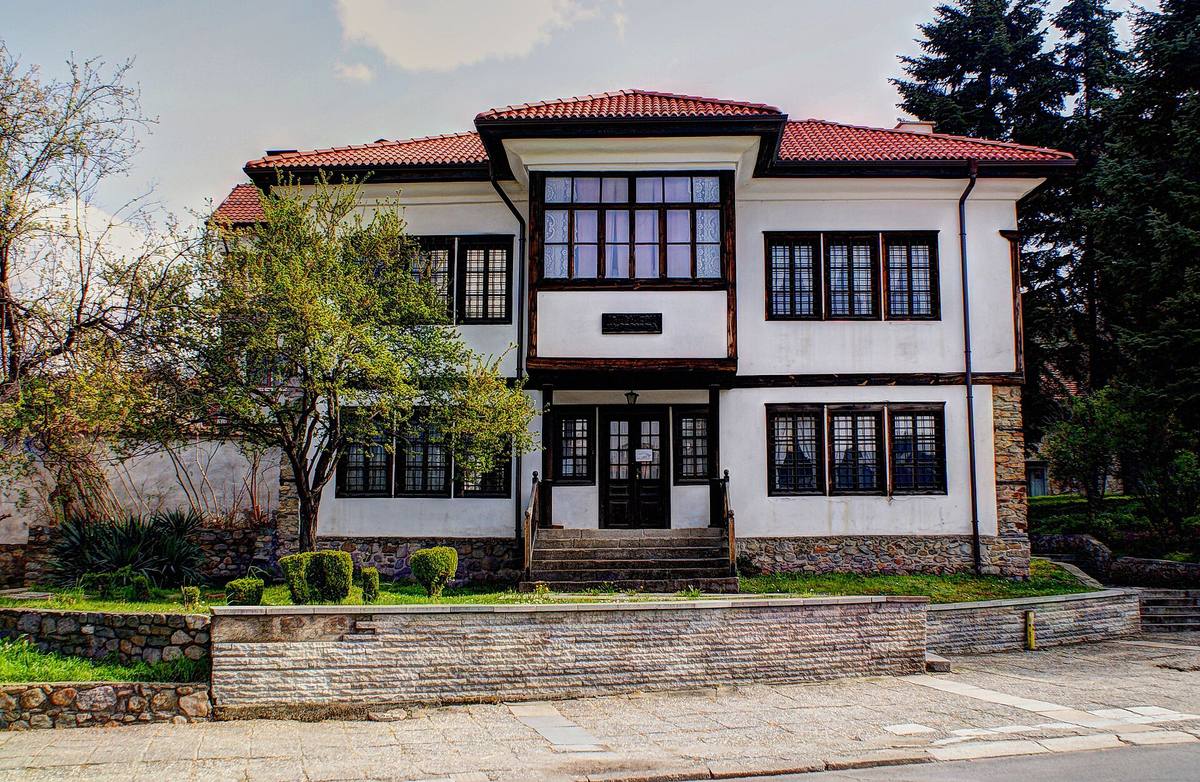
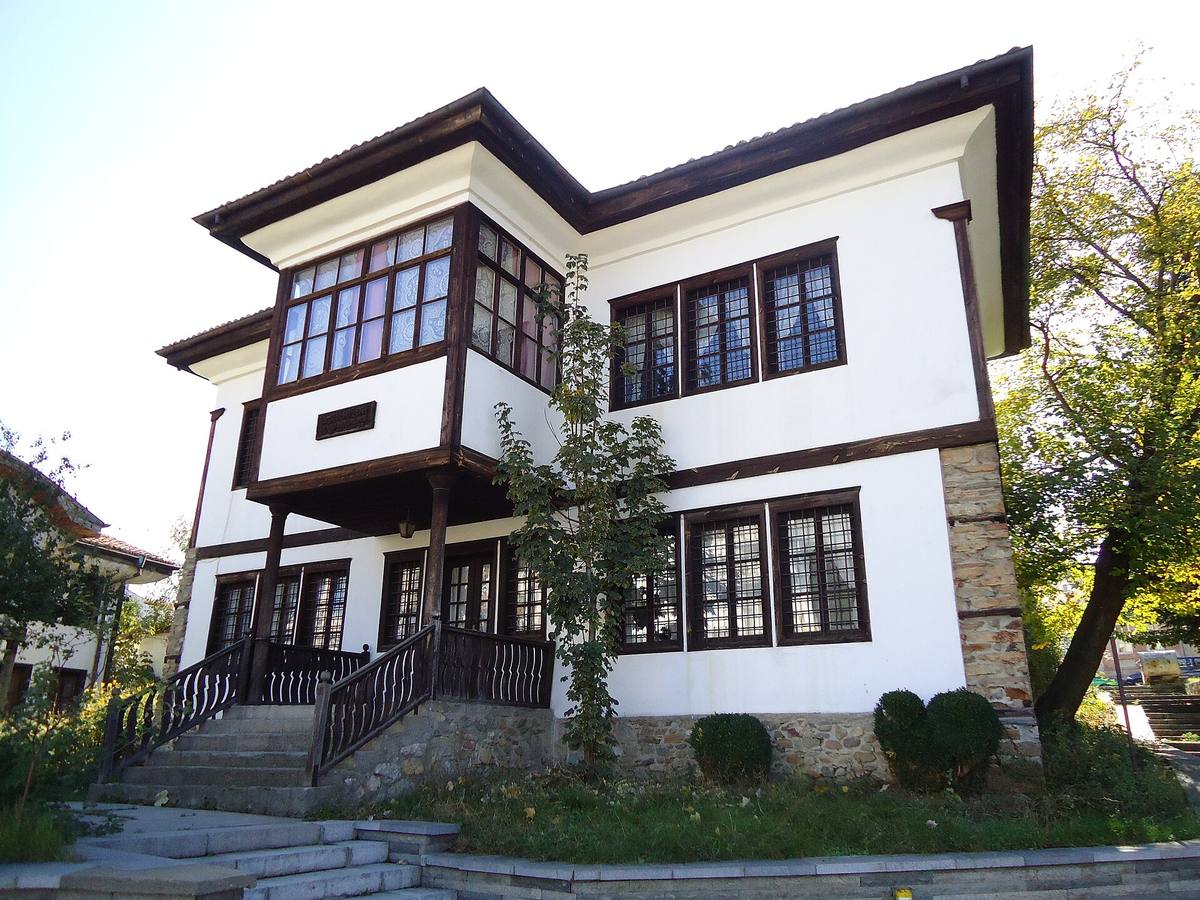
The house where Ilyo Voyvoda lived from 1878 until his death in 1898: the hajduk from Maleshevo, the legionary of Rakovski, and the leader of the band that entered Kyustendil together with Russian units on January 11, 1878. Today it holds the exhibition on the region’s struggle for liberation.
Hours, admission, and directions ↓
People sang songs about him while he was still alive. They called him Kara Iliya, Grandfather Ilyo, Ilyo of Maleshevo. For more than half a century he fought Turks, robbers, and irregulars, from the Maleshevo mountains to Belgrade and back. He spent the last twenty years of his life here in Kyustendil, in this house.
Dates for events before 1916 follow the Old Style (Julian) calendar, as in the Bulgarian sources used here.
Kara Iliya of Berovo
↗Iliya Markov was born in Berovo, in the Maleshevo region. The traditional date is May 28, 1805, but scholars also give 1815, 1817, or about 1822. His grandfather, the priest Georgi, was killed leading a band against irregular Ottoman troops. Iliya grew up “big and swarthy,” and the Turks of Berovo called him “Kara Iliya, that is, Black Iliya.”
At about twenty he clashed with a Turkish chieftain who had been harassing his sisters. The Macedonian version says he saved his sister from forced conversion and killed one of the Turks. He then went to a relative, a monk at the Rila Monastery. There, from 1830 to 1838, he served as a pandur, a guard, and met hajduks and the scholars Neofit Rilski and Averkiy Popstoyanov. He returned to Berovo, married Tsona, and farmed.
In 1850 Mehmed Bayraktar of Berovo fired at Ilyo from ambush but wounded his brother instead. Ilyo killed him and “went out into the mountains.”
Hajduk
↗His band, with Stoimen Zhibaro, Niko Kambera, and others, roamed Maleshevo, Piyanets, and Osogovo. During the Crimean War (1853-1856) it numbered 70 men.
In 1854 the Turks of Dupnitsa planned to attack the Christians on Easter morning. Ilyo sent word that he would circle the town all night, and at the slightest sign of trouble he would come in and “raze the Turkish quarter to the ground.” The attack never happened. After that, writes the Encyclopedic Dictionary Kyustendil, “Ilyo’s fame grew, and he entered the folk songs.”
In 1856 the pasha of Skopje negotiated with him and, through Metropolitan Avksentiy of Kyustendil, gave him a written pardon. Ilyo entered Kyustendil, was received with honors, allowed to keep his weapons, and took an oath in the church of the Holy Mother of God. He soon uncovered a plot to kill him, killed the plotters, and went back to the mountains.
The authorities’ reply was harsh:
- 1859: on the orders of the governor of Niš, his house in Berovo was looted and pulled down, and his wife and children were brought to Kyustendil under close watch.
- June 1860: twelve of his pardoned companions were arrested. Four were hanged in public in Kyustendil, the rest in Niš.
In Rakovski’s Legion
↗In 1861 Ilyo was in Belgrade, in the First Bulgarian Legion, as Georgi Rakovski’s assistant. Hristo Makedonski remembered: “When I went to Serbia, and then came to Belgrade (1861), to Rakovski, Grandfather Ilyo was there.”
On June 2, 1862, in the storming of the Belgrade fortress, Ilyo “commanded the battalion that carried the Legion’s flag.” Meanwhile his family had been imprisoned in Skopje. On July 28, 1862, Nayden Gerov visited them and found his daughter and both his sons gravely ill.
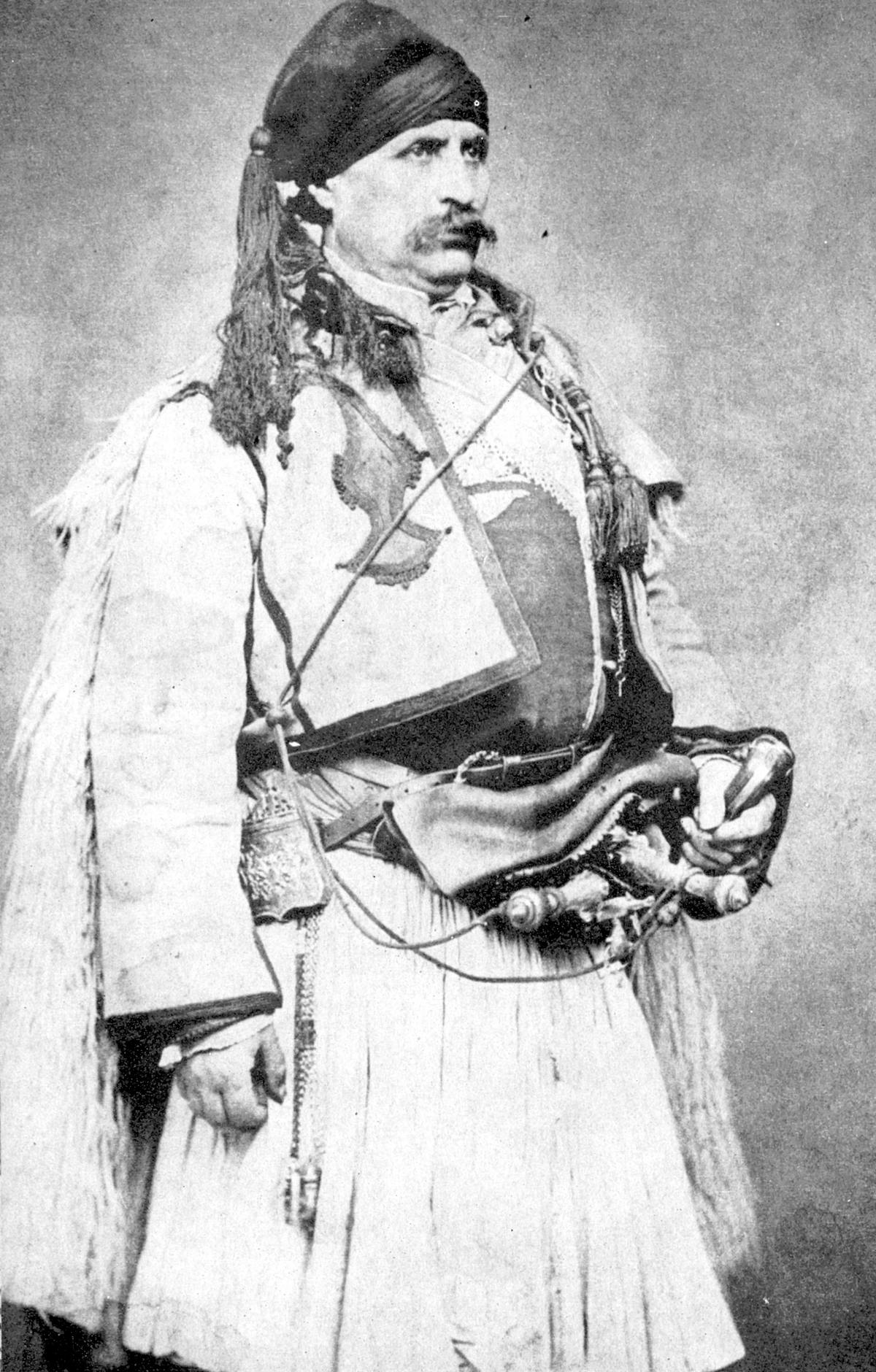
The Serbian Prince Mihailo Obrenović gave him a decoration, the rank of captain, and a pension of 150 dinars. In 1867 the photographer Anastas Karastoyanov took his portrait in Belgrade; it is in the gallery below.
The wars
↗- 1876, the Serbian-Turkish War. Ilyo led a volunteer band of 300, with his two sons, Nikola and Ivan. On August 1, it counterattacked and stopped the Turkish advance. Near Deligrad he was badly wounded by friendly fire: two ribs were removed, and his right arm was left crippled. He received the Serbian Cross of Takovo for bravery.
- 1877, the Russo-Turkish War. Still not recovered, he offered his services to the Russian command at Svishtov. He was made a captain and commander of a volunteer band, operated behind Turkish lines near Lovech, and then in General Gurko’s Western Detachment.
The ruse at Konyavo
Radomir was freed on December 27, 1877, and Dupnitsa on January 2, 1878. On January 8, Ilyo was at Konyavo. From there he sent volunteers into Kyustendil “to spread the rumor that he was coming as the vanguard of the Russian army” and that the town should negotiate its surrender. “Grandfather Ilyo’s trick worked”: the town’s provisional council sent a delegation to General Arnoldi in Sofia, who sent Russian cavalry.
On January 11, 1878, Ilyo’s band and Russian troops entered Kyustendil. On January 12, they pulled back before a large Turkish force. On January 17, the town was finally liberated, with General Baron Theophil Meyendorff (the municipality’s tourism site says January 30). In March Ilyo was at San Stefano and received another order for bravery.
The last years
↗After the Treaty of Berlin, Ilyo settled in Kyustendil. He fought in the Kresna-Razlog Uprising “on the right bank of the Struma.” At Stambolov’s insistence, Parliament granted him a pension of 220 leva a month.
In the Serbo-Bulgarian War of 1885, his band fought with the Radomir detachment at Breznik, Slivnitsa, Vranya, Kraishte, and Izvor. Yordanka Yancheva adds in Sofia University’s Kyustendil Readings (2006) that his volunteers reached Radomir on November 5, 1885, but that “grandfather” Ilyo himself was ill at the time, and the band was led by Kostandi Popgeorgiev. The whole detachment numbered 1,949 men, though participants gave higher figures. Serbia responded by taking away his pension. In the 1890s he advised the new revolutionary bands in Macedonia. [2]
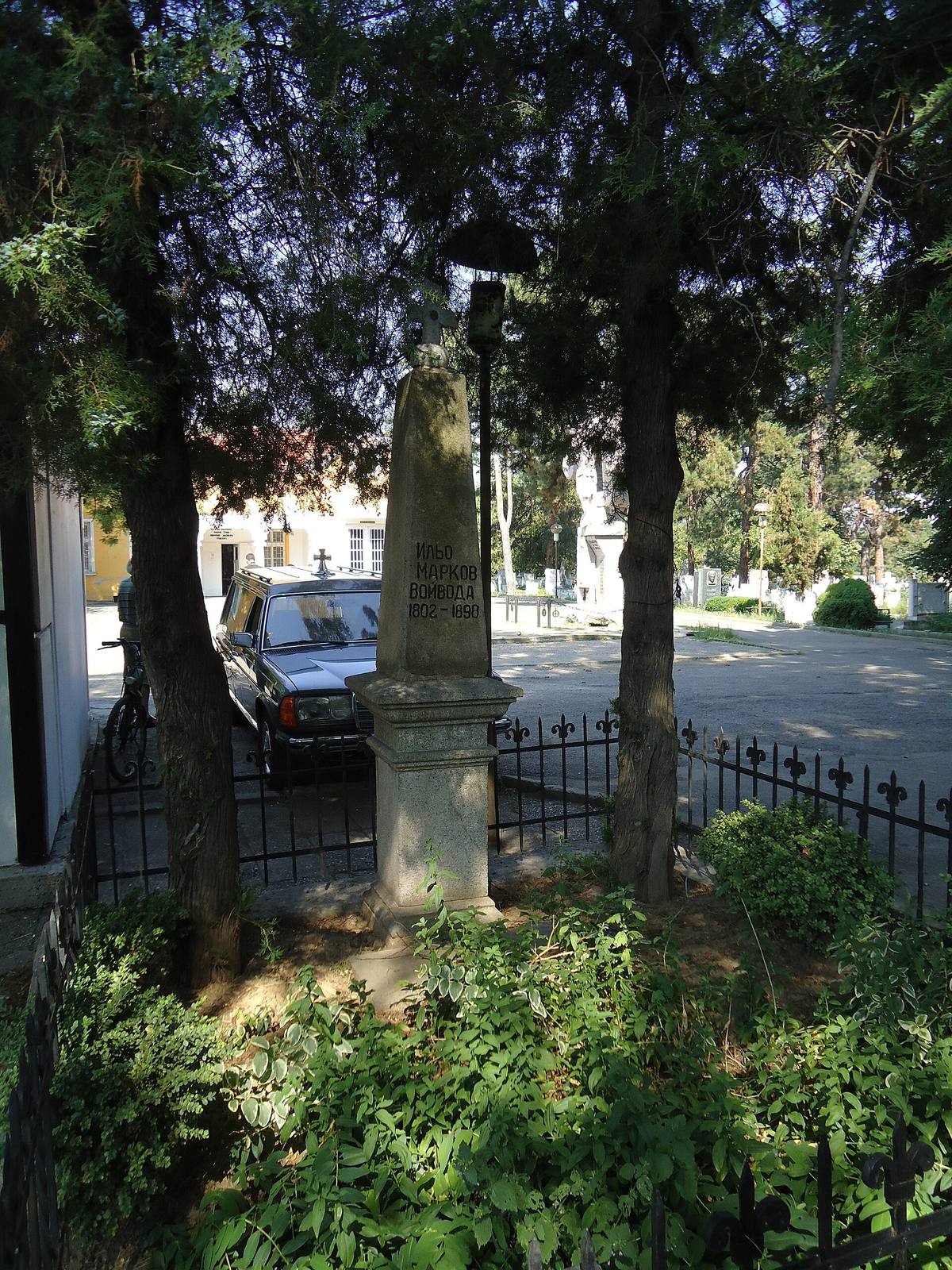
Ilyo Voyvoda died in Kyustendil on April 17, 1898. “The whole town took part” in his funeral. His grave is in the Central Cemetery.
Songs and memories
↗“Ilyo Voyvoda’s extraordinary courage and deeds are celebrated in many folk songs, and they made him a legend in his own lifetime,” writes the Encyclopedic Dictionary Kyustendil (1988), as quoted by Bulgarian Wikipedia.
The song on Bulgarian Wikisource begins:
Ilyo Voyvoda, / Hey, he called out, oh, he called out, / oh, Ilyo of Maleshevo called out…
and ends with Maleshevo setting out “to fight the Turks, to drive out the foe.”
What his contemporaries said:
- Hristo Makedonski, as a boy, dreamed of joining his band: “We envied and adored Stoimen and Ilyo Voyvoda, who struck fear and trembling into the oppressors.”
- Petar Berkovski wrote: “Grandfather Ilyo captivated us Bulgarians, and the Serbs too, with his heroic look, his frankness, and his good nature.”
- Panayot Hitov wrote that Ilyo fought Turkish forces more than twenty times, and as a guard at the Rila Monastery broke up robber bands more than ten times.
Near Rila, a rock overhang that sheltered the voyvoda is still called Grandfather Ilyo’s Cave, and the stream below it Iliyna River. Nikola Zhivkov, the author of the song “Shumi Maritsa,” wrote a play called Ilyo Voyvoda.
In North Macedonia Ilyo is honored as Dedo Iljo Maleshevski. His bust stands in front of a school in Berovo, and his image appears in relief on the lions of the Goce Delčev Bridge in Skopje.
The house
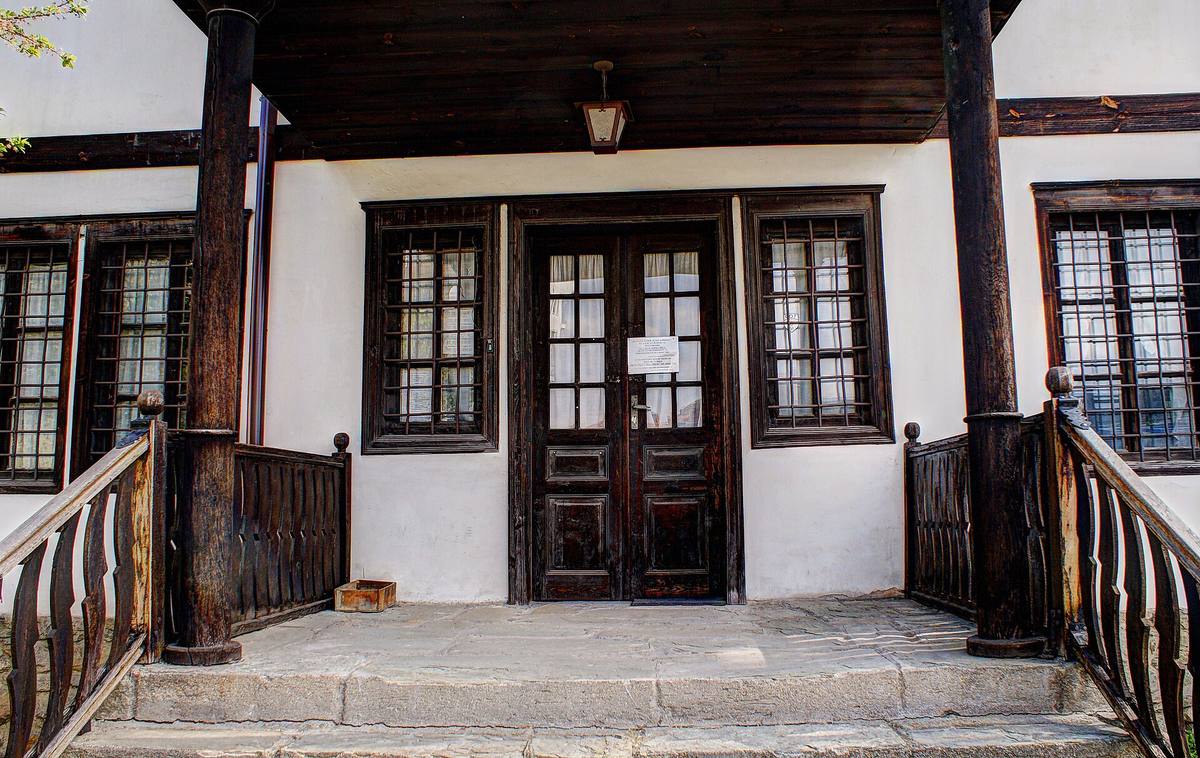
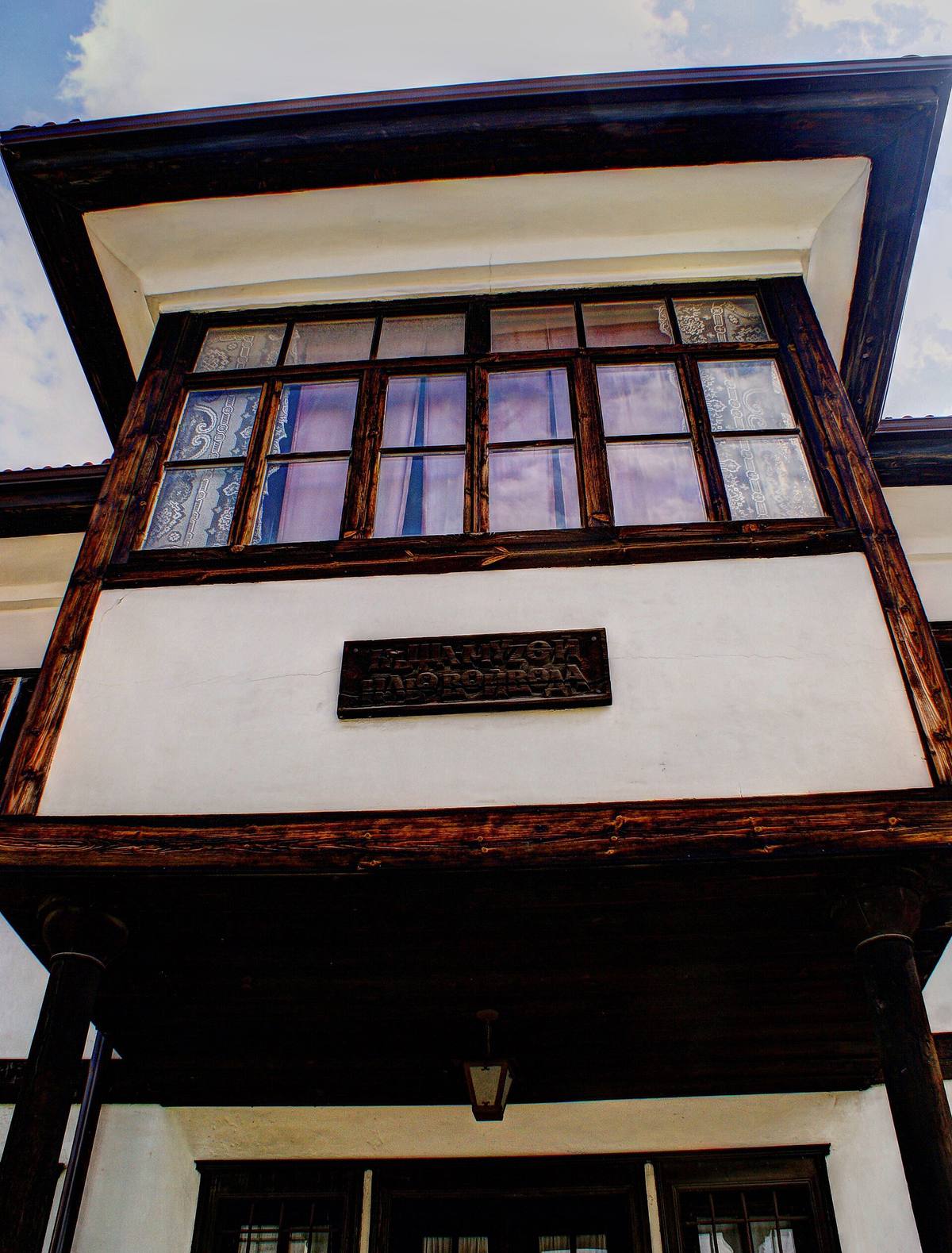
↗The house was built in the 1870s on the Straight Street, today’s Tsar Osvoboditel Street, “at the back of a narrow, steep plot, facing northwest” toward the bustle of the street. The plan is symmetrical, “emphasized by the bay above the entrance.” The ground floor is of rough stone with timber bands; the upper floor is white, under broad eaves.
It was restored in 1979-1980 and opened as a museum in January 1981. Together with the restored houses of Konstantin Popgeorgiev and Tonche Kadinmostki, and with the 1979 granite monument (sculptor Stefan Stoimirov, architect Yuliy Farkov), it forms a Revival-era memorial complex.
The exhibition
↗The exhibition, The National Liberation Struggles of the People of the Kyustendil Region, follows the Bulgarians’ struggles here from the 15th century to the Liberation. It fills six halls covering 150 m², with about 800 exhibits. Its themes are:
- the life and deeds of Ilyo Voyvoda;
- the Razlovtsi Uprising of May 1876;
- the volunteers of the Kyustendil region in the Bulgarian militia;
- the town’s liberation in January 1878.
The sixth hall opened in October 2003. It shows Kyustendil’s role in the struggles for the liberation of Macedonia, up to the early 1950s.
Remembrance
↗In 1978 Ilyo Voyvoda was named an honorary citizen of Kyustendil. His bronze bust by Dragan Lozenski was put up in the 1930s at the old timber market and moved in 2018 to the garden opposite the Town Hall. In January 1946 Kyustendil students published a one-off newspaper, Grandfather Ilyo Voyvoda. A quarter of the town and a school bear his name.
Photos and related images
The image could not load. Its caption and source remain available.

The image could not load. Its caption and source remain available.

The image could not load. Its caption and source remain available.

The image could not load. Its caption and source remain available.

The image could not load. Its caption and source remain available.

Sources
(14)
A date may refer to construction, renewal, or another stated stage. Legends are accounts recorded in sources, rather than established events. Bibliography links help locate the named author; no automatic reference is added where the match is ambiguous.
- Къща музей „Ильо Войвода“, РИМ, КюстендилInstitutional page · Bulgarian · kyustendilmuseum.bg
Source address
https://kyustendilmuseum.bg/muzeyni-obekti-na-rim-kyustendil/kashta-muzey-ilyo-voyvoda.html
If a link does not open, use its title, author, and address to search, or consult another listed source.
- Йорданка Янчева. Брезнишката битка и Радомирският отряд за изхода на Сръбско-българската война, 1885 г. Кюстендилски четения 6, СУ, 2006, 146-149Research publication · Bulgarian · periodicals.uni-sofia.bg↑1
Source address
https://periodicals.uni-sofia.bg/index.php/KRe/bg/article/view/kre-2005-16
If a link does not open, use its title, author, and address to search, or consult another listed source.
- Цени и работно време, РИМ, КюстендилInstitutional page · Bulgarian · kyustendilmuseum.bg
Source address
https://kyustendilmuseum.bg/za-muzeya/ceni-i-rabotno-vreme.html
If a link does not open, use its title, author, and address to search, or consult another listed source.
- Fund History of the Bulgarian lands 15th-19th century, RHM KyustendilInstitutional page · English · en.kyustendilmuseum.bg
Source address
https://en.kyustendilmuseum.bg/funds-collections/fund-history-of-the-bulgarian-lands-15th-19th-century.html
If a link does not open, use its title, author, and address to search, or consult another listed source.
- Христо Македонски. Записки, гл. 1: Защо станах хайдутин, УикиизточникOnline source · Bulgarian · bg.wikisource.org
Source address
https://bg.wikisource.org/wiki/Записки_на_Христо_Македонски:_1.Защо_станах_хайдутин
If a link does not open, use its title, author, and address to search, or consult another listed source.
- Христо Македонски. Записки, гл. 23: Сражения, УикиизточникOnline source · Bulgarian · bg.wikisource.org
Source address
https://bg.wikisource.org/wiki/Записки_на_Христо_Македонски:_23.Сражения
If a link does not open, use its title, author, and address to search, or consult another listed source.
- Христо Македонски. Записки, гл. 25: Допълнение към записките ми, УикиизточникOnline source · Bulgarian · bg.wikisource.org
Source address
https://bg.wikisource.org/wiki/Записки_на_Христо_Македонски:_25.Допълнение_към_записките_ми
If a link does not open, use its title, author, and address to search, or consult another listed source.
- Песен за Ильо войвода, УикиизточникOnline source · Bulgarian · bg.wikisource.org
Source address
https://bg.wikisource.org/wiki/Песен_за_Ильо_войвода
If a link does not open, use its title, author, and address to search, or consult another listed source.
- Почетни граждани на Кюстендил, Община КюстендилInstitutional page · Bulgarian · kyustendil.bg
Source address
https://www.kyustendil.bg/index.php?option=com_content&view=article&id=171&Itemid=318&lang=bg
If a link does not open, use its title, author, and address to search, or consult another listed source.
- Ильо войвода, УикипедияEncyclopedia article · Bulgarian · bg.wikipedia.org
Source address
https://bg.wikipedia.org/wiki/Ильо_войвода
If a link does not open, use its title, author, and address to search, or consult another listed source.
- Къща музей „Ильо войвода“, УикипедияEncyclopedia article · Bulgarian · bg.wikipedia.org
Source address
https://bg.wikipedia.org/wiki/Къща_музей_„Ильо_войвода“
If a link does not open, use its title, author, and address to search, or consult another listed source.
- Дедо Иљо Малешевски, Википедија (мк)Encyclopedia article · Macedonian · mk.wikipedia.org
Source address
https://mk.wikipedia.org/wiki/Дедо_Иљо_Малешевски
If a link does not open, use its title, author, and address to search, or consult another listed source.
- Ilyo Voyvoda, WikipediaEncyclopedia article · English · en.wikipedia.org
Source address
https://en.wikipedia.org/wiki/Ilyo_Voyvoda
If a link does not open, use its title, author, and address to search, or consult another listed source.
- Wikidata: Къща музей „Ильо войвода“ (Q12284497)Online source · Bulgarian · wikidata.org
Source address
https://www.wikidata.org/wiki/Q12284497
If a link does not open, use its title, author, and address to search, or consult another listed source.