Georgi Goranov's House
Goranov's birthplace (1882); restored in the 1980s
Dating stated in the sources: 1882
Your visit at a glance
- Address
- 2 Georgi Goranov St.
- Approximate time at the site
- about 10 minutes
- Opening hours
- No verified information found
- Admission
- No verified information found
The image could not load. Its caption and source remain available.

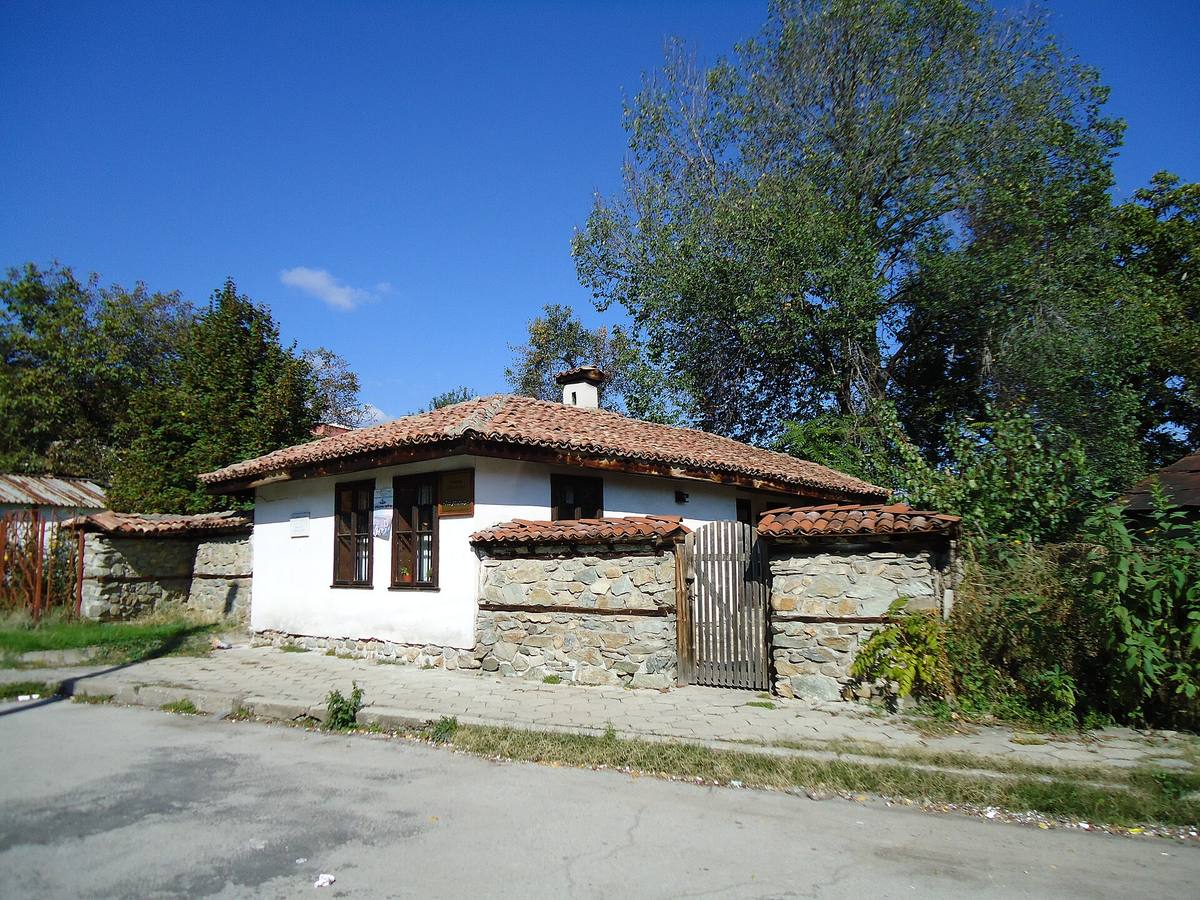
The low white house at 2 Georgi Goranov Street is the birthplace of the composer Georgi Goranov (1882-1905), who wrote the music of "Druzhna Pesen," also known as the "Song of Labor." It was restored in the 1980s and holds a small museum collection.
Hours, admission, and directions ↓
A small single-story house with a tiled roof, a stone wall, and a wooden gate, on a quiet side street in the eastern part of town. Georgi Goranov was born here on May 20, 1882. He lived only 23 years, and Struma writes that with one song he “entered the history of our musical culture forever.”
The composer
↗His real name was Georgi Dimitrov Yovev. His parents, Yordanka and Dimitar Yovevi, were Macedonian Bulgarians who had moved from the village of Virche in the Pijanec region, Bulgarian Wikipedia writes, citing the newspaper Struma. The family was poor. Struma (2023) describes their home as “the little low house in the Adzhundar quarter, built right behind the Daskal Dimitri school.”
Goranov graduated from the Pedagogical School in Kyustendil in 1902 (the building is now the Town Hall). As a musician he developed under the influence of his teacher Karel Mahan, and as a student he was a member of the secret Macedonian-Adrianople student circle “Osvobozhdenie” (Liberation), founded in 1897. Wikipedia gives these facts from the Encyclopedic Dictionary of Kyustendil (Bulgarian Academy of Sciences Press, 1988). Mahan was Czech and came to the school in 1900, Struma writes.
In his short life he wrote about 80 songs, instrumental pieces, and orchestral works, among them waltzes, mazurkas, polkas, and pieces for mandolin orchestra and violin. The Encyclopedic Dictionary calls him the author of “Druzhna Pesen” and of “Hubava si, moya goro” (“You Are Beautiful, My Forest”); Struma describes the latter as a medley for mandolin orchestra.
He wanted to study music in Zagreb, but tuberculosis brought him home. The year differs between sources: the Encyclopedic Dictionary says 1902, while Struma and the blog Probuzhdane say September 1903. According to them, he stayed in Zagreb for about a month and was not admitted to the conservatory because of his illness.
He died on December 23, 1905 (Old Style). Struma notes that at his funeral, for the first time in Kyustendil’s history, a military band played at the funeral of a civilian.
“Druzhna Pesen”
↗The words are by Georgi Kirkov. The Encyclopedic Dictionary calls the song “Druzhna Pesen,” or “Pesen na Truda” (“Song of Labor”), and dates it to 1900. Its first line is “Druzhna pesen dnes da ekne” (“Let a song in unison ring out today”).
According to Struma, the 18-year-old Goranov worked on the tune in the hot summer of 1900 and wrote seven versions before choosing the best one. The song is for a four-part male choir. It was first performed in public on May 24, 1903, in Kyustendil. By 1904 it had reached Sofia, and by 1905 it was being sung at May Day meetings across the country.
Struma calls it “the Bulgarian Marseillaise” and writes that it became the anthem of the working class. The blog Probuzhdane draws on the memoirs of Goranov’s friend Todor Tsekov and on Petar Lyondev’s book about the composer (Kyustendil, 1964).
The house
↗The house is described in the Encyclopedic Dictionary, which Wikipedia follows:
- One story. On both sides of the yard gate there are niches to sit in.
- The north part of the plot. Here are a small farm building and the dwelling: the vkashti (the main room) with its fireplace, and a bedroom.
- The south part. There was a flower garden here. It was cut off in the early 20th century, when the street was laid out.
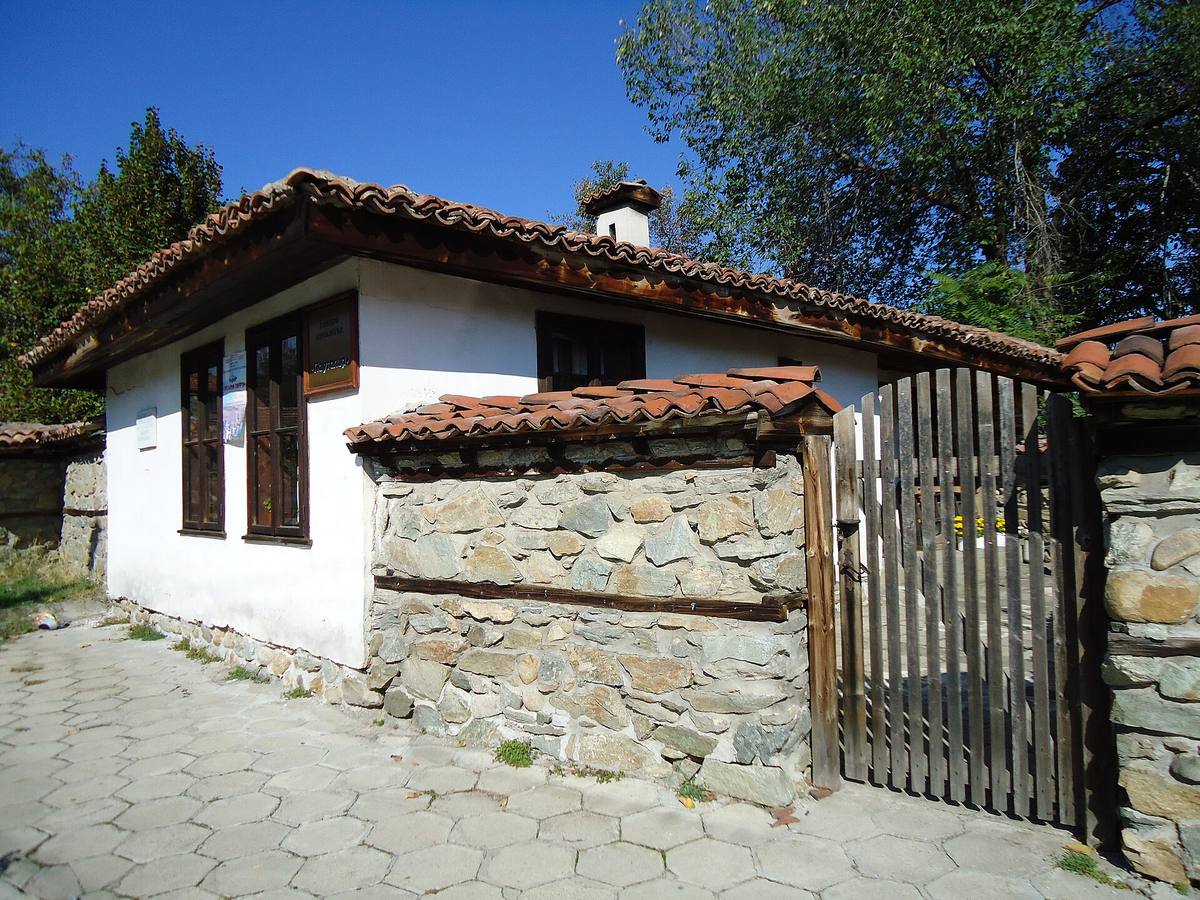
From outside, the house is white, on a low stone base, with a roof of red tiles and a chimney. Two windows with brown frames face the street. Beside the house is a stone wall with a small tiled roof and a plank gate.
Museum and monument
↗The house was restored in the 1980s. It holds a small museum collection on the composer’s life and work. The Encyclopedic Dictionary calls it a cultural monument of local importance.
In 2002, by decision of the Municipal Council, a memorial plaque was placed on the house, BNR reports. On May 1, socialists from Kyustendil traditionally lay flowers there.
His name is carried by the street and by the Georgi Goranov Children’s Music School, which the website of the Bratstvo 1869 community center (chitalishte) writes about. Around his birthday, May 20, the community center puts on photo-documentary exhibitions about him (in 2023 and 2025).
Today
↗We could not find out who looks after the house, nor any published visiting hours. The Regional History Museum does not list it among its sites. The exhibitions of recent years were held in the community center, not in the house.
The house can be seen well from the street. It is about 600 m east of Velbazhd Square and about 240 m from the Roman Thermae, so it is easy to combine with them.
Photos and related images
The image could not load. Its caption and source remain available.

Sources
(11)
A date may refer to construction, renewal, or another stated stage. Legends are accounts recorded in sources, rather than established events. Bibliography links help locate the named author; no automatic reference is added where the match is ambiguous.
- Къща на Георги Горанов (Кюстендил), Уикипедия (по Енциклопедичен речник Кюстендил, Изд. на БАН, 1988, с. 334)Encyclopedia article · Bulgarian · bg.wikipedia.org
Source address
https://bg.wikipedia.org/wiki/Къща_на_Георги_Горанов_(Кюстендил)
If a link does not open, use its title, author, and address to search, or consult another listed source.
- Георги Горанов, Уикипедия (по Енциклопедичен речник Кюстендил, Изд. на БАН, 1988, с. 138)Encyclopedia article · Bulgarian · bg.wikipedia.org
Source address
https://bg.wikipedia.org/wiki/Георги_Горанов
If a link does not open, use its title, author, and address to search, or consult another listed source.
- Живот, кратък като песен! Георги Горанов, композиторът от Кюстендил, вестник „Струма“, 2023Online source · Bulgarian · struma.bg
Source address
https://struma.bg/%D0%B6%D0%B8%D0%B2%D0%BE%D1%82-%D0%BA%D1%80%D0%B0%D1%82%D1%8A%D0%BA-%D0%BA%D0%B0%D1%82%D0%BE-%D0%BF%D0%B5%D1%81%D0%B5%D0%BD-%D0%B3%D0%B5%D0%BE%D1%80%D0%B3%D0%B8-%D0%B3%D0%BE%D1%80%D0%B0%D0%BD%D0%BE/
If a link does not open, use its title, author, and address to search, or consult another listed source.
- Георги Горанов, блог „Пробуждане“, 2014Online source · Bulgarian · probuzhdane.wordpress.com
Source address
https://probuzhdane.wordpress.com/2014/03/30/georgi-goranov/
If a link does not open, use its title, author, and address to search, or consult another listed source.
- Почетоха паметта на Георги Горанов, БНР Благоевград, 2025Online source · Bulgarian · bnrnews.bg
Source address
https://bnrnews.bg/blagoevgrad/post/213308/pochetoha-pametta-na-georgi-goranov
If a link does not open, use its title, author, and address to search, or consult another listed source.
- Фотодокументална изложба за Георги Горанов, читалище „Братство 1869“, 2025Online source · Bulgarian · bratstvokn.org
Source address
http://www.bratstvokn.org/index.php?option=com_content&view=article&id=1898
If a link does not open, use its title, author, and address to search, or consult another listed source.
- Фотодокументална изложба за Георги Горанов, читалище „Братство 1869“, 2023Online source · Bulgarian · bratstvokn.org
Source address
http://www.bratstvokn.org/index.php?option=com_content&view=article&id=1610
If a link does not open, use its title, author, and address to search, or consult another listed source.
- Цигулка (Детска музикална школа „Георги Горанов“), читалище „Братство 1869“Online source · Bulgarian · bratstvokn.org
Source address
http://www.bratstvokn.org/index.php?option=com_content&view=article&id=85
If a link does not open, use its title, author, and address to search, or consult another listed source.
- Цени и работно време, РИМ, КюстендилInstitutional page · Bulgarian · kyustendilmuseum.bg
Source address
https://kyustendilmuseum.bg/za-muzeya/ceni-i-rabotno-vreme.html
If a link does not open, use its title, author, and address to search, or consult another listed source.
- Къща-музей на Георги Горанов, opoznai.bgOnline source · Bulgarian · opoznai.bg
Source address
https://opoznai.bg/view/kashta-na-georgi-goranov-kiustendil
If a link does not open, use its title, author, and address to search, or consult another listed source.
- OpenStreetMap: ул. „Г. Горанов“Map record · Bulgarian · openstreetmap.org
Source address
https://www.openstreetmap.org/way/182868373
If a link does not open, use its title, author, and address to search, or consult another listed source.