The Iron Bridge
1909; rebuilt in 1969
Dating stated in the sources: 1909
Your visit at a glance
- Address
- Bulgaria Blvd., over the Banshtitsa River
- Approximate time at the site
- about 10 minutes
- Visiting conditions
- No verified information found
- Admission
- No verified information found
The image could not load. Its caption and source remain available.

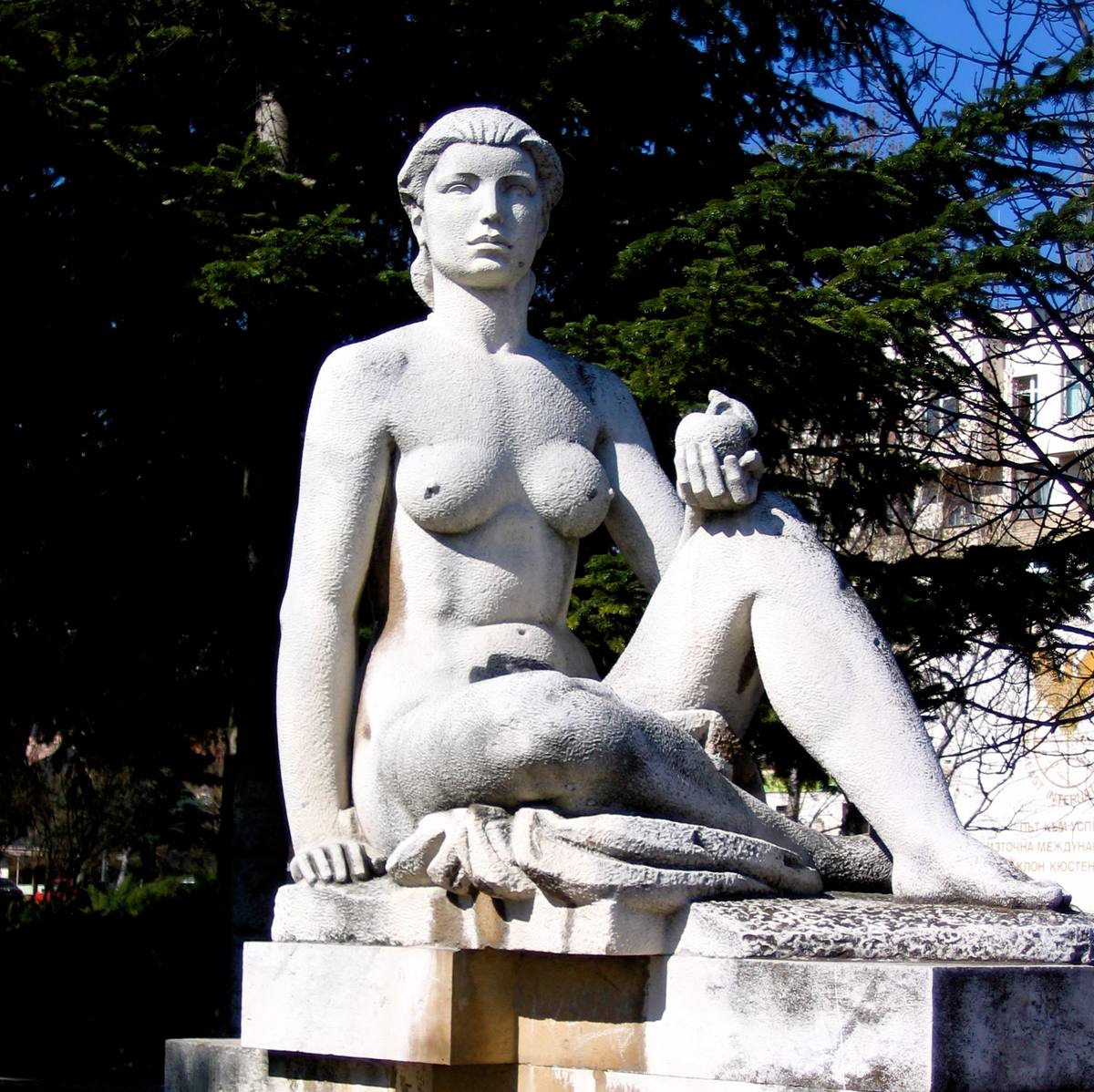
The bridge over the Banshtitsa on Bulgaria Boulevard was built in 1909 to a design by the architect Rudolf Fischer, to link the town center with the new railway station. In 1969 it was rebuilt in reinforced concrete and given four nude female figures in white Vratsa stone by the sculptor Lyuben Dimitrov. That is why locals also call it "the Bridge with the Naked Women."
Your photographs are welcome
We do not yet have an illustration of this sight. We would be delighted to receive your photographs to help us show it in the guide.
Send a photograph by email Please name the photographer and say whether we may publish it on the website. You can write to info@manifaktura.eu.
Hours, admission, and directions ↓
If you come to Kyustendil by train, you cross it on your way into the center. The bridge carries Bulgaria Boulevard over the Banshtitsa River, between the station and the central square. It has kept the name of the first bridge, although it is concrete today. Most people remember it for the four stone women at its ends.
A bridge to the station
↗The railway came to Kyustendil in 1909. The station opened that year, when the Radomir-Kyustendil line went into service, BNT reports (2024). But it stood far from the town center of the time, and a boulevard had to be built to reach it.
The bridge was part of that project. The municipality writes that it was built in 1909 to a design by the architect Rudolf Fischer, and that “its construction was part of a larger project to connect the center of Kyustendil with the railway station.” Bulgarian Wikipedia gives the same year and the same architect, citing the Encyclopedic Dictionary of Kyustendil (Bulgarian Academy of Sciences Press, 1988). According to Wikipedia, the first bridge was made of steel; the name has stayed from it.
The Banshtitsa is the river that runs through the town. It is also called the Banska River: that is how Ekaterina Keremidarska and Mihal Nikolov write it in Kyustendil Readings, published by Sofia University (1996), and so does the National Gallery.
The Nish Gate
↗Bulgarian Wikipedia writes that just south of the bridge stood the northern gate of the Ottoman town, known as the Nish Gate. From here the Nish Road ran north through the Kraishte region toward Niš, the birthplace of Constantine the Great. Wikipedia gives no source for this, however.
The architect Rudolf Fischer
↗Fischer was Czech. The newspaper Trud (2015) writes that he was then the chief architect of Kyustendil. At an open day in 2019, the State Archives in Kyustendil explained that the town’s European look is owed to two town architects:
- Libur Bayer, who drew the first town plan after the Liberation;
- Rudolf Fischer, who “designed some of the buildings in the town center, the iron bridge, and the station building.”
His other works:
- The station, opened in 1909 (BNT).
- The Chifte Bath, which he completed in 1912-1913 (Trud).
- The house of Ivan Stradalski on Tsar Osvoboditel Street, built in 1911 to his design. Veska Spasova of the Regional History Museum (Muzeen Vestnik, 2026) writes that “Fischer’s hand shows” in the house of Todor Raychilovski as well, the old Dragoman Hotel at 37 Demokratsia Street. She writes that Viennese and Czech architects were working in the town in 1905-1911.
- The Holy Trinity church-ossuary in Gyueshevo, built in 1925-1930. According to Wikipedia, Fischer directed the construction.
We could not find Fischer’s years of birth and death.
1969: concrete and stone
↗In 1969 the bridge was rebuilt and widened with a reinforced-concrete structure. That is when it got its sculptures. According to the municipality, four columns at the two ends of the bridge carry sculptures of women, made of white Vratsa stone in 1969 by Lyuben Dimitrov.
The women are nude. Hence the nickname “the Bridge with the Naked Women.” Today two lanes of traffic cross the bridge, with a separate walkway for pedestrians beside them.
The sculptor Lyuben Dimitrov
↗Lyuben Dimitrov (1904-2000) was born in Musina. He graduated in sculpture from the Academy of Art in 1930, under Ivan Lazarov. Among his best-known works are:
- the lions in front of the Sofia University library (1932);
- the composition “All Quiet on Shipka” in the Shipka ossuary (1957);
- the monument to Hadzhi Dimitar on Buzludzha (1961).
The National Gallery writes that he taught at the Academy of Art from 1939 to 1975; Wikipedia gives 1954 as the start. In 1969, the year of the Kyustendil figures, he became a professor and was named an Honored Artist.
In 2024-2025 the National Gallery showed a large exhibition of his work at Kvadrat 500. Its list of his works includes “the figures on the bridge over the Banska River in Kyustendil (1969).”
Today
↗The bridge is an ordinary part of town life: people cross it to reach the station and the museum’s archaeological exhibition. It is worth stopping for a few minutes to look at the sculptures. Judging by the photo on Wikipedia, one of them sits holding an apple. We could not find out what the four represent together.
Sources
(13)
A date may refer to construction, renewal, or another stated stage. Legends are accounts recorded in sources, rather than established events. Bibliography links help locate the named author; no automatic reference is added where the match is ambiguous.
- Недвижимо културно наследство, Община Кюстендил, 2017Institutional page · Bulgarian · kyustendil.bg
Source address
https://kyustendil.bg/index.php?Itemid=273&id=119&lang=bg&option=com_content&view=article
If a link does not open, use its title, author, and address to search, or consult another listed source.
- Железен мост (Кюстендил), Уикипедия (по Енциклопедичен речник Кюстендил, Изд. на БАН, 1988, с. 219)Encyclopedia article · Bulgarian · bg.wikipedia.org
Source address
https://bg.wikipedia.org/wiki/Железен_мост_(Кюстендил)
If a link does not open, use its title, author, and address to search, or consult another listed source.
- Любен Димитров (1904-2000), изложба, Национална галерия, 2024-2025Online source · Bulgarian · nationalgallery.bg
Source address
https://nationalgallery.bg/bg/exhibitions/lyuben-dimitrov-1904-2000/
If a link does not open, use its title, author, and address to search, or consult another listed source.
- Мадони и лъвици на Любен Димитров властват 5 месеца в „Квадрат 500“, Сега, 2024Online source · Bulgarian · segabg.com
Source address
https://www.segabg.com/category-culture/madoni-i-luvici-na-lyuben-dimitrov-vlastvat-5-meseca-kvadrat-500
If a link does not open, use its title, author, and address to search, or consult another listed source.
- Любен Димитров (скулптор), УикипедияEncyclopedia article · Bulgarian · bg.wikipedia.org
Source address
https://bg.wikipedia.org/wiki/Любен_Димитров_(скулптор)
If a link does not open, use its title, author, and address to search, or consult another listed source.
- 10 000 крачки: Сградата на жп гарата в Кюстендил, БНТ, 2024Online source · Bulgarian · bnt.bg
Source address
https://bnt.bg/news/sgradata-na-zhp-garata-v-kyustendil-326763news.html
If a link does not open, use its title, author, and address to search, or consult another listed source.
- Показаха общия градоустройствен план на Кюстендил от 1924 г. (Държавен архив, Кюстендил), Инфомрежа, 2019Online source · Bulgarian · infomreja.bg
Source address
https://infomreja.bg/pokazaha-obshtiq-gradoustrojstven-plan-na-kiustendil-ot-1924-g-69714.html
If a link does not open, use its title, author, and address to search, or consult another listed source.
- Кирил Фалин. Реквием за Чифте баня, Труд, 2015Online source · Bulgarian · trud.bg
Source address
https://trud.bg/a/articles/article-4646393
If a link does not open, use its title, author, and address to search, or consult another listed source.
- Веска Спасова. За величието и духа на старите кюстендилски къщи, Музеен вестник, бр. 28, РИМ, Кюстендил, 2026PDF document · Bulgarian · kyustendilmuseum.bg
Source address
https://kyustendilmuseum.bg/uploads/MUZEEN_VESTNIK_2026_cveten_3.pdf
If a link does not open, use its title, author, and address to search, or consult another listed source.
- Света Троица (Гюешево), УикипедияEncyclopedia article · Bulgarian · bg.wikipedia.org
Source address
https://bg.wikipedia.org/wiki/Света_Троица_(Гюешево)
If a link does not open, use its title, author, and address to search, or consult another listed source.
- Екатерина Керемидарска, Михал Николов. Отдихът и развлеченията на кюстендилци след Освобождението. Кюстендилски четения 3, СУ, 1996, 38-47Research publication · Bulgarian · periodicals.uni-sofia.bg
Source address
https://periodicals.uni-sofia.bg/index.php/KRe/bg/article/view/kre-1996a-06
If a link does not open, use its title, author, and address to search, or consult another listed source.
- Железният мост, opoznai.bgOnline source · Bulgarian · opoznai.bg
Source address
https://opoznai.bg/view/jelezniiat-most-kiustendil
If a link does not open, use its title, author, and address to search, or consult another listed source.
- OpenStreetMap: мостът на бул. „България“Map record · Bulgarian · openstreetmap.org
Source address
https://www.openstreetmap.org/way/182984921
If a link does not open, use its title, author, and address to search, or consult another listed source.