02Places of worship · Kolusha quarter
Medieval Church of St. George
11th-12th centuries
Dating stated in the sources: 11th-12th c.
Your visit at a glance
- Address
- 1 Kolusha St., Kolusha quarter
- Approximate time at the site
- about 45 minutes
- Opening hours
- Visit details
- Admission
- Visit details
The image could not load. Its caption and source remain available.

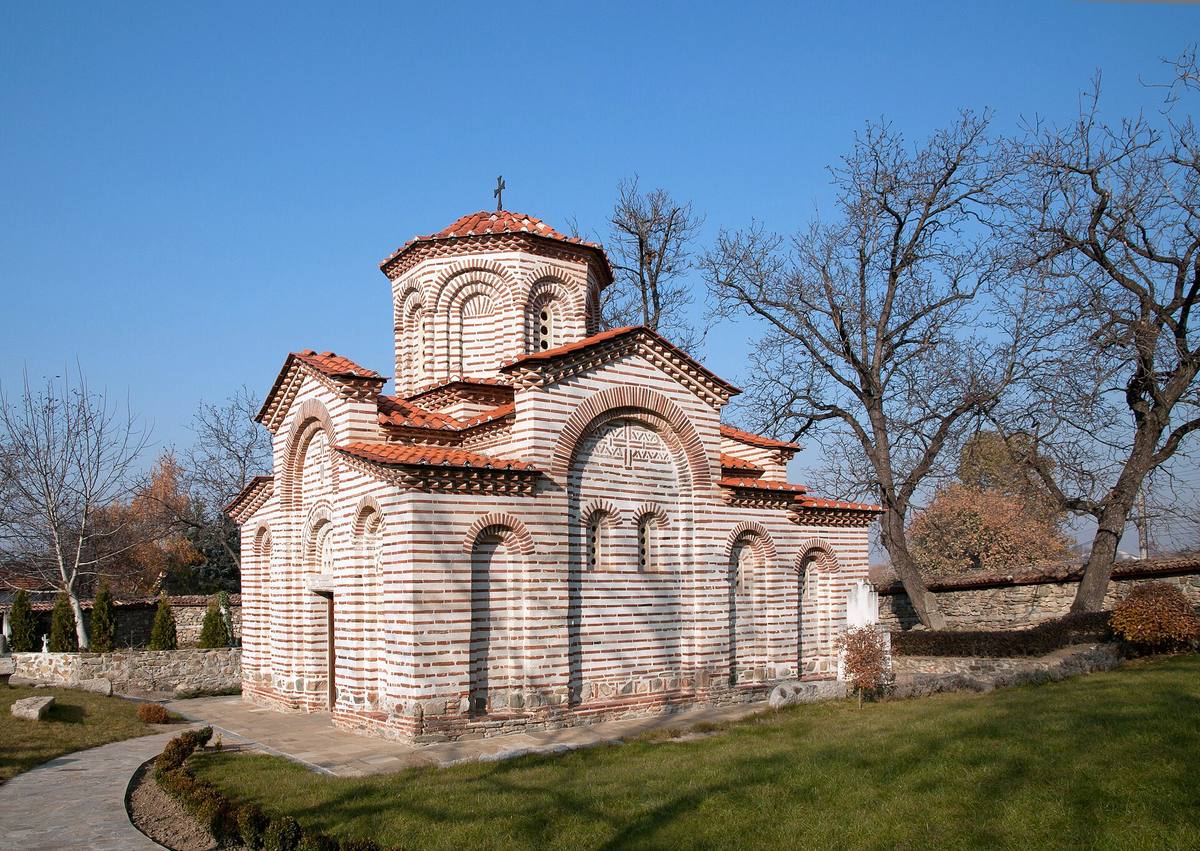
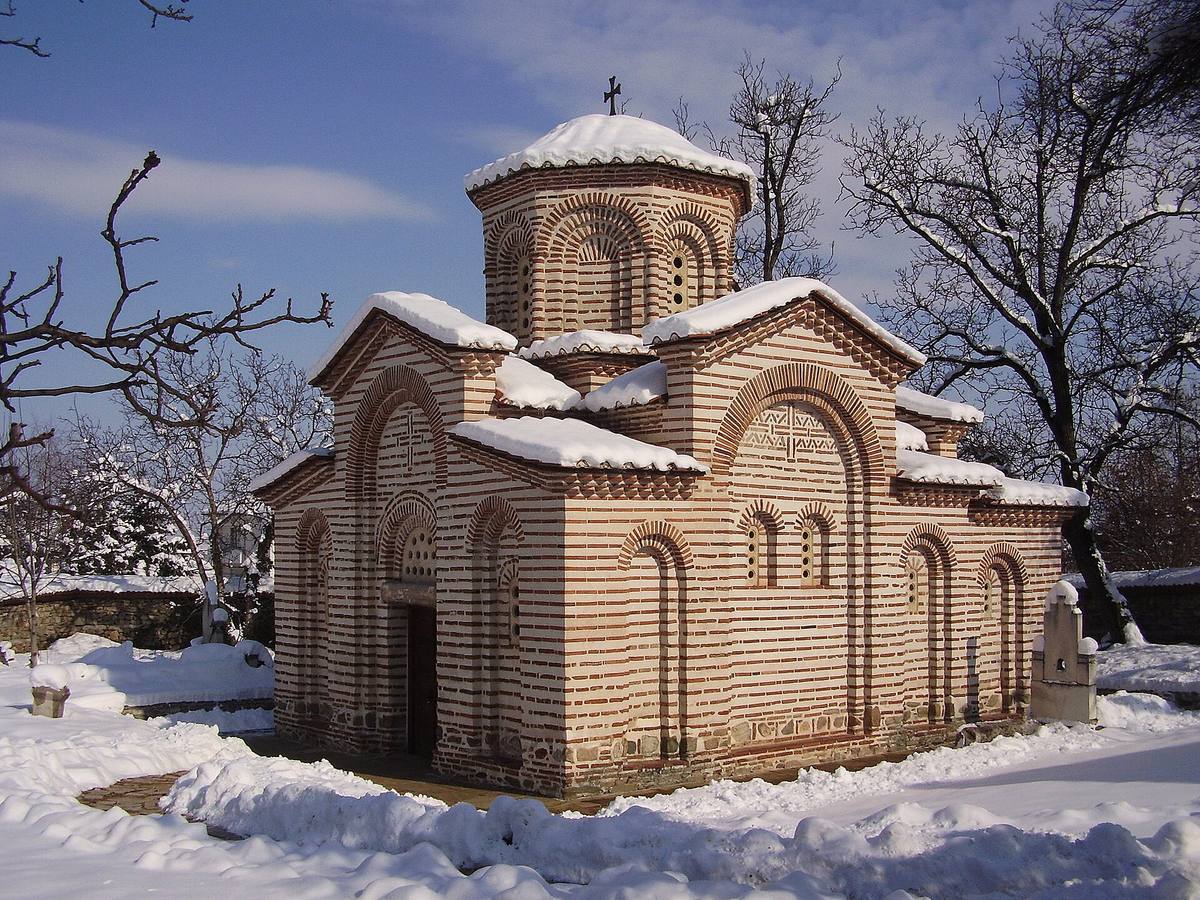
A small cross-in-square church in the Kolusha quarter, dated by the museum to the 11th-12th centuries; its precise construction period is disputed. It holds five layers of murals, among them a well-preserved image of St. Nicholas, and more than two hundred graffiti scratched by visitors over the centuries. It is also tied to a local legend: the grave of Tsar Mihail III Shishman.
Hours, admission, and directions ↓
The church stands in Kolusha, once a separate village at the foot of the Osogovo Mountains that became part of Kyustendil only in 1939. It is no longer a working church but a museum run by the Regional History Museum in Kyustendil.
The church that was “St. Nicholas”
↗The name St. George came later. In the Middle Ages the church was dedicated to St. Nicholas of Myra. Two royal charters call it “the metochion of St. Nicholas in Velbuzhd, at Kolusha”: the Virgino Charter of Tsar Konstantin Tih Asen and the 1299-1300 charter of the Serbian King Stefan Uroš II Milutin. A metochion was a dependency of a larger monastery, in this case St. George Gorgos near Skopje.
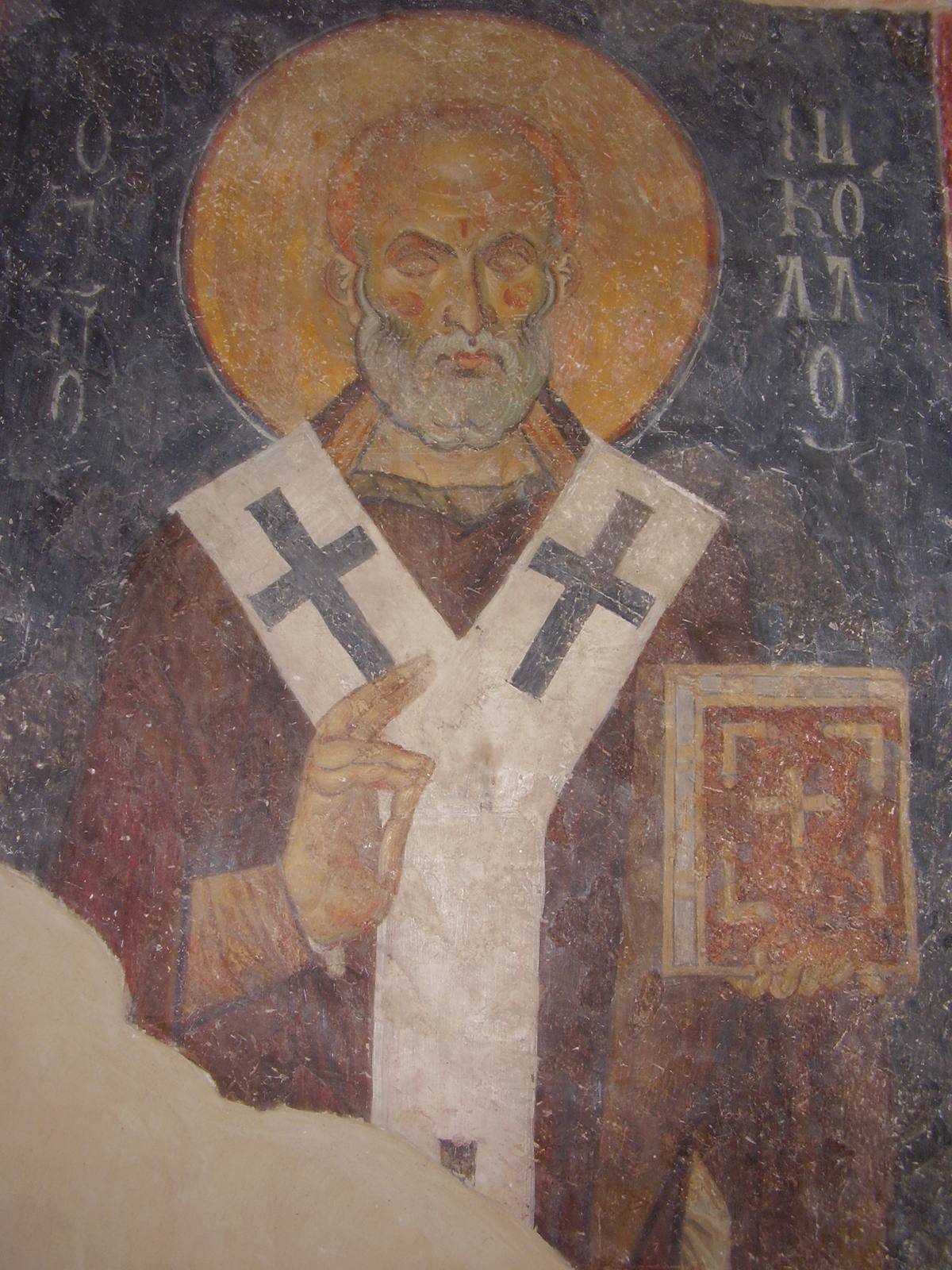
The art historian Lilyana Mavrodinova established the original dedication. In a 2008 article in the Athens journal Deltion of the Christian Archaeological Society, she writes that St. Nicholas is painted on the west face of the northeast pier under the dome, in front of the altar. That is the place traditionally reserved for the patron saint of a church. On the Gospel book in his hand the restorers found traces of gold leaf, which in her view prove the donor’s high rank. Exactly when the church changed its name is not known.
Mavrodinova also explains who founded the monastery the church belonged to. The Bulgarian charter names its first donor “the holy king Romanos,” and Milutin’s “king Diogenes.” So she accepts the view of the Russian scholar Grigory Ilyinsky that this was the Byzantine emperor Romanos IV Diogenes. Before he became emperor, he had been duke and strategos of the regions of Sredets and Velbazhd.
When it was built
↗The date is disputed. The museum places it in the 11th-12th centuries. Some authors argue for the late 10th or early 11th century, others for the mid-11th, and the Ministry of Culture’s list gives the 12th-13th centuries.
In the 15th century Kolusha became the seat of the Velbazhd bishopric, which took the village’s name: the bishopric of Kolasia. Its metropolitans kept the title “of Kolasia” until the second half of the 18th century. The art historian Desislava Strahilova writes that the people of Kyustendil used the church as their cathedral until 1816, when the town’s first Revival-era church was built. That church is today’s Church of the Assumption. [8]
The architecture
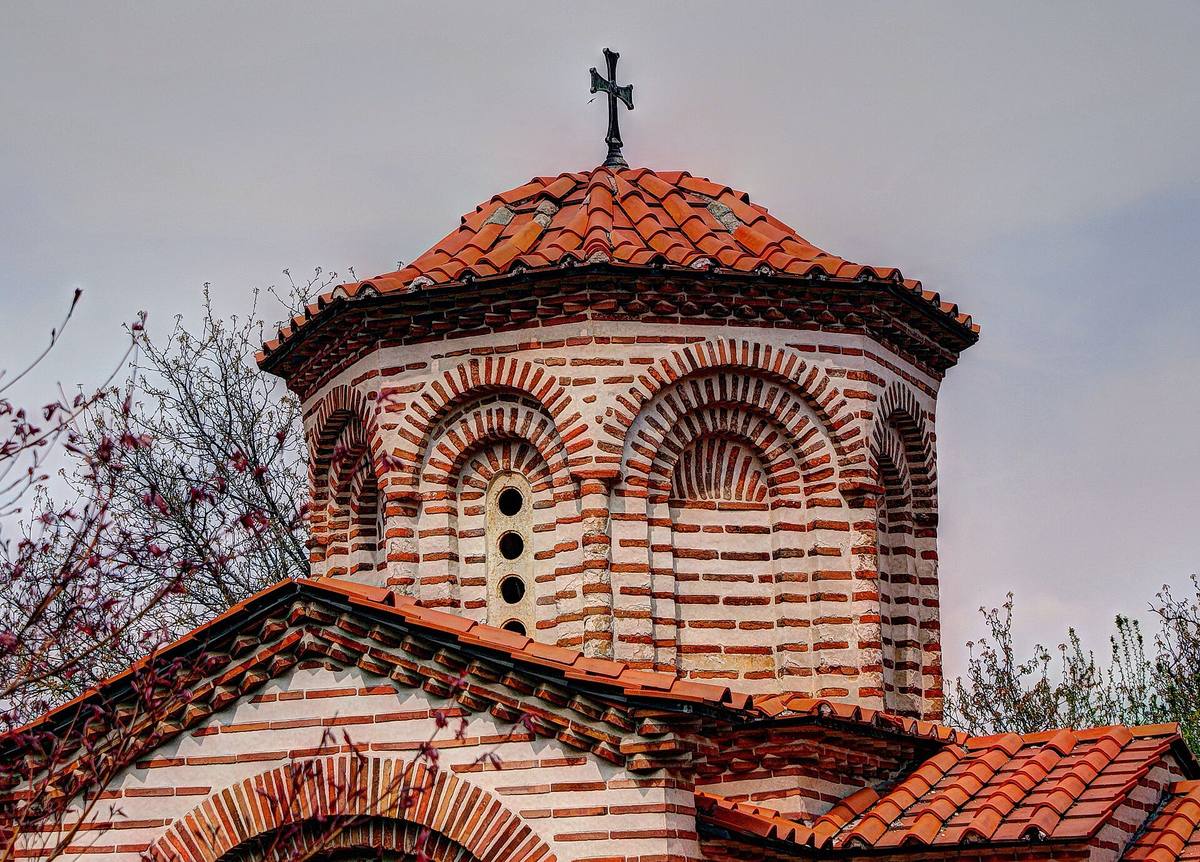
↗The church has a cross-in-square plan, called the “Constantinople” type because it came from the Byzantine capital. It is 10 m long without the narthex, 8.70 m wide, and 9.86 m high, with three semicircular apses. The dome rests on four solid piers, and two more piers extend the sanctuary to the east (according to Mavrodinova). Above them rises the dome on an octagonal drum with eight arched bays, four of which are windows.
The walls are its most striking feature. They are built in the “hidden courses” technique: every other row of bricks is set back and covered with mortar, which gives the façades their red-and-white stripes. Under the eaves runs a double brick cornice of the “wolf’s tooth” type. The builders also reused stones and columns from ancient Pautalia, and fragments of them are displayed around the church.
The museum compares it with three churches of the same period: St. John the Theologian at the Zemen Monastery, St. Archangel Michael near the Rila Monastery, and St. Dimitar at Patalenitsa.
Five layers of murals
↗The murals were painted in five different periods, one on top of another:
- 11th century. Only small fragments of the first layer survive, traces of the red frames of some figures and of the dark background, Mavrodinova writes. The Kyustendil Chamber of Commerce study credits it with much more: the image of St. Nicholas and full-length saints in the altar (bishops, healers such as Cosmas and Damian and Panteleimon, warriors, and women saints). Mavrodinova, however, assigns St. Nicholas to the second layer.
- 12th century, covering the whole church, with inscriptions in Greek. Mavrodinova dates these murals to the first decades of the 12th century, under Emperor Alexios I Komnenos (1081-1118), and attributes them to painters from Thessaloniki, or at least their pupils from Ohrid. The scenes include the Melismos, the Christ Child on the paten, a symbol of the Eucharist. The restoration also uncovered fragments of the Vision of St. Eustathius Placidas and of the Forty Martyrs of Sebaste, on either side of the door in the west wall. The bishops and deacons in the altar have parallels at the churches of the Virgin Eleousa at Veljusa, St. Sophia in Ohrid, and St. Leontius at Vodoča, Luben Domozetski writes in Problemi na izkustvoto, the journal of the Institute of Art Studies at the Bulgarian Academy of Sciences (2014).
- Late 15th century. Only St. John the Baptist survives, with inscriptions in Church Slavonic.
- 1530s-1540s. St. John the Baptist again, and St. Sava of Serbia.
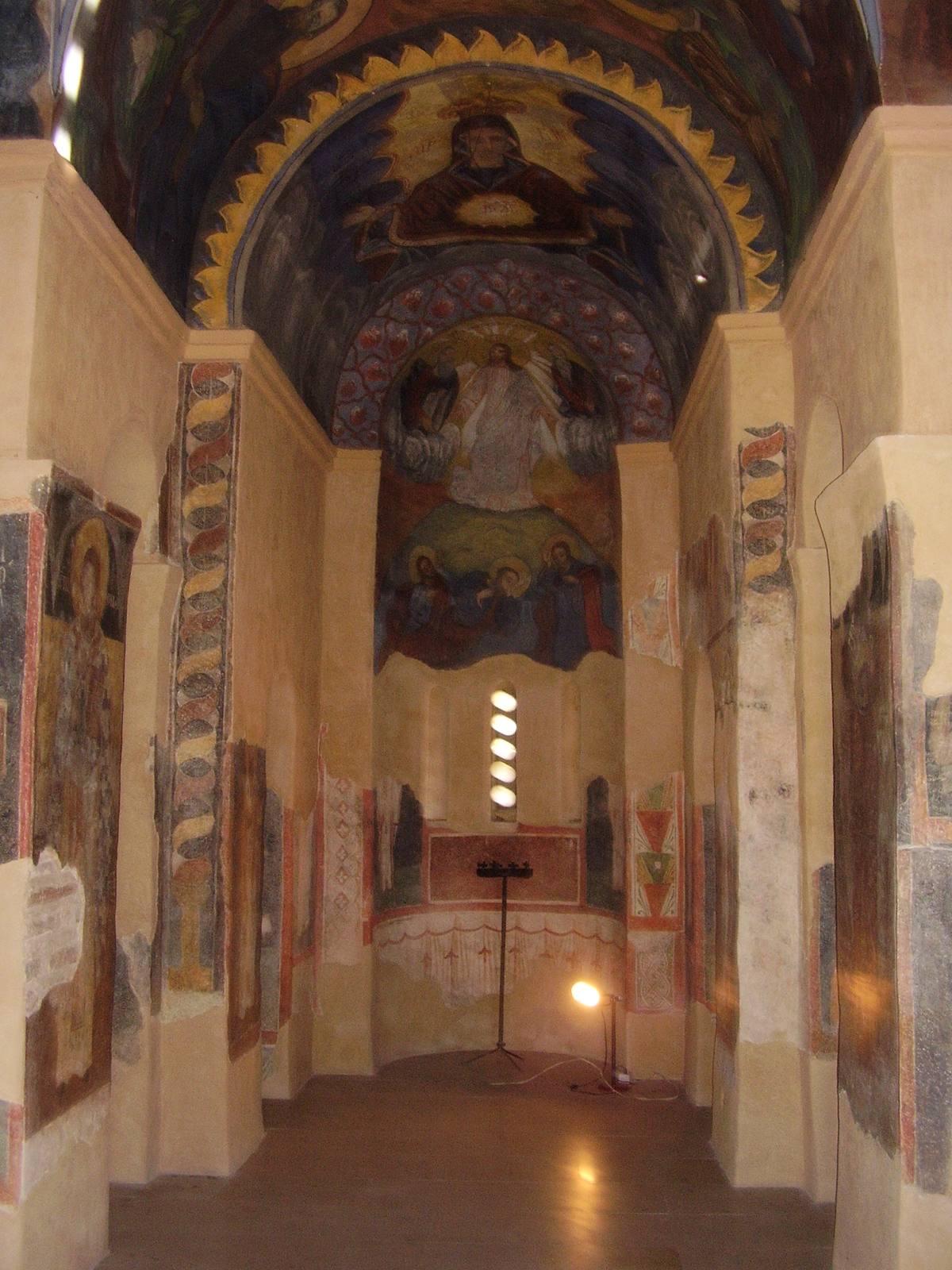
- 1878-1882. Revival-era painting that once covered everything. It survives high up and in the dome: God Sabaoth with the prophets David, Moses, Isaiah, and Jeremiah, and the Virgin of the Sign in the altar.
The image of St. Nicholas is the best preserved. The local press has called it one of the most valuable medieval murals in Bulgaria.
The last layer is the work of the Samokov masters Ivan Dospevski and Mihail Belostoynev, with Georgi Popaleksov of Debeli Lak. The repair and repainting after the Liberation were organized and paid for by a Kolusha notable, “grandfather” Stoyan Georgiev. Dospevski was more than a painter: after the Liberation he became the first mayor of Samokov and a member of the Constituent Assembly.
The graffiti
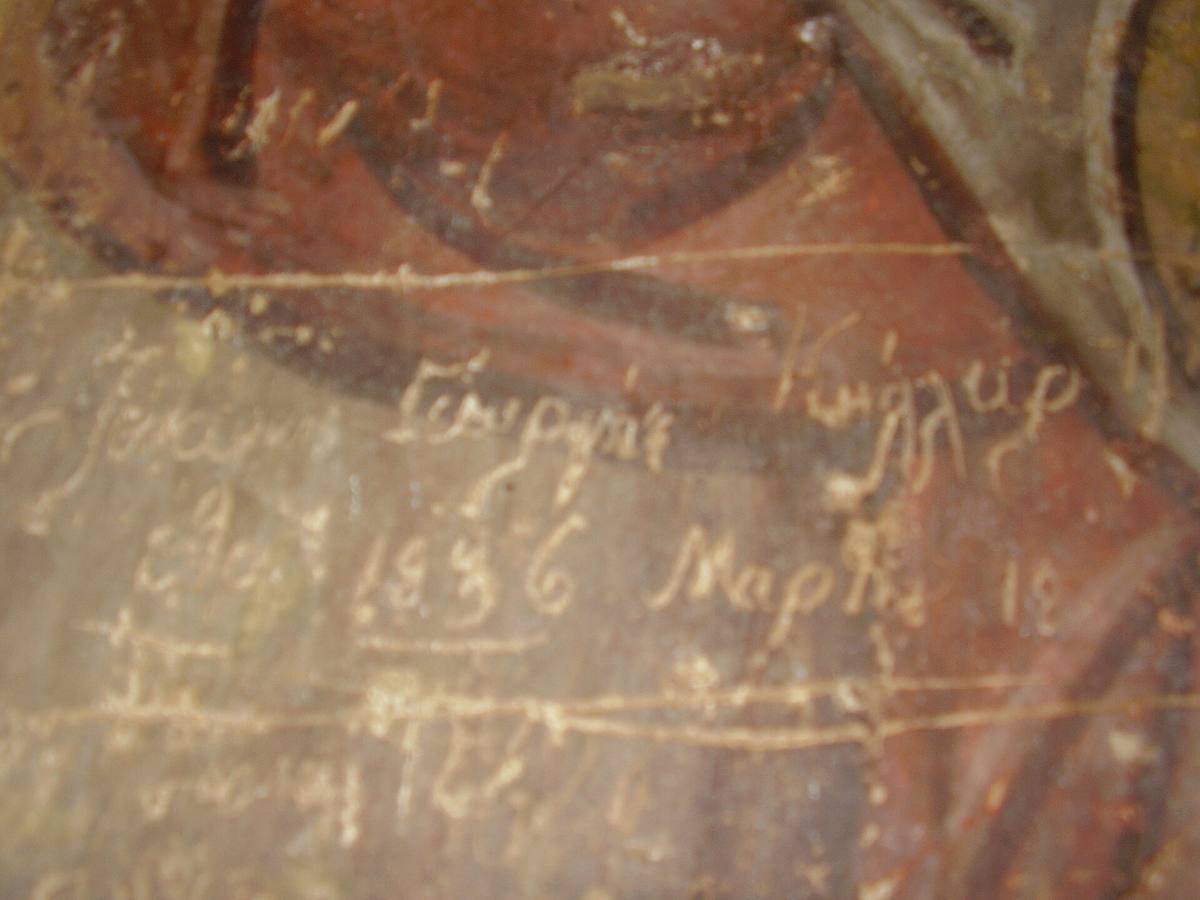
↗The walls carry 216 scratched drawings, as counted by Yavor Mitov, and about 100 inscriptions, left by visitors and locals over the centuries. The drawings are cut into the 12th-century murals: horsemen, people, horses, deer, dogs, crosses, and plant and sun symbols. There are also many ships, a curious subject so far from the sea. In an article in Problemi na izkustvoto (2014), Mitov sorts them into nine groups and, from the weapons and the types of ships, dates them most likely to the 12th-13th centuries. Some of the horsemen are drawn inside a pentagram. [3]
One inscription bears the year 1836. Yavor Mitov of the Regional History Museum has published 34 of the inscriptions, most of them from the 17th and 18th centuries. In 2022 the St. Kliment Ohridski University Press published his monograph on the church and its graffiti. [6]
Legends and traditions
↗The grave of Tsar Mihail III Shishman
On July 28, 1330, at the Battle of Velbazhd, the Bulgarian Tsar Mihail III Shishman was killed fighting the army of the Serbian King Stefan Dečanski. People in Kyustendil still say he is buried in the Kolusha church. The museum puts it carefully: “There is a supposition that the grave of the Bulgarian Tsar Mihail III Shishman is here.”
The story of that supposition is interesting in itself. Yordan Ivanov first proposed it in 1906, in a footnote to his book Northern Macedonia. He suggested that the Serbian chronicler had confused two churches of St. George: the one at Staro Nagoričane and the one at Kolusha, nearer the battlefield. He also cited the memory, kept by the people of Kolusha, of the grave of “a slain Bulgarian ruler.”
In 1931 Ivanov himself abandoned the idea. The evidence against Kolusha:
- The Serbian chronicler names Staro Nagoričane (now in North Macedonia) explicitly, and a tomb niche survives there high on the west wall.
- In 1330 the Kolusha church was dedicated to St. Nicholas, not St. George, so a mix-up of names is unlikely.
- The 1976 excavations inside the church found no rich burials.
Hypothesis or unconfirmed claim Bistra Nikolova of the Bulgarian Academy of Sciences also rejects the Kolusha version. Yavor Mitov concludes that the grave is at Staro Nagoričane. He notes, though, that the 1906 hypothesis “quickly” spread into local histories, newspapers, and museum talks. There is a third version too: according to Grigoriy Tsamblak, the tsar’s body was taken back to Tarnovo.
The curse
A local tale says that before the battle the tsar and his retinue entered the church armed: “They enter the house of God in full armor. The local people were outraged and cursed them.” According to the tale, the curse caused the defeat and the tsar’s death.
Place names from the battle
Around Kyustendil, people tell stories that explain place names through the tsar’s last day. At Bagrentsi, Shishman tore off his bagrenitsa, the royal purple mantle, and threw it down. At Shishmanitsa he was killed. And in Tsaropadalishte, a neighborhood of Tsarvenyano whose name means “the place where the tsar fell,” he fell. Yavor Mitov writes that such stories are the least reliable kind of historical source, but they keep the memory of the battle alive.
Ruin and rescue
↗By the 19th century the church was badly damaged. It was renewed in 1878-1882: it got a gabled roof, exterior plaster, a new narthex and bell tower, and new murals.
It was listed as a national antiquity in 1927, and in 1968-1969 it was declared a cultural monument of national importance, for both its architecture and its murals. Research and restoration went on for decades:
- 1971-1976: the archaeologist D. Dimitrova excavated in and around the church. She found no trace of an older building beneath it (according to Mavrodinova).
- 1974-1976: Plamen Petrov carried out the first restoration survey.
- 1979-1985: the architect Hristina Staneva and the restorer Lyuba Krasovska continued the work. In 1985 the 19th-century narthex and bell tower were removed to bring back the medieval form.
- From 1990: the restorer Ablena Mazakova began uncovering the medieval murals.
The restoration was finally completed in 2004.
Today
↗The church is part of the St. George museum complex. The former village school in the courtyard holds an exhibition of icons and liturgical books, and the old Kolusha cemetery surrounds the church. The site is on the list of the 100 National Tourist Sites, and museum talks are given in Bulgarian, English, and Greek.
Photos and related images
The image could not load. Its caption and source remain available.

The image could not load. Its caption and source remain available.

The image could not load. Its caption and source remain available.

The image could not load. Its caption and source remain available.

The image could not load. Its caption and source remain available.

Sources
(13)
A date may refer to construction, renewal, or another stated stage. Legends are accounts recorded in sources, rather than established events. Bibliography links help locate the named author; no automatic reference is added where the match is ambiguous.
- Средновековна църква „Св. Георги“, Регионален исторически музей, КюстендилInstitutional page · Bulgarian · kyustendilmuseum.bg
Source address
https://kyustendilmuseum.bg/muzeyni-obekti-na-rim-kyustendil/srednovekovna-carkva-sv-georgi.html
If a link does not open, use its title, author, and address to search, or consult another listed source.
- Liliana Mavrodinova. Données historiques sur l’église médiévale de Koloucha-Kustendil, Bulgarie. Δελτίον της Χριστιανικής Αρχαιολογικής Εταιρείας 29, 2008, 101-104Online source · French · ejournals.epublishing.ekt.gr
Source address
https://ejournals.epublishing.ekt.gr/index.php/deltion/article/view/4352
If a link does not open, use its title, author, and address to search, or consult another listed source.
- Явор Митов. Рисунки графити на конници от средновековната църква „Св. Георги“ в Колуша, Кюстендил (11-14); Любен Домозетски. За стенописите в църквата „Св. Георги“ в Колуша, Кюстендил (15-22). Проблеми на изкуството 2014/3, ИИИзк, БАН (резюмета)PDF document · Bulgarian · artstudies.bg↑1
Source address
https://artstudies.bg/wp-content/uploads/2015/12/BROI_3-summaries-content1.pdf
If a link does not open, use its title, author, and address to search, or consult another listed source.
- Цени и работно време, РИМ, КюстендилInstitutional page · Bulgarian · kyustendilmuseum.bg
Source address
https://kyustendilmuseum.bg/za-muzeya/ceni-i-rabotno-vreme.html
If a link does not open, use its title, author, and address to search, or consult another listed source.
- Явор Митов. Къде е гробът на цар Михаил III Шишман според историческите извори? Музеен вестник, бр. 22, 2021PDF document · Bulgarian · kyustendilmuseum.bg
Source address
https://kyustendilmuseum.bg/uploads/Музеен_вестник,_бр._22_(2021_г.).pdf
If a link does not open, use its title, author, and address to search, or consult another listed source.
- Явор Митов. Битката при Велбъжд в преданията и легендите от Кюстендилския край, Музеен вестник, бр. 23, 2022PDF document · Bulgarian · kyustendilmuseum.bg↑1
Source address
https://kyustendilmuseum.bg/uploads/Музеен_вестник,_бр._23_(2022_г.).pdf
If a link does not open, use its title, author, and address to search, or consult another listed source.
- Проучване: Църква „Свети Георги“, Кюстендилска търговско-промишлена палата (Interreg IPA)Online source · Bulgarian · tour.cci-kn.org
Source address
https://tour.cci-kn.org/проучване-църква-свети-георги/
If a link does not open, use its title, author, and address to search, or consult another listed source.
- Десислава Страхилова. За някои особености на църковната живопис в Кюстендил през Възраждането, LiterNet, 2007Online source · Bulgarian · liternet.bg↑1
Source address
https://liternet.bg/publish20/d_strahilova/za_niakoi.htm
If a link does not open, use its title, author, and address to search, or consult another listed source.
- Списък на паметниците на културата с национално значение в област Кюстендил, Министерство на културата, 2006PDF document · Bulgarian · mc.government.bg
Source address
https://mc.government.bg/images/NPK/KUSTENDIL.pdf
If a link does not open, use its title, author, and address to search, or consult another listed source.
- Пиргова кула и Средновековна църква „Св. Георги“, библиографска справка, Регионална библиотека, Кюстендил, 2023Online source · Bulgarian · libkn.bg
Source address
https://www.libkn.bg/пиргова-кула-и-средновековна-църква/
If a link does not open, use its title, author, and address to search, or consult another listed source.
- Свети Георги (Кюстендил), УикипедияEncyclopedia article · Bulgarian · bg.wikipedia.org
Source address
https://bg.wikipedia.org/wiki/Свети_Георги_(Кюстендил)
If a link does not open, use its title, author, and address to search, or consult another listed source.
- Church of St George, Kyustendil, WikipediaEncyclopedia article · English · en.wikipedia.org
Source address
https://en.wikipedia.org/wiki/Church_of_St_George,_Kyustendil
If a link does not open, use its title, author, and address to search, or consult another listed source.
- OpenStreetMap: Църква „Свети Георги“Map record · Bulgarian · openstreetmap.org
Source address
https://www.openstreetmap.org/way/412678949
If a link does not open, use its title, author, and address to search, or consult another listed source.