17Places of worship · Osogovo quarter
Church of St. Mina
1926-1933, consecrated 1934
Dating stated in the sources: 1926-1933
Your visit at a glance
- Address
- Osogovo quarter, between Tsar Osvoboditel Blvd. and Hadzhi Yoakim St.
- Approximate time at the site
- about 30 minutes
- Opening hours
- No verified information found
- Admission
- No verified information found
The image could not load. Its caption and source remain available.

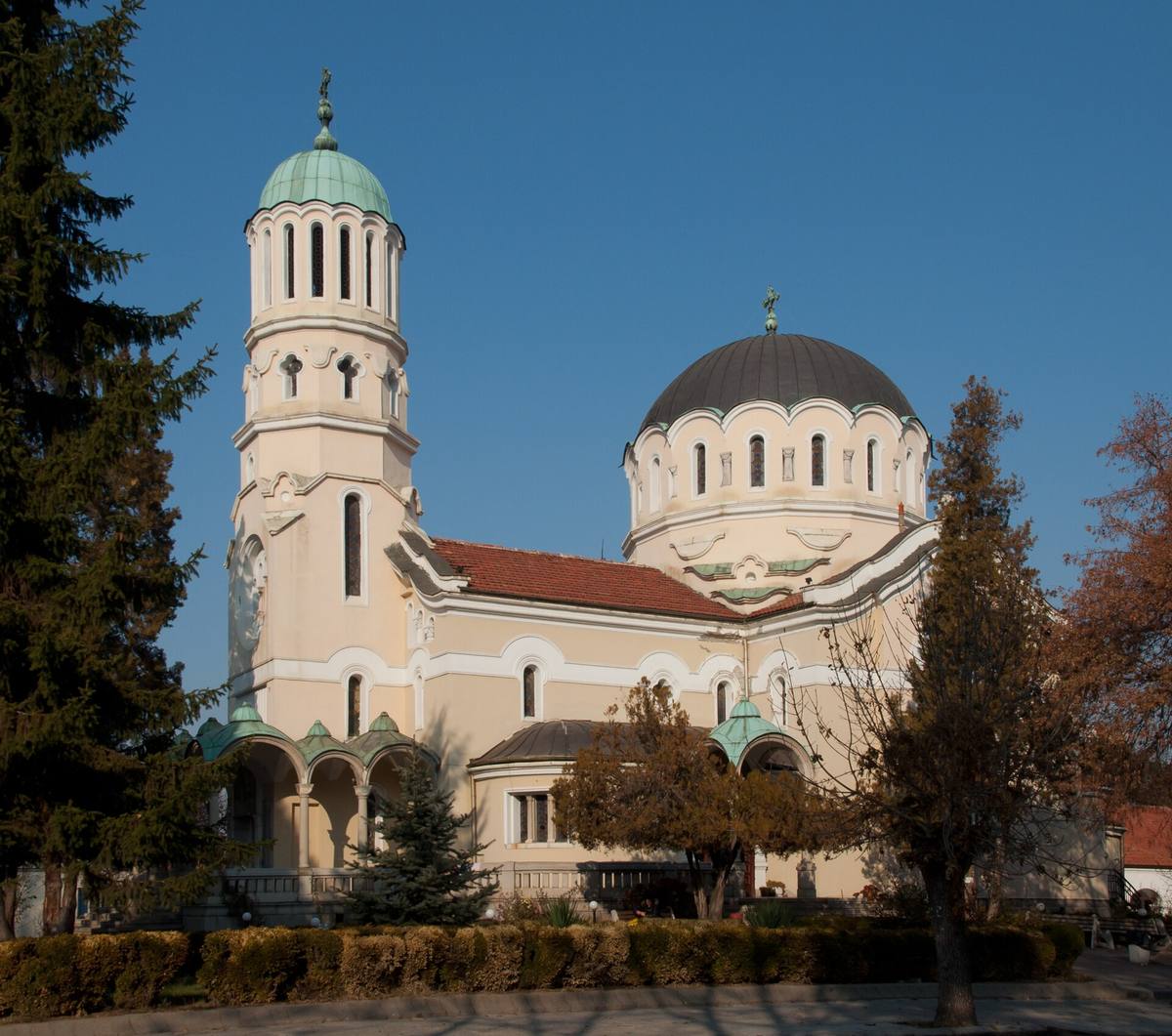
The largest church in Kyustendil by area, a neo-Byzantine memorial church built in 1926-1933 and consecrated in 1934. It is considered a smaller version of the Alexander Nevsky Cathedral in Sofia. Inside are an iconostasis by the master carvers of Debar and murals by Apostol Hristov, and many traditions surround it: a healing holy spring, lost things found again, and men who stand on the left.
Hours, admission, and directions ↓
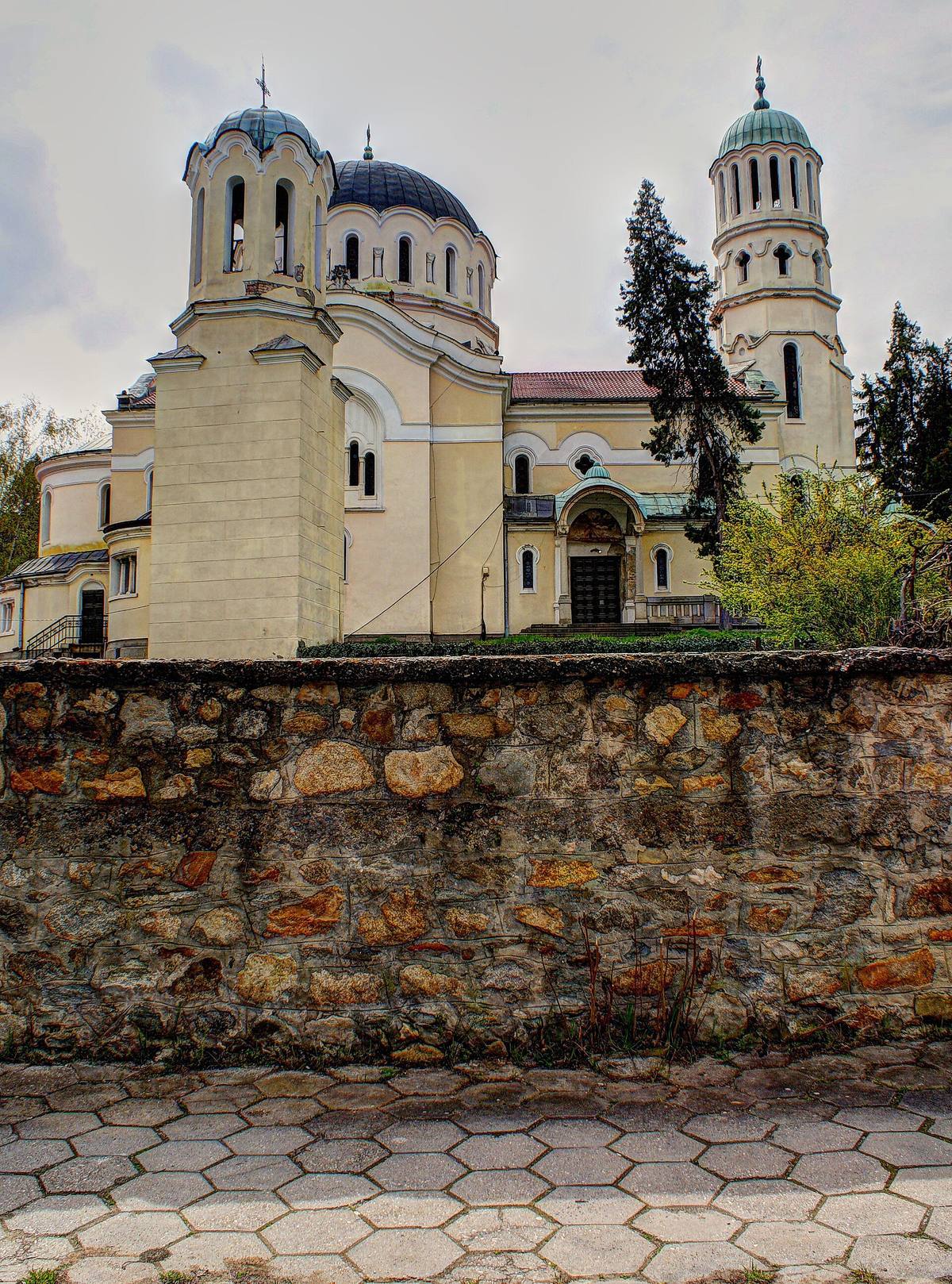
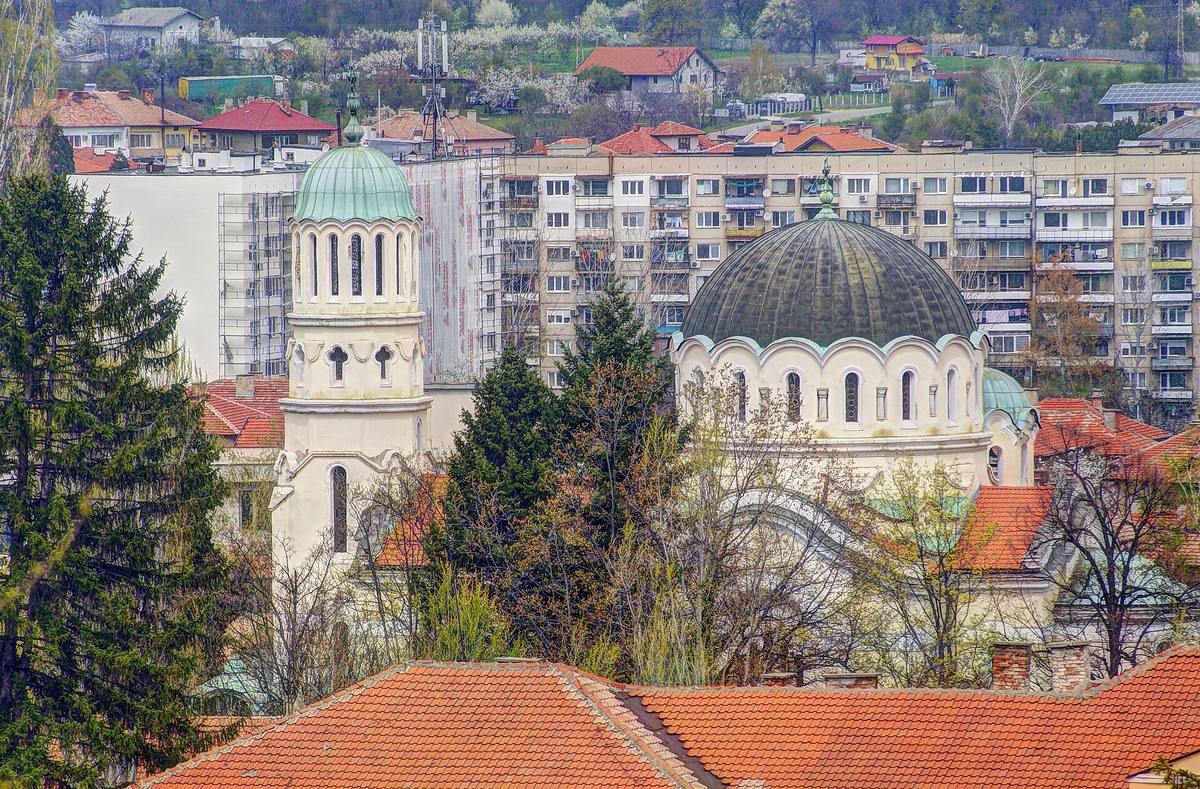
West of the center, in the Osogovo quarter, rises a large pale church with a dome and a tall round bell tower. Beside it stands the smaller, older church of the same name, from 1859. This page is about the new one, but their stories are shared: both are heirs of the old Kyustendil Monastery of St. Mina.
The patron is the Great Martyr Mina (Menas) of Kotyaeion, an Egyptian soldier martyred for his faith.
The monastery
↗The old church was built in 1859 as a monastery church, “a flimsy building of wattle daubed with mud,” over a spring believed to be holy, an ayazmo. After the Liberation the monastery housed “the first charitable institution in Kyustendil,” for orphans and poor families.
Those were not quiet years. Veneta Milusheva writes in Sofia University’s Kyustendil Readings (2009) that in 1865, 60 Circassian families were settled in Kyustendil: 30 on each side of town, by the church of St. Mina and by Stambol Kapiya. The Revival-era press and the memoirs of contemporaries tell of their violence, among it “priests beaten in the monastery church of St. Mina” in 1864. [2]
Later its buildings served almost every purpose: a district hospital (1890-1911), barracks for the 13th Rila Infantry Regiment (from 1896), an orphanage (1897), a shelter for about 500 Macedonian refugees (1910), and a tobacco store and garrison during World War I. In 1902-1904 master Ivancho Todorov built a bell tower about 11 m tall, four-sided below and eight-sided above. In 1905 the brothers Georgi and Stoyan Aleksov of Gorno Brodi near Serres cast three bells for it, of 125, 90, and 60 kg.
The new church
↗On March 5, 1923, a technical commission inspected the old church and concluded: “further services in the building are unthinkable.” On March 22, 1923, the church board decided to build a new one.
At the design competition in June 1925, first prize went to the Sofia architect Anton Tornyov. (In the chronicle of local historian Yordan Kotev his name appears as “Anton Todorov.”) [1]
- March 31, 1926: according to Kotev’s chronicle, before construction had even begun, the board’s cashier killed the steward-accountant “to cover up the embezzlement of 204,376.24 leva.”
- June 20, 1926: the foundations were laid, on Holy Trinity Sunday.
- July 12, 1933: the building was formally accepted.
- November 4, 1934: it was consecrated by Metropolitan Stefan of Sofia, later Exarch of Bulgaria. The same day the officers of the 13th Rila Infantry Regiment presented the carved metropolitan’s throne.
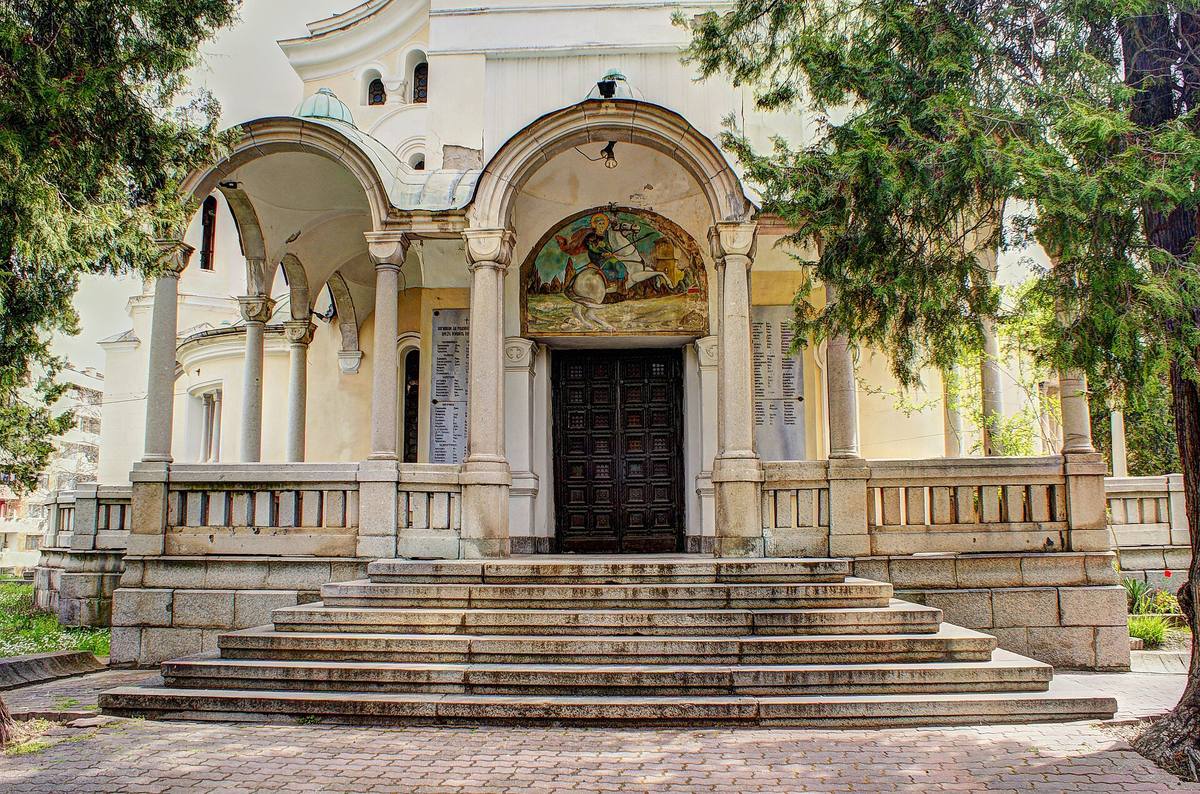
From September 15, 1934, marble plaques at the west entrance carry “the names of the officers and soldiers who fell for the homeland.” That is why it is called a memorial church.
The architecture
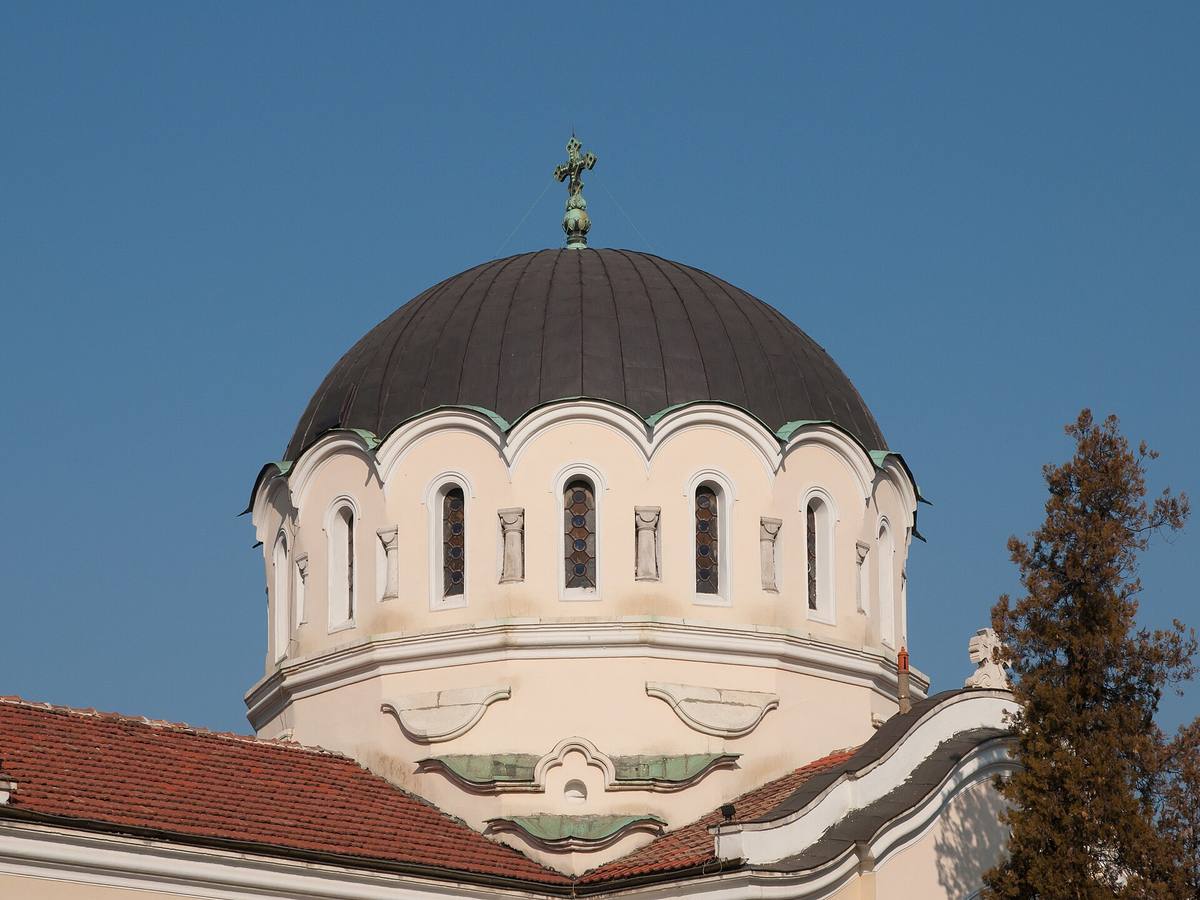
↗The church is neo-Byzantine and “architecturally a smaller version of the Alexander Nevsky Cathedral in Sofia.” It has two stories, with a cellar under the whole church, and it is “richly decorated with cornices and ornaments.” Above it rise “two tall domes with many window niches.” Kotev explains their symbolism: one dome stands for Christ, the head of the church, and two for “the inseparable twofold nature of Christ, God and man.”
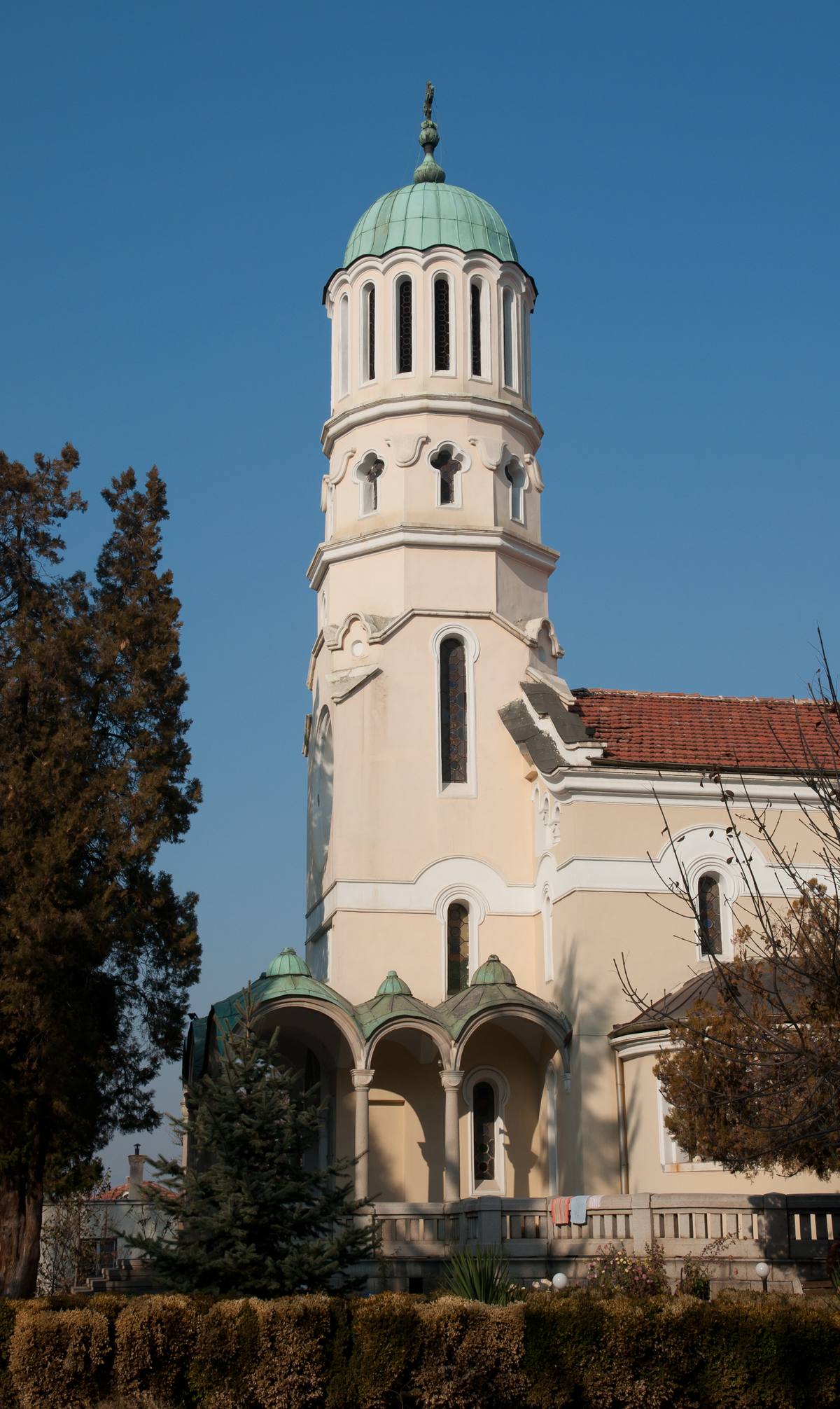
At the corner of the façade stands a tall round bell tower with a green cupola. The square bell tower of 1902-1904 also survives nearby.
Inside
↗The iconostasis is the work of the Debar carvers Kosta Filipov, Evtim Filipov, and Petar Yosifov of Osoy. It has eight large carved panels with sun symbols (eternity) and crosses in four circles (Christianity spreading in the four directions), eight smaller panels with phoenixes and plants, ten columns, and carved royal doors with the Last Supper.
The icons of the main tier are:
- left of the royal doors: the Virgin, St. Mina, St. Michael, and St. Tsar Boris;
- right: Christ, St. John the Baptist, St. John of Rila, and St. Clement of Ohrid.
The icons and murals are by Apostol Hristov (1877-1947) of Galichnik, a painter of the Debar school and a revolutionary. The central dome is painted with the Platytera, “wider than the heavens.” The north and south walls carry a strongly Bulgarian and Balkan series of saints:
- Prohor of Pčinja, Gavril of Lesnovo, and Joachim of Osogovo;
- Patriarch Evtimiy and Teodosiy of Tarnovo;
- Tsar Boris the Baptizer and the Baptism of Bulgaria;
- St. John of Rila;
- the Seven Holy Teachers;
- St. Petka of Tarnovo.
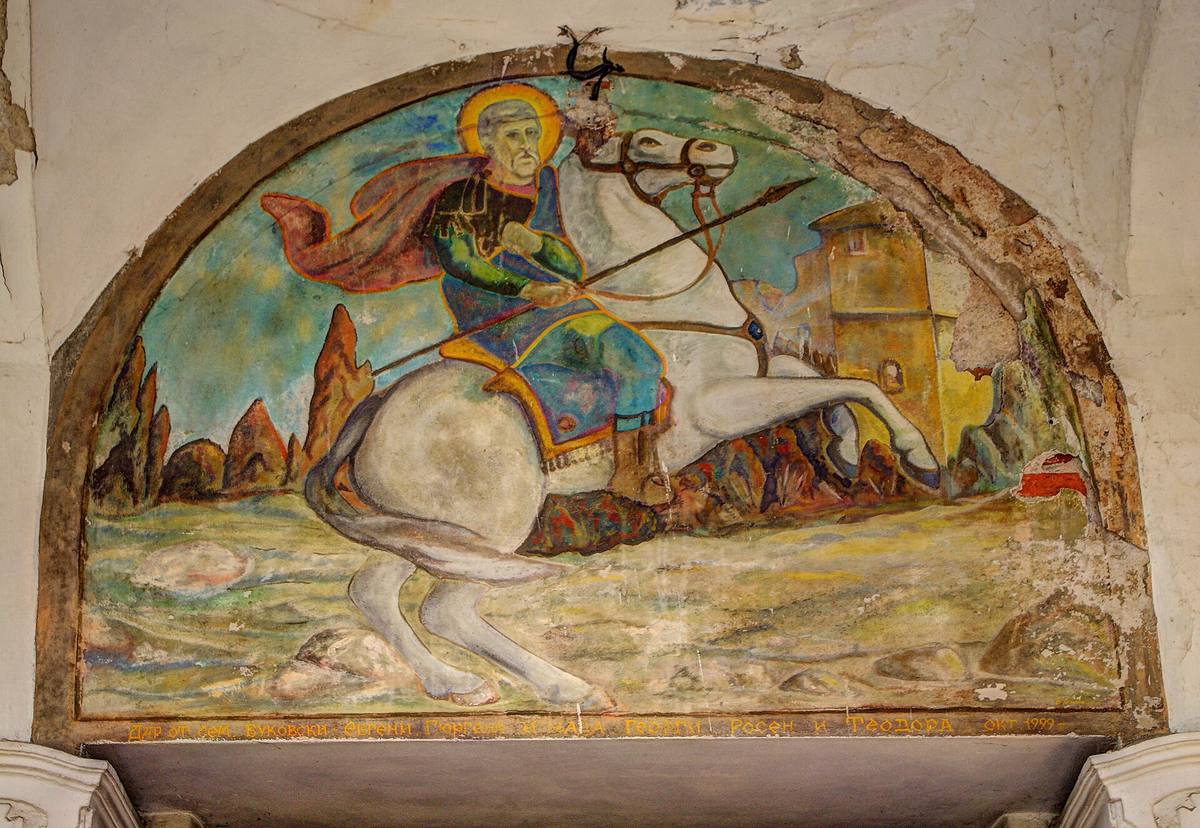
On the east wall St. Mina is painted as a mounted warrior.
Many of the murals carry their donors’ names. Christ with the Children, for example, is “in memory of Second Lieutenant Boris Stanchev Benev, 1918.” The western gallery has two balconies, from which the choir sings.
Traditions and customs
↗- The mortgaged horses. A legend says that when the money ran out, the town’s notables borrowed from Jewish lenders in Constantinople and pledged their property and their horses, “just so the building wouldn’t stop.” What is certain is that both churches were built “entirely with volunteer labor and donations.”
- The healing spring. The spring under the old church is known for its “healing power.” According to Kotev, many sick and “deranged” people washed in it and found a cure. Pilgrims came from southwestern Bulgaria, Macedonia, and Serbia. Older people say the water cures headaches and sore eyes.
- Lost things. It is believed that St. Mina helps you find lost or stolen things if you pray to him in faith. He is also seen as “patron and protector of the town” and of travelers coming and going. The local educated class used to compare him to the god Janus, who was in fact Roman.
- Men on the left. Kotev records an unusual custom: here the men stand on the left and the women on the right, the reverse of the usual order. People in Kyustendil explain it as a sign of respect for their wives, who are to be “their intercessors before God.”
- Baba Vanga. According to Kotev, the prophetess Vanga came to the church’s feast every year as a pilgrim, as long as she lived.
- The relics of St. Haralambos. Around 1893 the priest Grigoriy Hristov brought a reliquary whose relics, “according to tradition,” belong to St. Haralambos. It was later stolen.
- The bell tower’s builder. Ivancho Todorov, who built the bell tower, “nearly fell from it at the end of the work… and soon died.”
Buried in the altar of the old church is the priest, folklorist, and ethnographer Petar Lyubenov (1816-1905), and before its altar Metropolitan Sinesiy of Skopje (1836-1917).
Today
↗St. Mina is a working church of the Sofia Metropolis and “the largest” church in Kyustendil. On St. Mina’s Day, November 11, thousands of believers come from all over the country. They bring flowers and light candles, and the church prepares a kurban, a shared feast. A fragment of the saint’s relics, kept at the church of St. Dimitar, is displayed in the center of the church.
Around 2005-2006 the façade was renewed under the Beautiful Bulgaria program. At Easter in 2005 and 2006 the church received the Holy Fire from Jerusalem, and in 2006 a Sunday school opened.
Photos and related images
The image could not load. Its caption and source remain available.

The image could not load. Its caption and source remain available.

The image could not load. Its caption and source remain available.

The image could not load. Its caption and source remain available.

The image could not load. Its caption and source remain available.

The image could not load. Its caption and source remain available.

Sources
(12)
A date may refer to construction, renewal, or another stated stage. Legends are accounts recorded in sources, rather than established events. Bibliography links help locate the named author; no automatic reference is added where the match is ambiguous.
- Йордан Котев. Старата църква и православният храм-паметник „Свети Великомъченик Мина“Online source · Bulgarian · sveti.mina.free.bg↑1
Source address
http://sveti.mina.free.bg/
If a link does not open, use its title, author, and address to search, or consult another listed source.
- Венета Милушева. Черкезки заселници в югозападните български земи след Кримската война от 1853-1856 г. Кюстендилски четения 8, СУ, 2009, 151-159Research publication · Bulgarian · periodicals.uni-sofia.bg↑1
Source address
https://periodicals.uni-sofia.bg/index.php/KRe/bg/article/view/kre-2006-14
If a link does not open, use its title, author, and address to search, or consult another listed source.
- Престолният празник на храм „Св. Мина“ в гр. Кюстендил, Софийска света митрополия, 2023Online source · Bulgarian · mitropolia-sofia.org
Source address
https://mitropolia-sofia.org/2023/11/11/престолният-празник-на-храм-св-мина/
If a link does not open, use its title, author, and address to search, or consult another listed source.
- Кюстендилски манастир „Св. Мина“, СветиместаOnline source · Bulgarian · svetimesta.com
Source address
https://svetimesta.com/svetimesta.com/%D0%9C%D0%B0%D0%BD%D0%B0%D1%81%D1%82%D0%B8%D1%80%D0%B8/%D0%9A%D1%8E%D1%81%D1%82%D0%B5%D0%BD%D0%B4%D0%B8%D0%BB%D1%81%D0%BA%D0%B8%20%D0%BC%D0%B0%D0%BD%D0%B0%D1%81%D1%82%D0%B8%D1%80%20-%20%D0%A1%D0%B2.%20%D0%9C%D0%B8%D0%BD%D0%B0
If a link does not open, use its title, author, and address to search, or consult another listed source.
- Храм „Св. Мина“, библиографска справка, Регионална библиотека, КюстендилOnline source · Bulgarian · libkn.bg
Source address
https://www.libkn.bg/храм-св-мина-библиографска-справка/
If a link does not open, use its title, author, and address to search, or consult another listed source.
- Миряни от цялата страна идват в Кюстендил, за да почетат „Св. Мина“, kustendil.info, 2011Online source · Bulgarian · kustendil.info
Source address
https://kustendil.info/novini/8944-miryani-ot-tzyalata-strana-idvat-v-kyustendil-za-da-pochetat-sv-mina-v15-8944
If a link does not open, use its title, author, and address to search, or consult another listed source.
- Спират проект по „Красива България“ в Кюстендил, CityBuild.bg, 2009Online source · Bulgarian · citybuild.bg
Source address
https://citybuild.bg/news/spirat-proekt-krasiva-bylgariia
If a link does not open, use its title, author, and address to search, or consult another listed source.
- Музеен вестник, бр. 28, 2026, РИМ, КюстендилPDF document · Bulgarian · kyustendilmuseum.bg
Source address
https://kyustendilmuseum.bg/uploads/MUZEEN_VESTNIK_2026_cveten_3.pdf
If a link does not open, use its title, author, and address to search, or consult another listed source.
- Свети Мина (Кюстендил, 1933), УикипедияEncyclopedia article · Bulgarian · bg.wikipedia.org
Source address
https://bg.wikipedia.org/wiki/Свети_Мина_(Кюстендил,_1933)
If a link does not open, use its title, author, and address to search, or consult another listed source.
- Свети Мина (Кюстендил, 1859), УикипедияEncyclopedia article · Bulgarian · bg.wikipedia.org
Source address
https://bg.wikipedia.org/wiki/Свети_Мина_(Кюстендил,_1859)
If a link does not open, use its title, author, and address to search, or consult another listed source.
- Апостол Христов, УикипедияEncyclopedia article · Bulgarian · bg.wikipedia.org
Source address
https://bg.wikipedia.org/wiki/Апостол_Христов
If a link does not open, use its title, author, and address to search, or consult another listed source.
- OpenStreetMap: Св. МинаMap record · Bulgarian · openstreetmap.org
Source address
https://www.openstreetmap.org/way/977565671
If a link does not open, use its title, author, and address to search, or consult another listed source.