Fatih Mehmed Mosque
1531 according to the brick date on the drum below the dome; before 1463 according to Machiel Kiel
Dating stated in the sources: 1531
Your visit at a glance
- Address
- Tsar Osvoboditel Blvd., town center
- Approximate time at the site
- about 15 minutes
- Opening hours
- No verified information found
- Admission
- No verified information found
The image could not load. Its caption and source remain available.

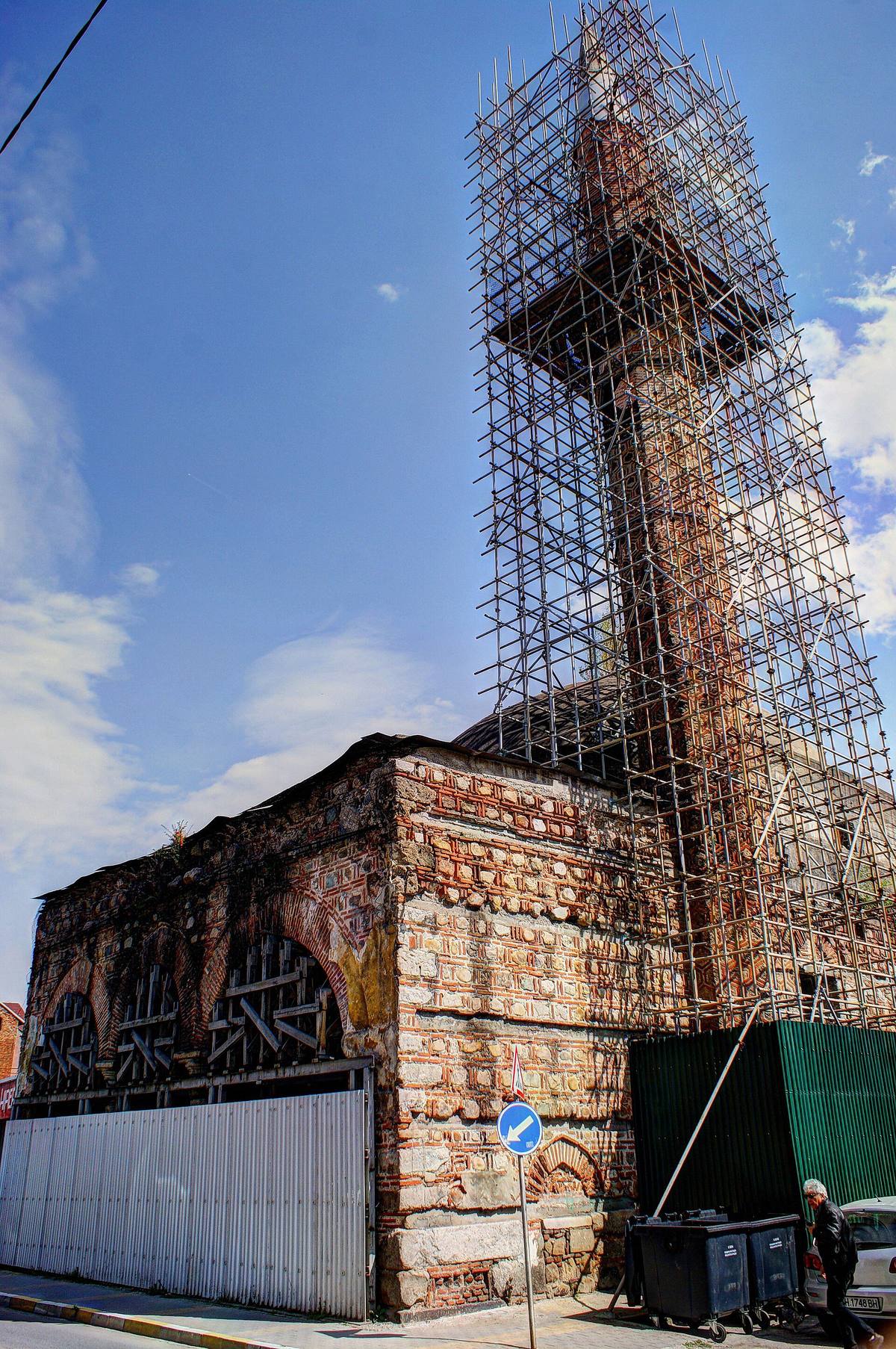
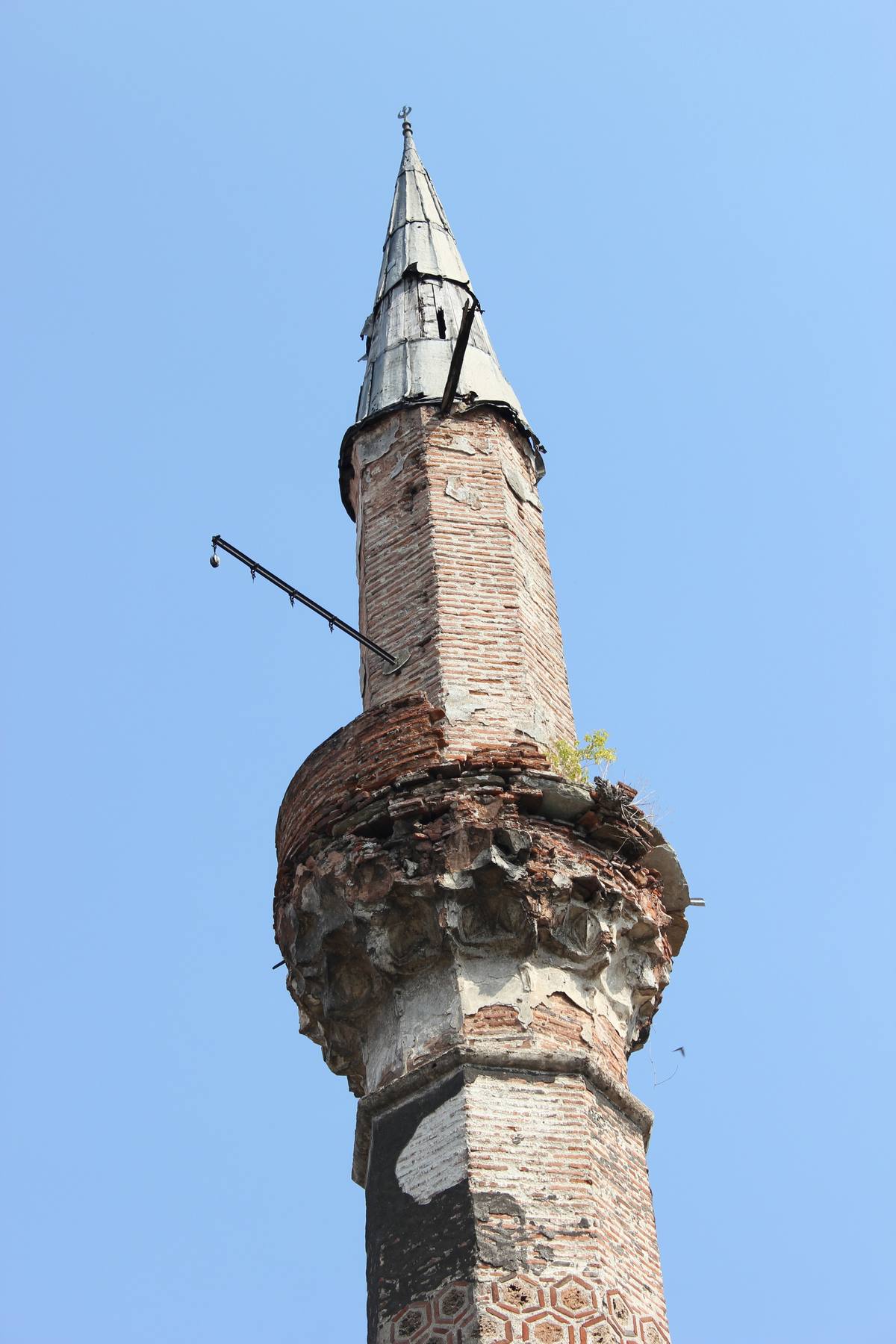
A single-domed Ottoman mosque on Tsar Osvoboditel Blvd., with the only surviving minaret in Kyustendil, faced with hexagonal stones in brick frames like a honeycomb. The year 1531 is spelled out in brick on the drum below the dome, but the Ottomanist Machiel Kiel believes the mosque is older, from the time of Sultan Mehmed II. It is not in use, is propped up, and awaits restoration.
Hours, admission, and directions ↓
The mosque stands on Tsar Osvoboditel Blvd., among the shops. From a distance you see the minaret, the only one left in town. Up close you notice the cracked walls, the wooden props under the arches, and the metal fence. A cultural monument of national importance, it is waiting to be restored.
The name and the builder
↗The mosque is named after Sultan Mehmed II (1444-1446 and 1451-1481), called Fatih, “the Conqueror.” Local sources call its builder Haradzhi (or Karadzhi) Kara Mehmed bin Ali. The municipality calls him “the master builder well known in the region,” and Wikipedia “one of the well-known builders of public buildings in Kyustendil.” The municipality’s tourism portal also calls it the Shaldarvan Mosque.
Machiel Kiel tells the story of the name in the Turkish Encyclopedia of Islam (TDV, 2002). In 1463, on his way to Bosnia, Sultan Mehmed II passed through Plovdiv, Samokov, and Kyustendil toward Skopje. During the campaign, Haraççı Kara Mehmed Bey, the region’s tax collector (a haraççı collected the haraç, the tax on non-Muslims), dedicated to the sultan a large domed mosque that he had built but had not managed to endow with enough property. Since then it has been called the Fatih Mosque. Its upkeep was paid partly from Kara Mehmed’s endowment (vakıf) and partly from the state treasury. Kara Mehmed also built a small mosque (mescid) and a madrasa in town. The mosque itself, Kiel writes, was built directly on the foundations of the walls of Roman Pautalia. [1]
Kiel also cites the Ottoman tax registers. In 1517 Kyustendil had just one Friday mosque, the “Sultan Mehmed,” and three domed mescids with lead roofs. By 1570 the mescids numbered twenty-one.
1531 or earlier?
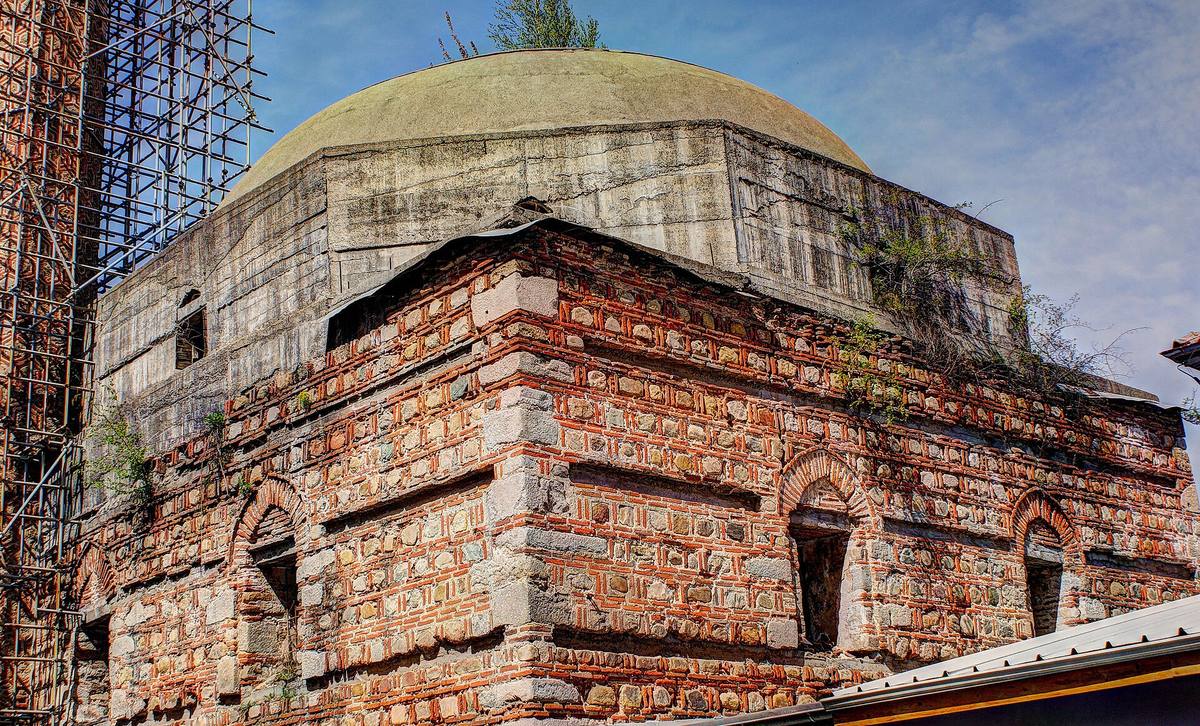
↗On the drum under the dome, a year in the Islamic calendar is spelled out in brick. Here opinions divide.
- Semavi Eyice (TDV, 1995) reads it as 937 AH, that is, 1530-1531. He saw it on site in 1966 and writes that it is “rather crudely made.” In his view the mosque was built under Suleiman the Magnificent, and it is not correct to call it the Fatih Mosque. He also cites Ekrem Hakkı Ayverdi, who stated that there is no Fatih Mosque in Kyustendil.
- Machiel Kiel (TDV, 2002) reads 938 AH, that is, 1531-1532, on a small brick mosaic on the drum. He writes that scholars usually take it as the year of construction, but he himself connects the mosque with the campaign of 1463.
- The municipality and Bulgarian Wikipedia date the mosque to the mid-15th century and treat 1531 as the year of a later rebuilding.
The minaret
↗“But the most interesting feature of the mosque is its minaret, which has no parallel in Turkish architecture of the Ottoman period,” Eyice writes. The shaft is octagonal. From the base to the balcony (şerefe) it is faced with neatly laid light-colored stones cut as hexagons, each framed in brick. The result is a honeycomb pattern. Bulgarian Wikipedia calls it the only surviving minaret in Kyustendil.
The minaret has survived. In photos on Wikimedia Commons from 2013 and 2021, it stands with its balcony and its sheet-metal conical cap, but the balcony’s parapet is missing and the plaster beneath it is crumbling. In April 2026 the minaret was in scaffolding.
The building
↗Eyice describes the building like this:
- the prayer hall is square, under a single dome slightly more than 11.5 m across, on an octagonal drum with windows;
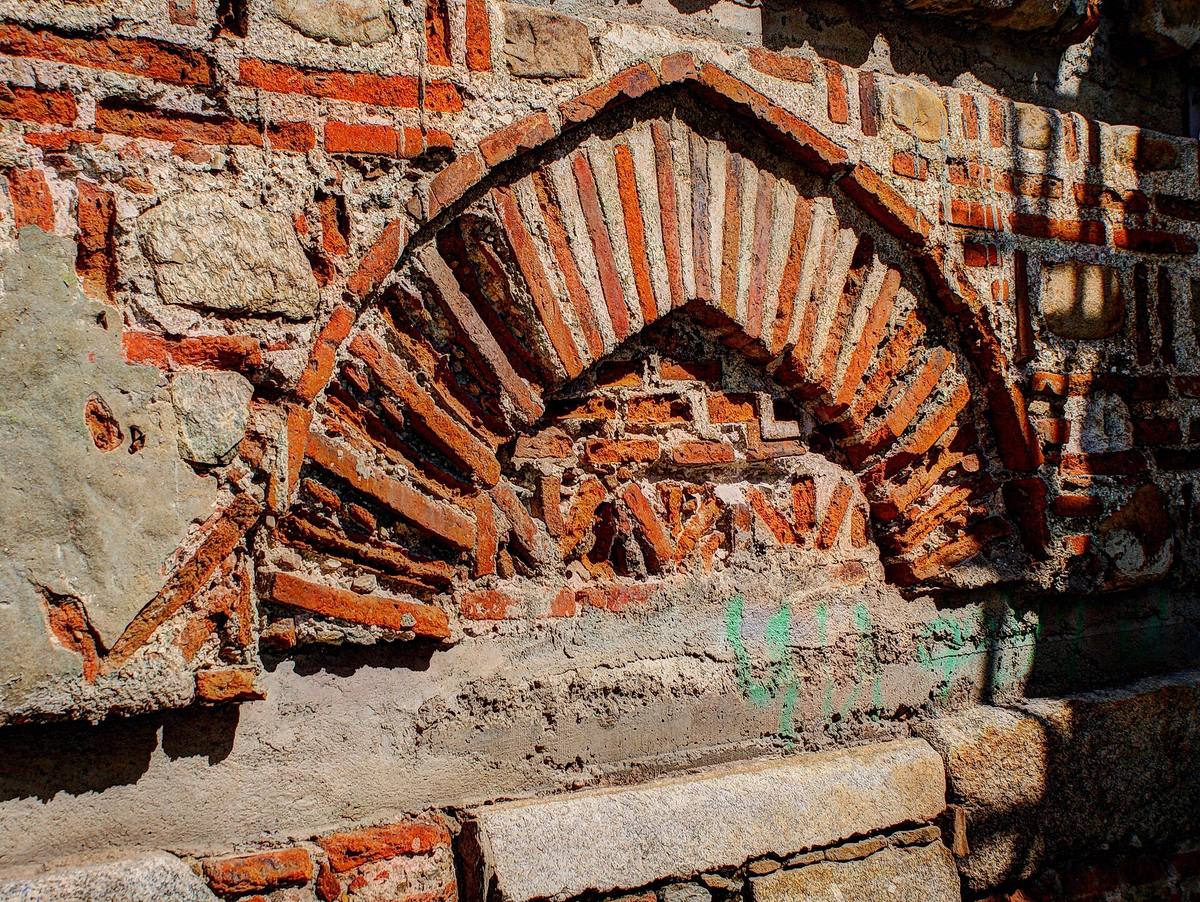
- the walls are of stone and brick in mixed masonry;
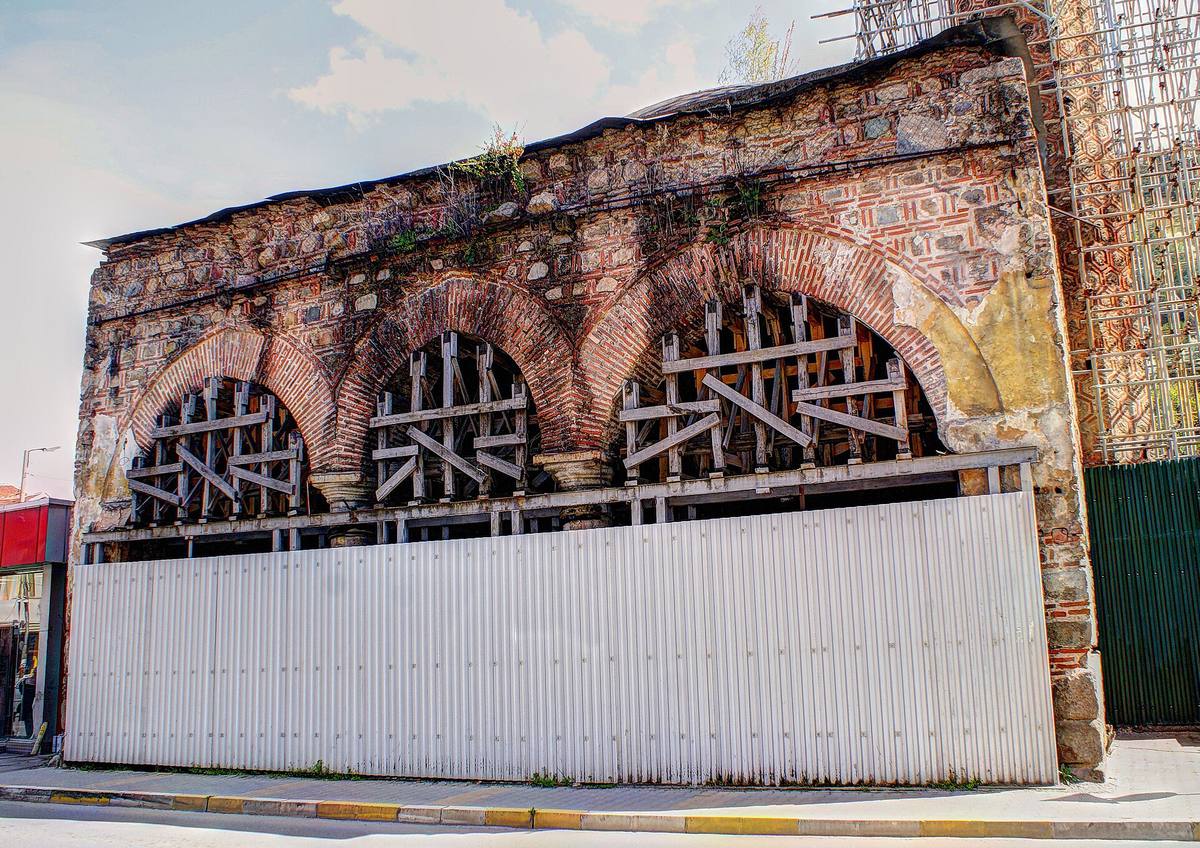
- the entrance arcade is closed at the sides by walls and has three bays, the middle one narrower; the vault of the middle bay and the transitions to the side domes are worked in rich stalactite carving (muqarnas);
- the wooden gallery (mahfil) inside, drawn on H. Minetti’s plan, is gone. Minetti studied the town’s buildings during World War I and recorded the mosque under the name Fatih.
Decay and rescue
↗In the 1950s many Ottoman buildings in Kyustendil were destroyed. The Fatih Mosque is one of the few that survived, Kiel writes (see the Dervish Bath). But already in 1966 Eyice saw “very deep cracks” in several places in the dome. Bulgarian Wikipedia says the mosque is a cultural monument of national importance (State Gazette No. 77/1968) but, for lack of care, is threatened with ruin. In a photo from 2013, the arches of the entrance are already propped up with wooden beams.
In February 2021 the municipality announced that the Council of Ministers was granting 140,088 leva for urgent strengthening of “the overhanging, threatening, crumbling and extremely dangerous highest part of the mosque.” This was the first stage of a joint project of the municipality, the Council of Ministers, and cultural institutions to restore the mosque and turn it into a museum. On April 22, 2021, engineering and geological surveys were made for “emergency measures on the minaret and the entrance arcade.” We could not find out whether the repair was finished. In the photos of April 2026, the minaret is in scaffolding, the arches are propped up, and the building is fenced off.
Today
↗The mosque is not in use and cannot be visited. It can be seen from the sidewalk of the boulevard, about 250 m from Velbazhd Square. The town’s other surviving mosque, the Ahmed Bey Mosque, is about 300 m away, next to the Roman Thermae, and hosts exhibitions.
Photos and related images
The image could not load. Its caption and source remain available.

The image could not load. Its caption and source remain available.

The image could not load. Its caption and source remain available.

The image could not load. Its caption and source remain available.

Sources
(11)
A date may refer to construction, renewal, or another stated stage. Legends are accounts recorded in sources, rather than established events. Bibliography links help locate the named author; no automatic reference is added where the match is ambiguous.
- Machiel Kiel. Köstendil, TDV İslâm Ansiklopedisi, c. 26, 2002, 277-279Online source · Turkish · islamansiklopedisi.org.tr↑1
Source address
https://islamansiklopedisi.org.tr/kostendil
If a link does not open, use its title, author, and address to search, or consult another listed source.
- Semavi Eyice. Fâtih Camii (Bulgaristan), TDV İslâm Ansiklopedisi, c. 12, 1995, 242-243Online source · Turkish · islamansiklopedisi.org.tr
Source address
https://islamansiklopedisi.org.tr/fatih-camii--bulgaristan
If a link does not open, use its title, author, and address to search, or consult another listed source.
- Fatih Camii, Köstendil, Kültür EnvanteriOnline source · Turkish · kulturenvanteri.com
Source address
https://kulturenvanteri.com/yer/fatih-camii-kostendil/
If a link does not open, use its title, author, and address to search, or consult another listed source.
- Министерски съвет предостави 140 088 лв. за спешен и укрепителен ремонт на джамията „Фатих Мехмед“, Община Кюстендил, 2021Institutional page · Bulgarian · kyustendil.bg
Source address
https://kyustendil.bg/index.php?option=com_k2&view=item&id=1037:140-088&lang=bg
If a link does not open, use its title, author, and address to search, or consult another listed source.
- Съобщение за инженерно-геоложки проучвания за обект „Прилагане на аварийни мерки на минаре и аркада преддверие на джамия „Фатих Мехмед“, Община Кюстендил, 2021Institutional page · Bulgarian · kyustendil.bg
Source address
https://kyustendil.bg/index.php?option=com_k2&view=item&id=1118:2021-04-21-13-31-07&lang=bg
If a link does not open, use its title, author, and address to search, or consult another listed source.
- Музеен вестник, бр. 23, РИМ, Кюстендил, 2022PDF document · Bulgarian · kyustendilmuseum.bg
Source address
https://kyustendilmuseum.bg/uploads/%D0%9C%D1%83%D0%B7%D0%B5%D0%B5%D0%BD_%D0%B2%D0%B5%D1%81%D1%82%D0%BD%D0%B8%D0%BA%2C_%D0%B1%D1%80._23_(2022_%D0%B3.).pdf
If a link does not open, use its title, author, and address to search, or consult another listed source.
- Недвижимо културно наследство, Община КюстендилInstitutional page · Bulgarian · kyustendil.bg
Source address
https://kyustendil.bg/index.php?Itemid=273&id=119&lang=bg&option=com_content&view=article
If a link does not open, use its title, author, and address to search, or consult another listed source.
- Джамия Фатих Султан Мехмед, Туристическа дестинация КюстендилOnline source · Bulgarian · visit-kyustendil.eu
Source address
https://visit-kyustendil.eu/djamia-fatih-sultan-mehmed
If a link does not open, use its title, author, and address to search, or consult another listed source.
- Фатих Мехмед джамия (Кюстендил), УикипедияEncyclopedia article · Bulgarian · bg.wikipedia.org
Source address
https://bg.wikipedia.org/wiki/Фатих_Мехмед_джамия_(Кюстендил)
If a link does not open, use its title, author, and address to search, or consult another listed source.
- Снимки на джамията, Gitanes232 (2026), Julian Nyča (2013), Wikicont007 (2021), Wikimedia CommonsImage and license · Bulgarian · commons.wikimedia.org
Source address
https://commons.wikimedia.org/wiki/Category:Fatih_Mehmet_Mosque
If a link does not open, use its title, author, and address to search, or consult another listed source.
- OpenStreetMap: Джамия Фатих МехмедMap record · Bulgarian · openstreetmap.org
Source address
https://www.openstreetmap.org/way/1117807540
If a link does not open, use its title, author, and address to search, or consult another listed source.