Dervish Bath
1566
Dating stated in the sources: 1566
Your visit at a glance
- Address
- On the traffic island at the Rodopi St. junction, about 250 m from Velbazhd Square
- Approximate time at the site
- about 15 minutes
- Opening hours
- No verified information found
- Admission
- No verified information found
The image could not load. Its caption and source remain available.

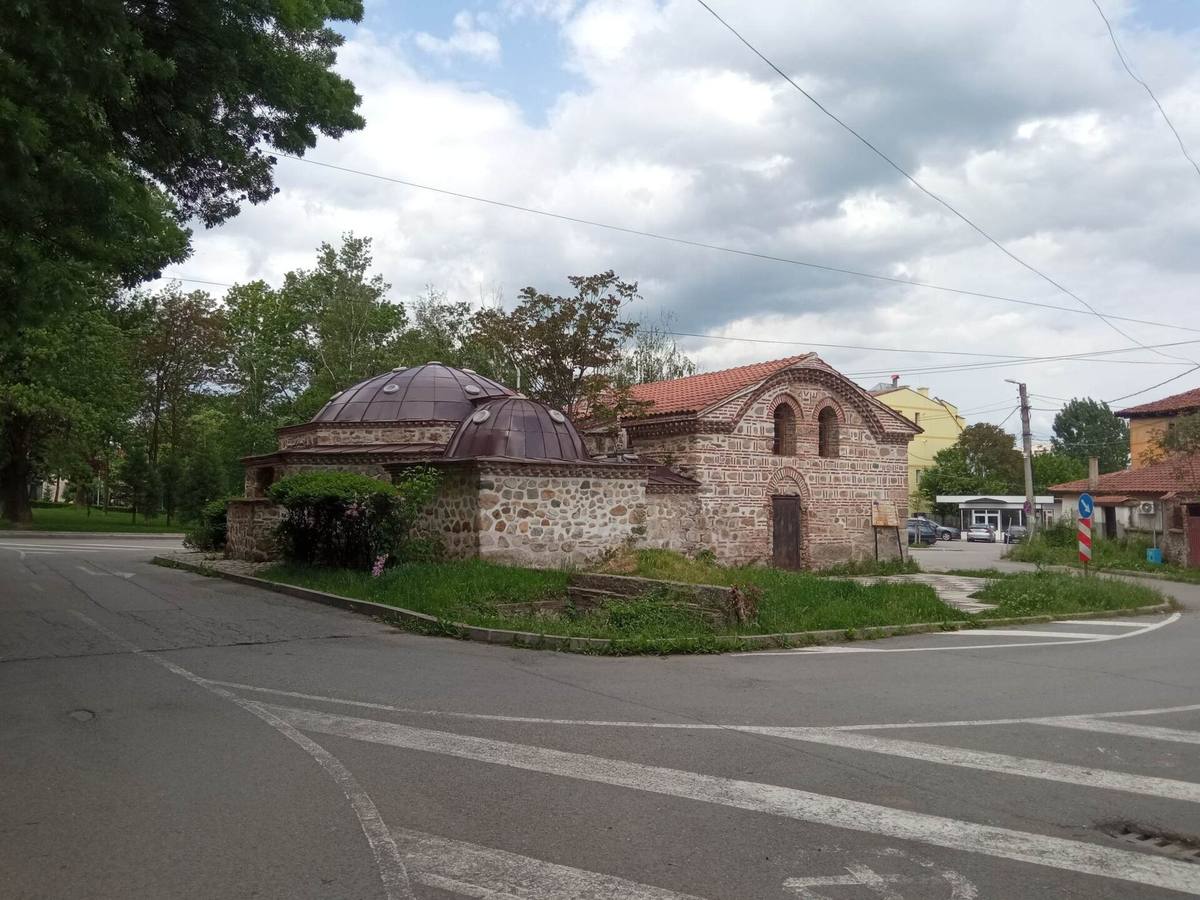
An Ottoman mineral bath from 1566; the year is spelled out in red brick on the façade. The municipality calls it the oldest preserved Ottoman public bath in Bulgaria. It worked for more than 400 years, until 1992, and it is one of the few Ottoman buildings in Kyustendil that survived the 1950s.
Hours, admission, and directions ↓
The small building with its two metal-clad domes stands alone on a traffic island in the middle of a junction. Most people walk past without suspecting that it is older than almost everything around it.
The years in the bricks
↗The bath tells you itself when it was built. Three years are spelled out in red brick on its façade:
- 1566: the year it was built;
- 1604: probably a repair;
- 1835: probably another repair.
1566 is also the year Sultan Suleiman the Magnificent died, the end of the empire’s “magnificent century.”
Stones from the fortress
↗The bath is built of rough stone blocks and red brick, including material taken from the walls of the medieval fortress. In 1906 Yordan Ivanov described an ancient stone fragment set into its north wall, with an inscription that mentions the town’s old fortress. [3]
What’s inside
↗The largest room is the bathing hall. At its center is an octagonal pool, and above it a tall dome with round openings that let in the light. The changing room was simpler and rectangular, but it has not survived. Niches and bathing seats line the walls.
The Ottomanist Machiel Kiel lists it among the kaplıca hamamları, the hot-spring baths the town was so famous for. In Ottoman documents Kyustendil is called simply Ilıca, “hot spring.” [1]
The bath in the 20th century
↗The 1923 rules for the Chifte and Dervish baths, kept in the State Archives in Kyustendil, expressly set the Dervish Bath aside for “prisoners, Gypsy men and Gypsy women,” on fixed days and hours: Sunday morning for the prisoners, Tuesday morning for the Romani women, and Tuesday afternoon for the Romani men. The bath had a single section, used in shifts, and shared one management and one doctor with the Chifte Bath. Violeta Kotseva (Seminar_BG, Sofia University, 2024), who quotes the rules, sees them as indirect evidence of the ethnic and social divisions in the town. She also calls the Dervish Bath “the oldest known” of the town’s three surviving baths, built, according to the State Archives, in the mid-16th century. [2]
Why “Dervish”
↗Bulgarian Wikipedia explains the name with the word “dervish,” which among the Bektashis is one of the four lower ranks of novices: ashık, talib, muhib, and dervish. But we found no document linking the bath to a dervish order or lodge. All we know is that when the traveler Evliya Çelebi passed through in 1661, he counted five dervish lodges in the town.
A survivor
↗In the 1950s many Ottoman buildings in Kyustendil were destroyed: dervish lodges, tombs, cemeteries. Machiel Kiel writes that only four survive today: [1]
- the Dervish Bath;
- a 15th-century tower;
- the mosque of Feridun Ahmed Bey;
- the Fatih Mosque.
The bath worked as a bath for more than 400 years, until 1992.
Rome underneath
↗Excavations at the spot, recorded in museum documents as “Darvish Banya,” turned up Roman coins minted in Serdica, most of them from the reign of Emperor Caracalla (198-217). So here too, as across the town center, Roman Pautalia lies beneath the Ottoman layer.
After 1992
↗- 2005: the bath was fully restored. For a while, artists used its niches and bathing seats for exhibitions and art events.
- 2017: the building was no longer in use. The municipality proposed a concession for a spa and balneotherapy, for 20 years with an option for 15 more. The concessionaire would have had to invest at least 152,750 leva in conservation, restoration, and adaptation. We could not find out whether the concession was ever awarded.
Today the bath is closed, but it is intact and easy to see from outside. If you pass by, stop for a moment: the municipality considers it the oldest preserved Ottoman public bath in Bulgaria.
Sources
(9)
A date may refer to construction, renewal, or another stated stage. Legends are accounts recorded in sources, rather than established events. Bibliography links help locate the named author; no automatic reference is added where the match is ambiguous.
- Machiel Kiel. Köstendil, TDV İslâm Ansiklopedisi, c. 26, 2002Online source · Turkish · islamansiklopedisi.org.tr↑1 ↑2
Source address
https://islamansiklopedisi.org.tr/kostendil
If a link does not open, use its title, author, and address to search, or consult another listed source.
- Виолета Коцева. Развитие на балнеолечението в гр. Кюстендил в началото на ХХ в. Семинар_BG 27, СУ, 2024, 260-276Research publication · Bulgarian · periodicals.uni-sofia.bg↑1
Source address
https://periodicals.uni-sofia.bg/index.php/seminar_bg/bg/article/view/6050
If a link does not open, use its title, author, and address to search, or consult another listed source.
- Йордан Иванов. Северна Македония, 1906, archive.orgOnline source · Bulgarian · archive.org↑1
Source address
https://archive.org/details/sievernamakedon00ivangoog
If a link does not open, use its title, author, and address to search, or consult another listed source.
- Светослава Филипова. Монети на Сердика от нумизматичния фонд на РИМ, Кюстендил, Музеен вестник, бр. 28, 2026PDF document · Bulgarian · kyustendilmuseum.bg
Source address
https://kyustendilmuseum.bg/uploads/MUZEEN_VESTNIK_2026_cveten_3.pdf
If a link does not open, use its title, author, and address to search, or consult another listed source.
- Недвижимо културно наследство, Община КюстендилInstitutional page · Bulgarian · kyustendil.bg
Source address
https://kyustendil.bg/index.php?Itemid=273&id=119&lang=bg&option=com_content&view=article
If a link does not open, use its title, author, and address to search, or consult another listed source.
- Правят СПА център в кюстендилската Дервиш баня, kmeta.bg, 2017Online source · Bulgarian · kmeta.bg
Source address
https://kmeta.bg/pravyat-spa-centur-v-kyustendilskata-dervish-banya/
If a link does not open, use its title, author, and address to search, or consult another listed source.
- Derviş Hamamı, Köstendil, Kültür EnvanteriOnline source · Turkish · kulturenvanteri.com
Source address
https://kulturenvanteri.com/yer/?p=12202
If a link does not open, use its title, author, and address to search, or consult another listed source.
- Дервиш баня (Кюстендил), УикипедияEncyclopedia article · Bulgarian · bg.wikipedia.org
Source address
https://bg.wikipedia.org/wiki/Дервиш_баня_(Кюстендил)
If a link does not open, use its title, author, and address to search, or consult another listed source.
- Wikidata: Дервиш баня (Q12277889)Online source · Bulgarian · wikidata.org
Source address
https://www.wikidata.org/wiki/Q12277889
If a link does not open, use its title, author, and address to search, or consult another listed source.