57Nature and parks · Stob
Stob Pyramids
Your visit at a glance
- Address
- Above Stob, Rila’s western slopes
- Approximate time for the whole walking outing
- about 1 hour 30 minutes
- Visiting conditions
- No verified information found
- Admission
- No verified information found
The image could not load. Its caption and source remain available.

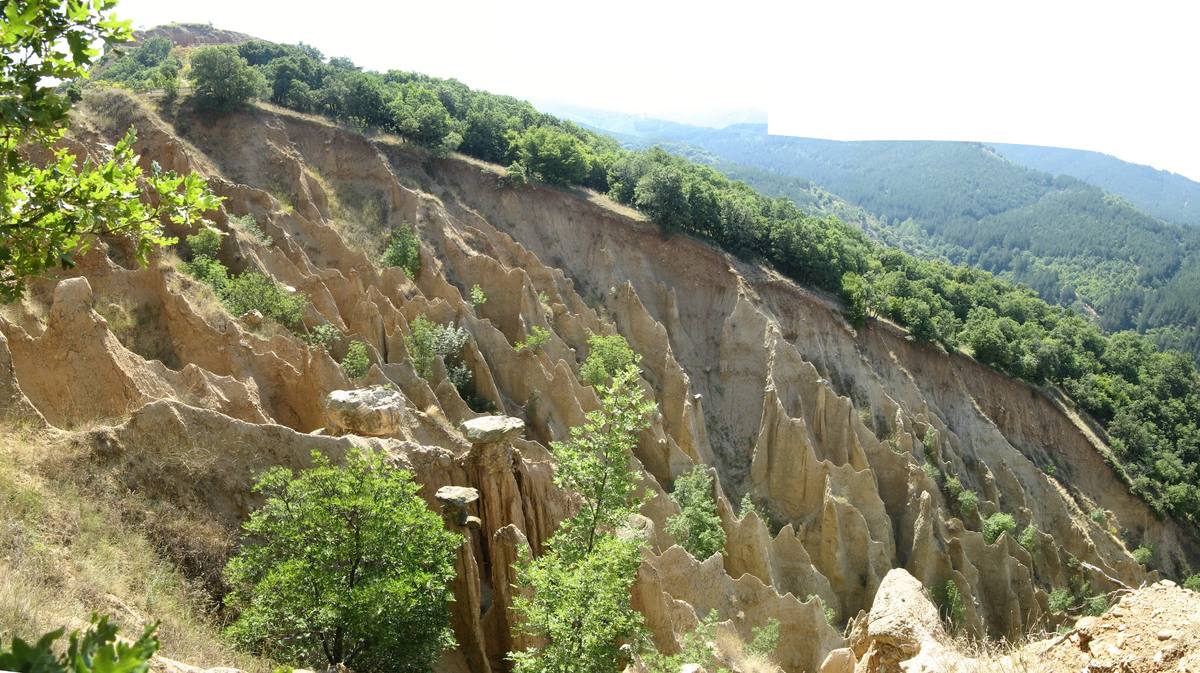
The Stob Pyramids are earth columns, cones, and ridges above Stob, on Rila’s western slopes. Some carry stone caps. The natural monument is viewed along a walking route, while erosion continues to change its forms.
Hours, admission, and directions ↓
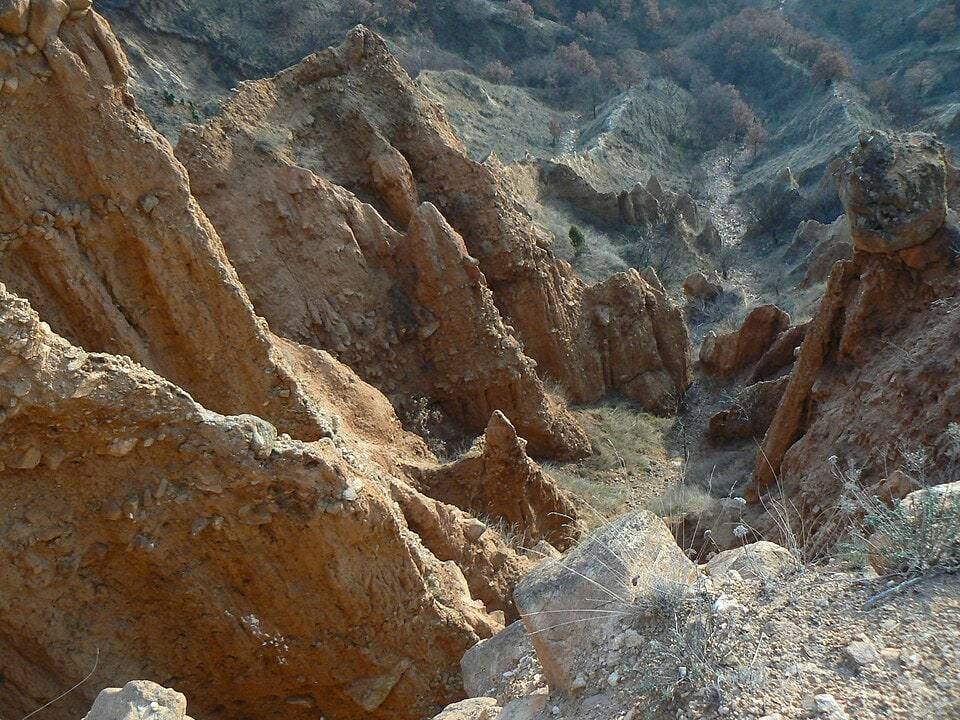
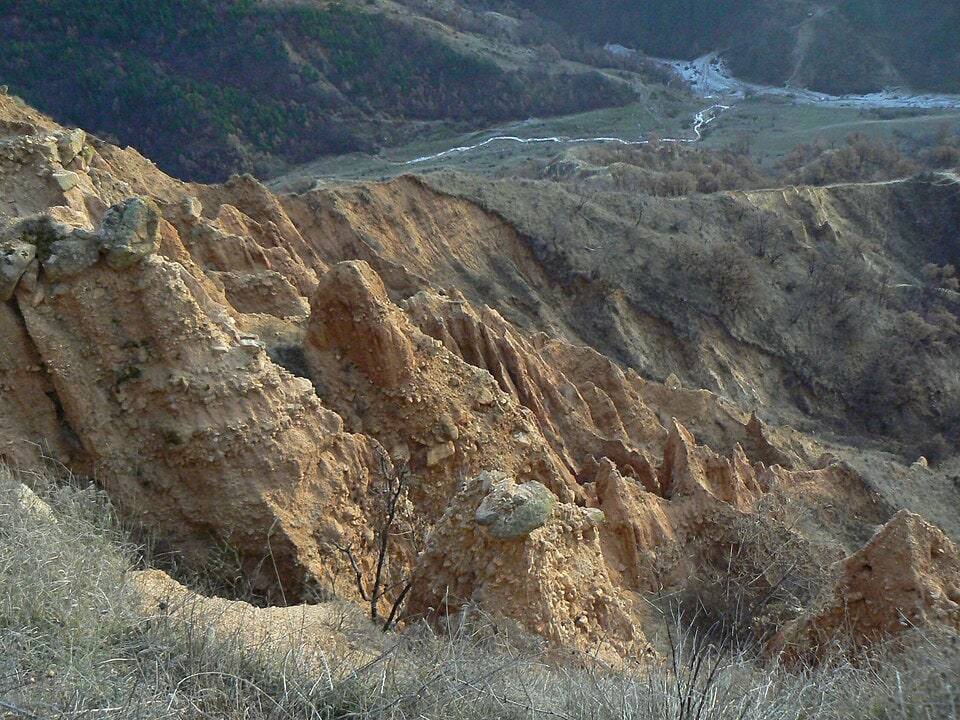
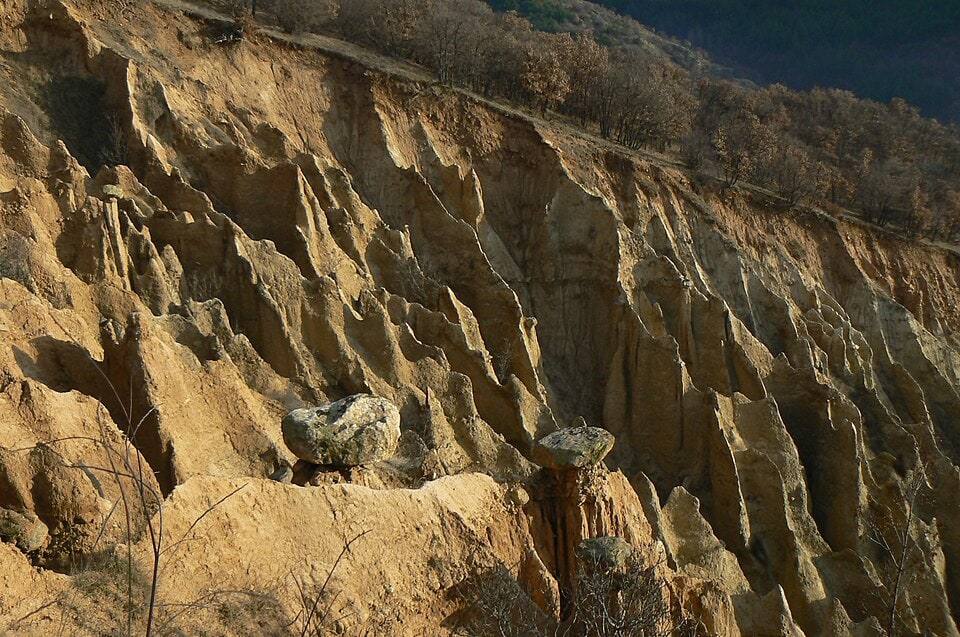
Above Stob, the slope is cut into narrow ribs and pale earth columns. Broader stones rest on some of them like caps. Individual forms sometimes join at their bases, then separate into pointed summits. The view combines an overall silhouette with many smaller details.
How the pyramids form
↗Veska Rusakova and Dimitar Dimitrov describe the habitat in volume 3 of the Red Data Book of the Republic of Bulgaria, published by BAS and the Ministry of Environment and Water in 2015. They associate it with Early Quaternary fluvioglacial deposits: material transported and deposited by waters linked to glacial activity.
The authors give a deposit thickness of 30-40 m. Individual formations are generally 6-10 m high, reaching 12 m at their tallest. Stone caps measure approximately 0.8-1 m. These figures distinguish the larger sediment layer from the individual columns carved within it.
Zdravko Iliev, Todor Todorov, Ivan Zagorchev, Evelina Djourova, and Paraskev Petrov of Sofia University and the BAS Geological Institute include Stob in “The Geological Heritage of Bulgaria,” Geologica Balcanica, volume 26, No. 1 (1996). They describe erosion forms in reddish and yellowish conglomerates and sandstones.
The accounts emphasize different aspects of the site: its geological material and the habitat developing upon it. The pyramids are natural earth formations, rather than stone buildings. Water removes more easily eroded material and gradually changes their outlines.
Color, slope, and vegetation
↗The Red Data Book gives colors ranging from pale yellow to red and dark brown. Its authors locate the habitat at 500-650 m above sea level in Rila’s Kapatnik subdivision. Most formations occupy a south-facing slope.
Vegetation is sparse on the immediately eroded surfaces. Grassland, shrub, and woodland communities develop around them. The bare columns and green slopes in panoramic photographs are neighboring parts of one habitat. Closer observation reveals differences between smooth faces, ridges, and stones retained on top.
Conservation
↗The 1996 geological overview records protection since 1964. The Red Data Book assesses the habitat as critically endangered and lists tourism infrastructure, erosion, and planting non-native trees among the adverse factors. This habitat assessment is separate from the legal category of natural monument.
View the formations from the designated trail. Climbing columns, removing their stone caps, and making shortcuts can damage features that constitute the site itself. Older photographs are not a precise map of every pinnacle, since the slope continues to change.
Visiting from Stob
↗Start from Stob. The Ministry of Tourism confirms a village tourist information center and the availability of accompaniment for organized groups along the eco-trail. Its listing gives +359 887 198 698 and +359 887 204 118.
Allow approximately an hour and a half for the ascent, observation, and return, depending on pace. Carry water and wear shoes with good grip. Check route conditions after rain. No current operator hours or prices were confirmed, so older travelogue tariffs have not been substituted.
The visit can be combined with Rila Monastery after separate travel along the valley. The two sites differ in character: this visit follows an earth slope, while the monastery has church and museum visiting arrangements.
Photos and related images
The image could not load. Its caption and source remain available.

The image could not load. Its caption and source remain available.

The image could not load. Its caption and source remain available.

Sources
(5)
A date may refer to construction, renewal, or another stated stage. Legends are accounts recorded in sources, rather than established events. Bibliography links help locate the named author; no automatic reference is added where the match is ambiguous.
- Веска Русакова, Димитър Димитров, Пирамидални образувания във флувиоглациални наслаги (Стобски пирамиди), Червена книга на Република България, том 3, БАН и МОСВ, 2015, онлайн версияOnline source · Bulgarian · e-ecodb.bas.bg
Source address
http://e-ecodb.bas.bg/rdb/bg/vol3/13H3.html
If a link does not open, use its title, author, and address to search, or consult another listed source.
- Zdravko Iliev, Todor Todorov, Ivan Zagorchev, Evelina Djourova, Paraskev Petrov, The Geological Heritage of Bulgaria (overview), Geologica Balcanica, 26, 1, 1996, с. 63-68PDF document · Bulgarian · geologica-balcanica.eu
Source address
https://www.geologica-balcanica.eu/sites/default/files/articles/GB%281996%29_26_1_pp.63-68%20%28Iliev%20et%20al%29.pdf
If a link does not open, use its title, author, and address to search, or consult another listed source.
- Stob: Tourist Information Center, Министерство на туризмаOnline source · English · tourism.government.bg
Source address
https://www.tourism.government.bg/en/node/1526
If a link does not open, use its title, author, and address to search, or consult another listed source.
- OpenStreetMap: node/4471942522Map record · Language not specified · openstreetmap.org
Source address
https://www.openstreetmap.org/node/4471942522
If a link does not open, use its title, author, and address to search, or consult another listed source.
- Национална библиотека: Български книгопис, 2016, кн. 2, записи 197-203, Червена книга, том 3 (2015)Online source · Bulgarian · nationallibrary.bg
Source address
https://www.nationallibrary.bg/BNB/s01_2016_kn02/content.html
If a link does not open, use its title, author, and address to search, or consult another listed source.