58Places of worship · Skrino
Ruen Monastery of St. John of Rila
Church built in 1995-1998; full consecration in 2003
Construction or start of building: 1995, church construction begins
Your visit at a glance
- Address
- Tsarkovnika locality, above Skrino, postal code 2663
- Suggested time; scope not confirmed
- about 1 hour
- Opening hours
- No verified information found
- Admission
- No verified information found
The image could not load. Its caption and source remain available.

Ruen Monastery of St. John of Rila stands above Skrino, in Tsarkovnika locality. Its present church was built in 1995-1998 and fully consecrated in 2003. Local tradition venerates the nearby cave as a place where St. John of Rila lived as a hermit in his early years.
Hours, admission, and directions ↓
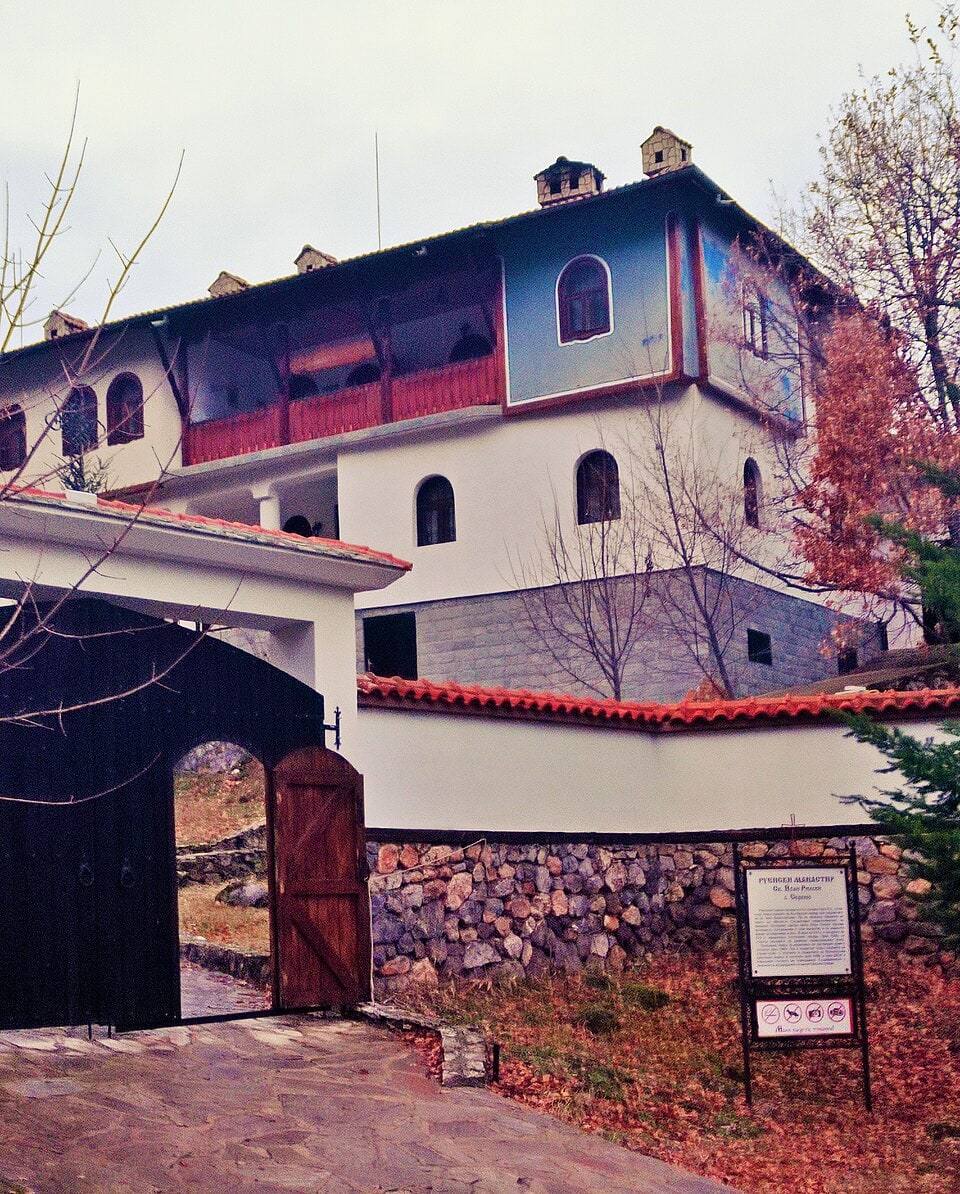
The stone church, tiled roofs, and residential wings enclose an active monastic site above the village. The monastery’s official Bulgarian name uses Yoan Rilski. Ivan is another established Bulgarian form of the same saint’s name.
Tsarkovnika and earlier remains
↗The monastery’s own history describes a small chapel that occupied the clearing before the present building. Excavations for the new construction in 1995 uncovered church foundations, parts of a floor, and fragments of wall painting.
The account suggests a medieval origin but explicitly notes the absence of further investigation to confirm it. The visible new church and the remains found beneath it therefore have different degrees of historical certainty.
Hypothesis or unconfirmed claim The same account cites a monastery called St. Father near Skrino in an Ottoman register of 1570/1573. Identifying it with the Tsarkovnika remains and the monastery of the saint’s hagiographic tradition is presented as a hypothesis. These references do not establish a single certain 10th-century building date.
Building the present monastery
↗The initiative for a church began in spring 1995. The foundation stone was laid on August 20 of that year. According to the monastery’s history, the designers were architect Anelia Paraskova and engineer Genoveva Raynova.
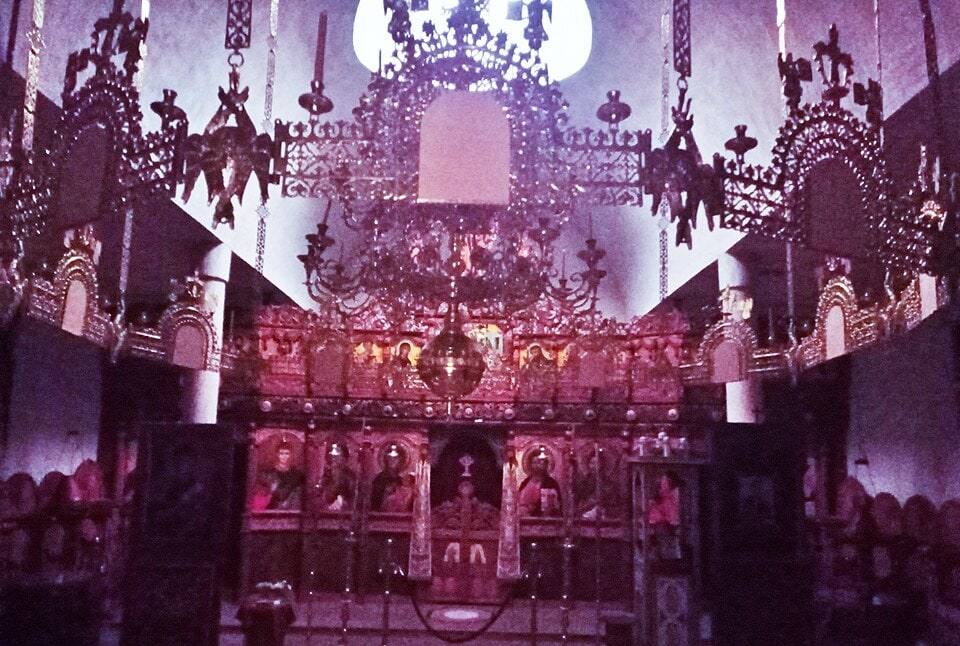
The church was completed in 1998. Simeon Toshev of Polena made the iconostasis, and Boris Donev of Blagoevgrad painted its icons. The monastery’s account thus identifies the artists responsible for these parts of the modern decoration.
Construction of a monastic wing began in 1999-2000 and finished in 2001. Full consecration of the church took place on November 19, 2003. Further buildings followed, including a bell tower in 2011-2012. This sequence explains why the commonly repeated year 1999 refers to one stage of the complex, rather than the church’s beginnings.
What is visible
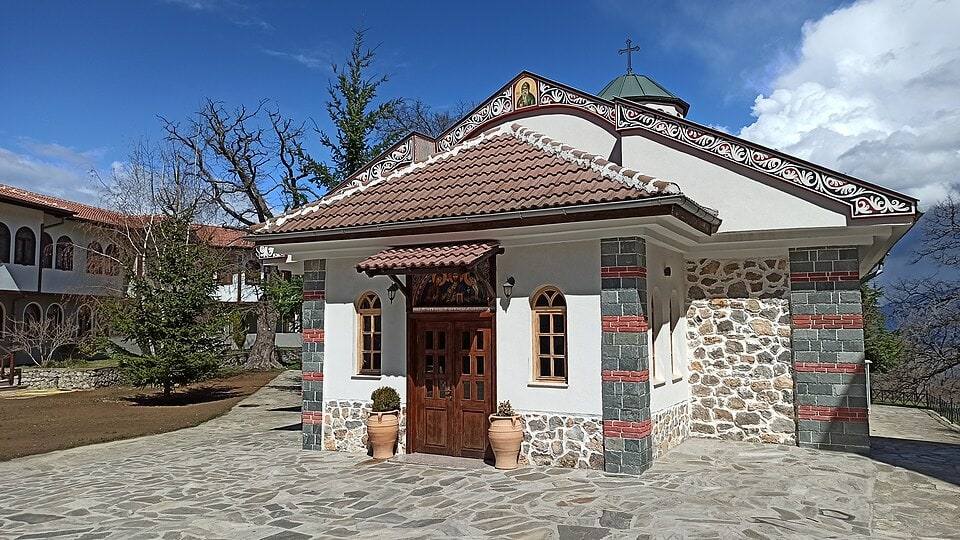
↗Stone and brick bands create a clear pattern on the main church’s exterior. Its tiled roof and small domed volume differ from the taller residential wings. Passing through the entrance leads into a courtyard that arranges these elements around the visitor.
The photographic gallery shows the church exterior, the entrance with one of the wings, and the carved iconostasis. Inside, observe icons, woodcarving, and chandeliers quietly without interrupting worship. An older freely licensed photograph does not authorize new photography on site; establish permission with the community.
Cave and tradition
↗The monastery describes a small rock niche vaulted with stone masonry, approximately ten minutes’ walk into the forest above the complex. Local people venerate it as St. John’s first hermit cave.
This is a local religious tradition. The precise place where the saint entered monastic life cannot be established from this niche alone. It is also distinct from the cave at the Old Hermitage of Rila Monastery.
Visiting
↗The official approach passes through Boboshevo toward Skrino. At the village entrance, turn left onto the paved road to the monastery. Allow approximately an hour for the courtyard, church, and short forest approach, with additional time for prayer or a service.
The monastery celebrates feast days on July 1, August 18, and October 19. Establish visiting arrangements for these days in advance. Its own website publishes an address in Skrino and ruen_manastir@abv.bg, but does not confirm a general tourist timetable or admission tariff.
Keep quiet and dress appropriately. Check the forest trail’s condition before visiting the cave. A monastery walk and a visit to medieval St. Theodore near Boboshevo are separate outings.
Photos and related images
The image could not load. Its caption and source remain available.

The image could not load. Its caption and source remain available.

Sources
(4)
A date may refer to construction, renewal, or another stated stage. Legends are accounts recorded in sources, rather than established events. Bibliography links help locate the named author; no automatic reference is added where the match is ambiguous.
- За манастира, Руенски манастир „Св. Йоан Рилски“Online source · Bulgarian · ruenskimanastir.bg
Source address
https://ruenskimanastir.bg/за-манастира_69
If a link does not open, use its title, author, and address to search, or consult another listed source.
- Как да стигнем, Руенски манастир „Св. Йоан Рилски“Online source · Bulgarian · ruenskimanastir.bg
Source address
https://ruenskimanastir.bg/как-да-стигнем_71
If a link does not open, use its title, author, and address to search, or consult another listed source.
- Контакти, Руенски манастир „Св. Йоан Рилски“Online source · Bulgarian · ruenskimanastir.bg
Source address
https://ruenskimanastir.bg/контакти_73
If a link does not open, use its title, author, and address to search, or consult another listed source.
- OpenStreetMap: node/3582420442Map record · Language not specified · openstreetmap.org
Source address
https://www.openstreetmap.org/node/3582420442
If a link does not open, use its title, author, and address to search, or consult another listed source.