34History · Zemen Gorge, above Polska Skakavitsa
Zemlangrad (Zemensko Kale)
Late Antiquity and the Middle Ages
Dating stated in the sources: 4th-6th centuries, earliest remains
Your visit at a glance
- Address
- Zemlangrad ruins in Zemen Gorge, Kyustendil Municipality
- Approximate time for the whole walking outing
- about 3 hours
- Visiting conditions
- No verified information found
- Admission
- No verified information found
The image could not load. Its caption and source remain available.

Zemlangrad stands above a bend of the Struma in Zemen Gorge. Its remains preserve traces of Late Antiquity, the Middle Ages, and later occupation, although a detailed history still requires access to the original excavation publications.
Hours, admission, and directions ↓
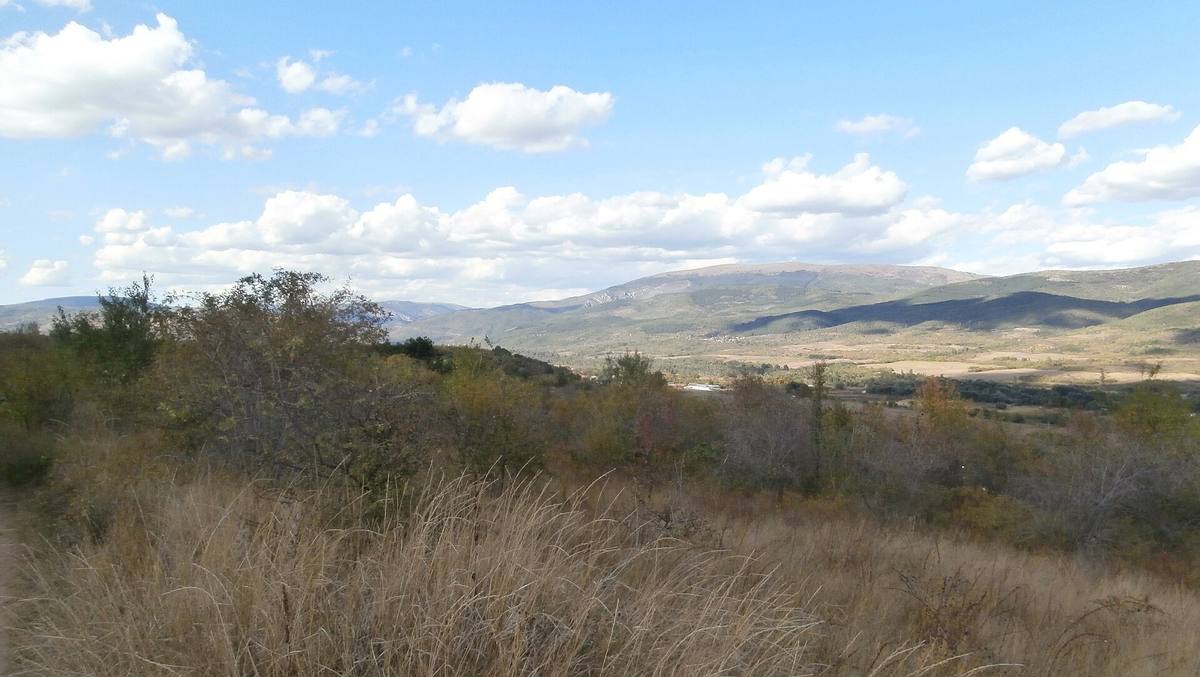
Zemlangrad, also called Zemensko Kale, is best understood through its terrain. The Struma curves around the rocky rise on three sides, with the fortification occupying its upper section. From a distance, its position above the river becomes clear; nearby, visitors must find surviving walls among the terrain and vegetation.
The fortress is in Kyustendil Municipality, in the area above Polska Skakavitsa. The gorge’s name and proximity to the town of Zemen can cause confusion. Zemlangrad is not Zemen Monastery and should not automatically be placed in Pernik Province.
Sveti Mesta’s account distinguishes the excavated Zemensko Kale from Gradishteto near Polska Skakavitsa and Trite Kuli. They are separate fortifications within the wider fortress system; excavations and finds at one do not automatically date the others.
Why a fortress stood here
↗In her 2014 account for Geograf.BG, Evgeniya Sarafova connects the remains with the old route between Pautalia and Serdica, later Velbazhd and Sredets. The gorge combines travel along a river valley with narrow sections and steep rocky slopes. Controlling such a place depended on both natural barriers and built defenses. [2]
Sarafova describes the fortress on the right bank of the Struma, with rocks rising about 130 m above the river. That height comes from her account and was not measured for this page. More useful for understanding the site is the visible relationship between the summit, the river bend, and the approaches.
Several building phases
↗The Bulgarian Castles portal summarizes four phases of construction and rebuilding: Late Antiquity, the Early Middle Ages, the 13th-14th centuries, and the 15th-17th centuries. Its description lists a defensive wall, residential and service buildings, a church, and a seven-sided keep. A keep is a separately fortified tower that can provide a last refuge and independently defended space.
The walls are described as rubble masonry bonded with mortar. Their outlines follow the rocky terrain. Visitors should not expect a regular geometric plan imposed on a level platform. The rise itself formed part of the defenses.
Hypothesis or unconfirmed claim In the same account, later finds include 16th-17th-century coins. These challenge the convenient assumption that every medieval fortress was permanently abandoned during the Ottoman conquest. Explanations of its particular ruler and the circumstances of its final destruction, however, remain hypotheses. They are not presented here as established events.
Excavations and gaps in the evidence
↗The bibliography for Polska Skakavitsa points to Dora Dimitrova: a report on the 1975 excavations, published in Archaeological Discoveries and Excavations in 1976, and an article about the fortress near Razhdavitsa in Museums and Cultural Monuments in 1981. These are important original publications for further checking. We did not have their full texts and do not attribute details from tourism summaries to Dimitrova.
Published areas also disagree. Descriptions give both 1.5 and 15 decares. Without an excavation plan, it is impossible to determine whether this reflects a mistake, differently measured sections, or different sites. This page therefore does not present either figure as the fortress’s established area.
Stories of a siege
↗Bulgarian Castles records a legend about defenders who left behind a drum powered by the wind and withdrew with their horses’ shoes fitted backward. The sound and tracks supposedly convinced the besiegers that troops remained inside. This is a story of a cunning retreat, rather than archaeological evidence for a particular siege.
Another tale concerns a treasury hidden after the Battle of Velbazhd. It belongs to local memories of warfare. It does not indicate where treasure can be found. The portal itself describes damage caused by treasure hunting to ancient remains in the gorge.
Visiting today
↗Hypothesis or unconfirmed claim Sarafova’s account describes unmarked paths that may be overgrown. The Karyerata railway stop mentioned in it has not been confirmed as operational at the time of this check. Do not treat the old article as a current timetable or instructions for crossing a quarry or railway infrastructure.
Allow several hours and confirm the approach with a local guide. We found no visiting arrangements or admission price published by a site operator. A distant panorama helps explain the fortress’s position; it does not promise easy access to the remains themselves.
Sources
(7)
A date may refer to construction, renewal, or another stated stage. Legends are accounts recorded in sources, rather than established events. Bibliography links help locate the named author; no automatic reference is added where the match is ambiguous.
- Google Maps: Землънград (Земенско кале)Online source · Bulgarian · google.com
Source address
https://www.google.com/maps/place/Крепост+„Земенско+кале“/data=!4m6!3m5!1s0x14aaa17ce48b233f:0x2779af652a1236ae!8m2!3d42.4375625!4d22.7089844!16s%2Fg%2F11j3rrh4z1
If a link does not open, use its title, author, and address to search, or consult another listed source.
- Евгения Сарафова. Крепостта Землънград, Географ.БГ, 30.01.2014Online source · Bulgarian · geograf.bg↑1
Source address
https://geograf.bg/bg/article/krepostta-zemlngrad-tneshcho-v-zabrava-myasto-na-slavni-boeve-ot-srednovekovieto
If a link does not open, use its title, author, and address to search, or consult another listed source.
- Гр. Кюстендил: Землънград, Български крепостиOnline source · Bulgarian · bulgariancastles.com
Source address
https://www.bulgariancastles.com/gr-kyustendil-zemlangrad/
If a link does not open, use its title, author, and address to search, or consult another listed source.
- История, Община ЗеменOnline source · Bulgarian · zemen-bg.com
Source address
https://zemen-bg.com/history
If a link does not open, use its title, author, and address to search, or consult another listed source.
- Полска Скакавица, Уикипедия (библиографски сведения)Encyclopedia article · Bulgarian · bg.wikipedia.org
Source address
https://bg.wikipedia.org/wiki/Полска_Скакавица
If a link does not open, use its title, author, and address to search, or consult another listed source.
- Свети места. Град Земен, раздел Крепостите на Землън град: отделните Градището, Земенско кале и Трите кулиOnline source · Bulgarian · svetimesta.com
Source address
https://svetimesta.com/България/Пернишка%20област/Zemen
If a link does not open, use its title, author, and address to search, or consult another listed source.
- Свети места. Село Полска Скакавица, двете крепости и библиографските сведенияOnline source · Bulgarian · svetimesta.com
Source address
https://svetimesta.com/България/Кюстендилска%20област/Село%20Полска%20Скакавица
If a link does not open, use its title, author, and address to search, or consult another listed source.