33Museums and buildings · Shishkovtsi
Vladimir Dimitrov-Maystora House Museum
Museum since 1982
Dating stated in the sources: 1982
Your visit at a glance
- Address
- Vladimir Dimitrov-Maystora House Museum, Shishkovtsi
- Suggested time; scope not confirmed
- about 1 hour
- Opening hours
- No verified information found
- Admission
- No verified information found
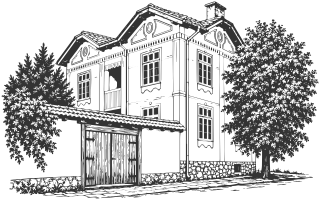
The house museum in Shishkovtsi tells the story of the people and places that entered Vladimir Dimitrov-Maystora’s paintings. Its photographic and documentary exhibition is maintained by the Kyustendil art gallery.
Hours, admission, and directions ↓
In Shishkovtsi, The Master found surroundings that became the subject of his mature paintings. The house museum brings that relationship into focus: the artist, the families with whom he lived, and the villagers who posed for him. Here, art history passes through ordinary rooms and specific human relationships.
From Frolosh to Shishkovtsi
↗Vladimir Dimitrov was born in 1882 in Frolosh. Shishkovtsi was the village of his mature years, but it was not his birthplace. The art gallery’s biography follows his family’s move to Kyustendil, his work as a court clerk, and his first exhibition in 1903. With support from local residents, he entered the State Drawing School in Sofia. His fellow students gave him the nickname “The Master.”
According to the gallery, he settled in Shishkovtsi in 1924 at the invitation of Andon Viyachev. This is the important starting date. The duration of his stay, however, is described in different ways. The page about his work highlights 1924-1945, while the museum exhibition covers the broader period 1921-1950 and refers to nearly 29 “Shishkovtsi years.” These spans describe different aspects of his life and work. They should not become a confident claim about an exact, uninterrupted residence in a single house.
An artist’s home, a family’s home
↗The gallery emphasizes that The Master had neither a home of his own nor a separate studio. He occupied a room in a family house, with painting and daily life sharing the same space. Much of his work took place outdoors: in fields and orchards, at village celebrations, and among local people. The museum’s story therefore includes his hosts, models, and friends.
Do not imagine a museum of a large private estate furnished to the artist’s taste. This house has a different significance. It preserves the memory of someone who chose to live close to his models and the land he painted. The exhibition presents villagers as identifiable people and participants in his creative process, rather than an anonymous backdrop.
Inside the exhibition
↗The official description lists six spaces on two floors: two downstairs and four upstairs. Photographic and documentary materials come from the Scientific Archive and collections of the Vladimir Dimitrov-Maystora Art Gallery in Kyustendil. They trace his life and artistic career, emphasizing the village and its surroundings.
The house museum opened in 1982, marking the centenary of the artist’s birth. Writing in Culture Portal in 2024, Daniel Penev describes the renewed exhibition, including the room The Master rented. This helps explain the difference between a visit here and viewing paintings in the Kyustendil art gallery. In the village, the emphasis is on place, documents, and people’s memories; in the gallery, visitors can follow his development as a painter. [4]
People’s memories
↗In the same report, Penev introduces curator Kiril Ivanov and his practice of collecting memories from local families and visitors. Ivanov’s grandmother, Verka Viyacheva, posed for The Master. Such oral accounts have their own value, but they should be understood as the memories of particular people. Not every family story is an independently established biographical fact.
The artist died in 1960. The gallery records his reburial in Shishkovtsi in 1972. His connection to the village therefore continued after his death. Visitors can bring together the house, memories of his models, and the village landscape in one walk, while keeping this museum distinct from other houses in which he lived.
Visiting
↗The gallery gives a road distance of about 15 km from Kyustendil and a separate museum telephone number: +359 895 554 782. Allow about an hour, or longer for a guided talk. Confirm access in advance. The official website contains conflicting seasonal hours, and we found no unambiguous admission price for this house. The city gallery’s hours and prices have therefore not been applied here.
Sources
(5)
A date may refer to construction, renewal, or another stated stage. Legends are accounts recorded in sources, rather than established events. Bibliography links help locate the named author; no automatic reference is added where the match is ambiguous.
- Къща музей, ХГ „Владимир Димитров-Майстора“Institutional page · Bulgarian · artgallery-maystora.org
Source address
https://artgallery-maystora.org/къща-музей/
If a link does not open, use its title, author, and address to search, or consult another listed source.
- Майстора, ХГ „Владимир Димитров-Майстора“Institutional page · Bulgarian · artgallery-maystora.org
Source address
https://artgallery-maystora.org/майстора/
If a link does not open, use its title, author, and address to search, or consult another listed source.
- Биография, ХГ „Владимир Димитров-Майстора“Institutional page · Bulgarian · artgallery-maystora.org
Source address
https://artgallery-maystora.org/биография/
If a link does not open, use its title, author, and address to search, or consult another listed source.
- Даниел Пенев. Памет за Майстора, Портал Култура, 1.02.2024Online source · Bulgarian · kultura.bg↑1
Source address
https://kultura.bg/web/пазителят-на-паметта-за-майстора/
If a link does not open, use its title, author, and address to search, or consult another listed source.
- OpenStreetMap: node/10665155495Map record · Language not specified · openstreetmap.org
Source address
https://www.openstreetmap.org/node/10665155495
If a link does not open, use its title, author, and address to search, or consult another listed source.