16History · Nevestino
Kadin Bridge
874 AH (1469-1470)
Dating stated in the sources: 1469-1470
Your visit at a glance
- Address
- Center of Nevestino village, over the Struma River
- Suggested time; scope not confirmed
- about 30 minutes
- Visiting conditions
- No verified information found
- Admission
- No verified information found
The image could not load. Its caption and source remain available.

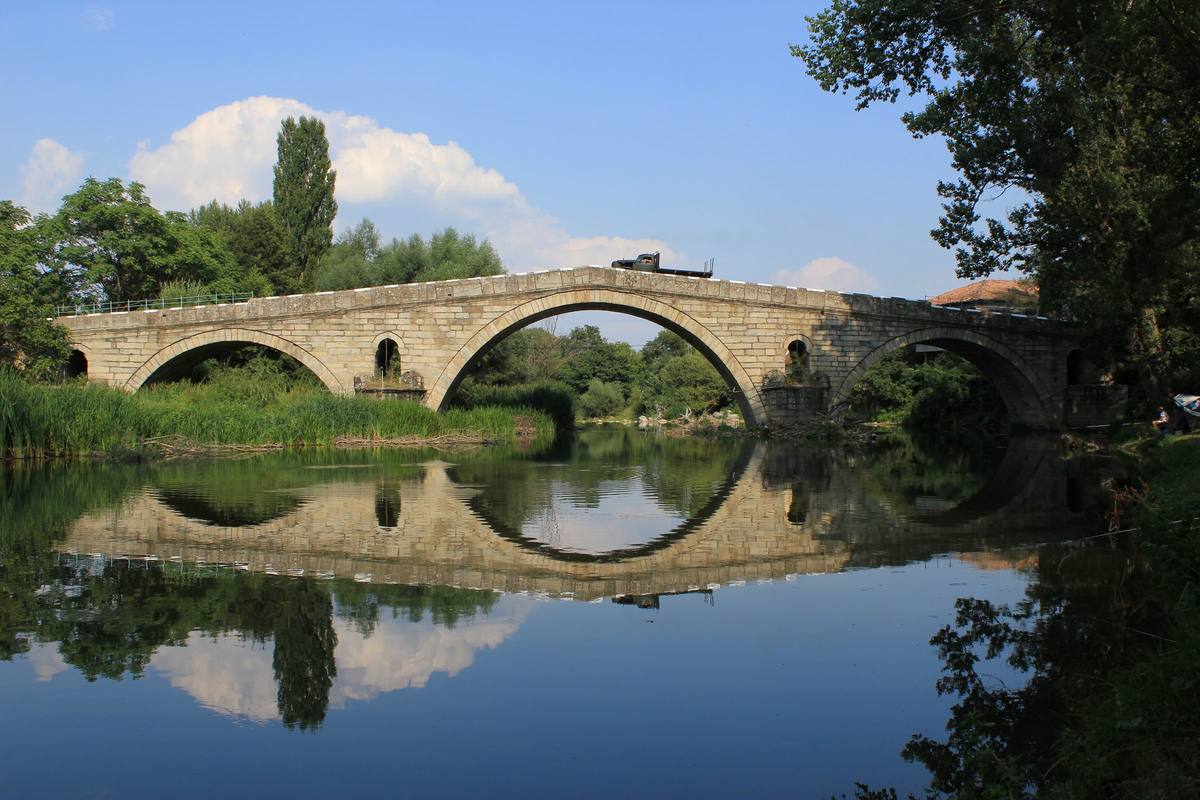
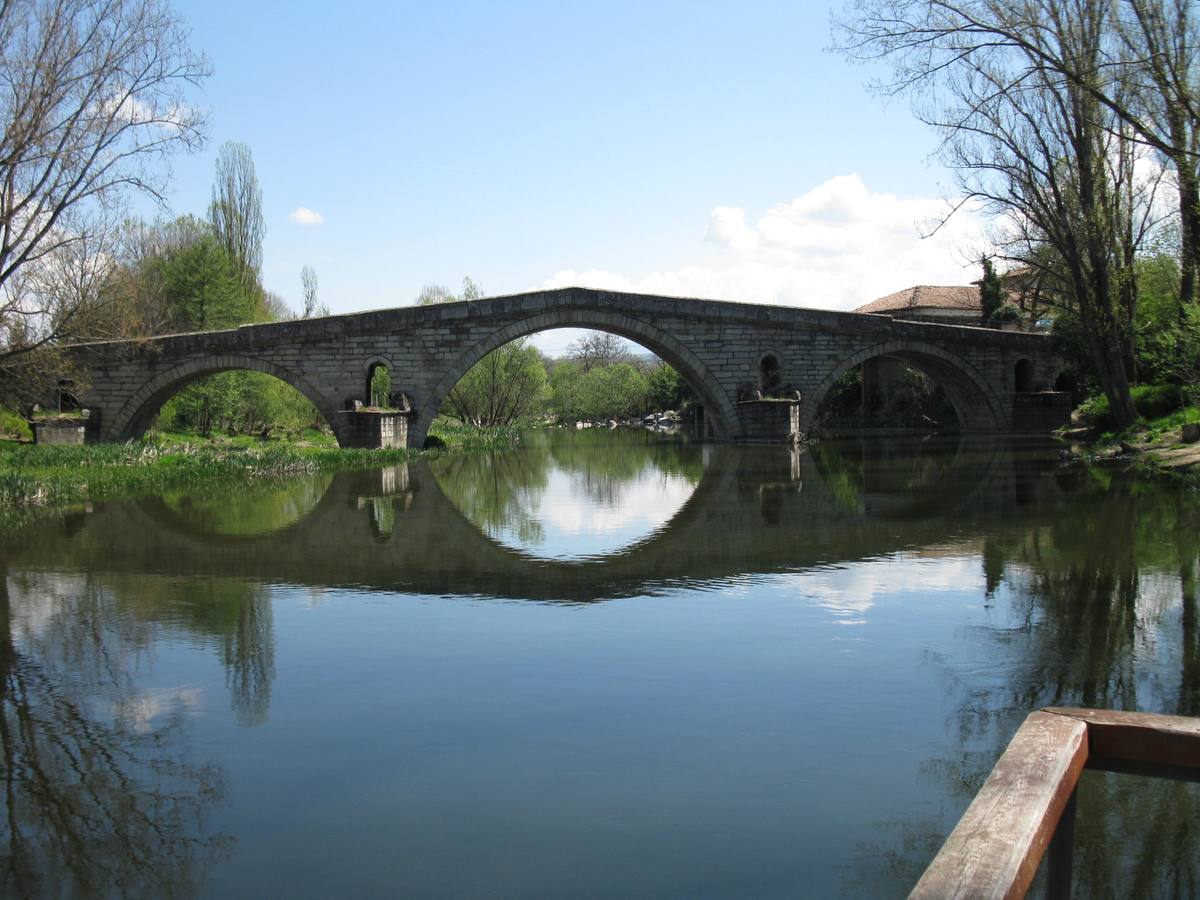
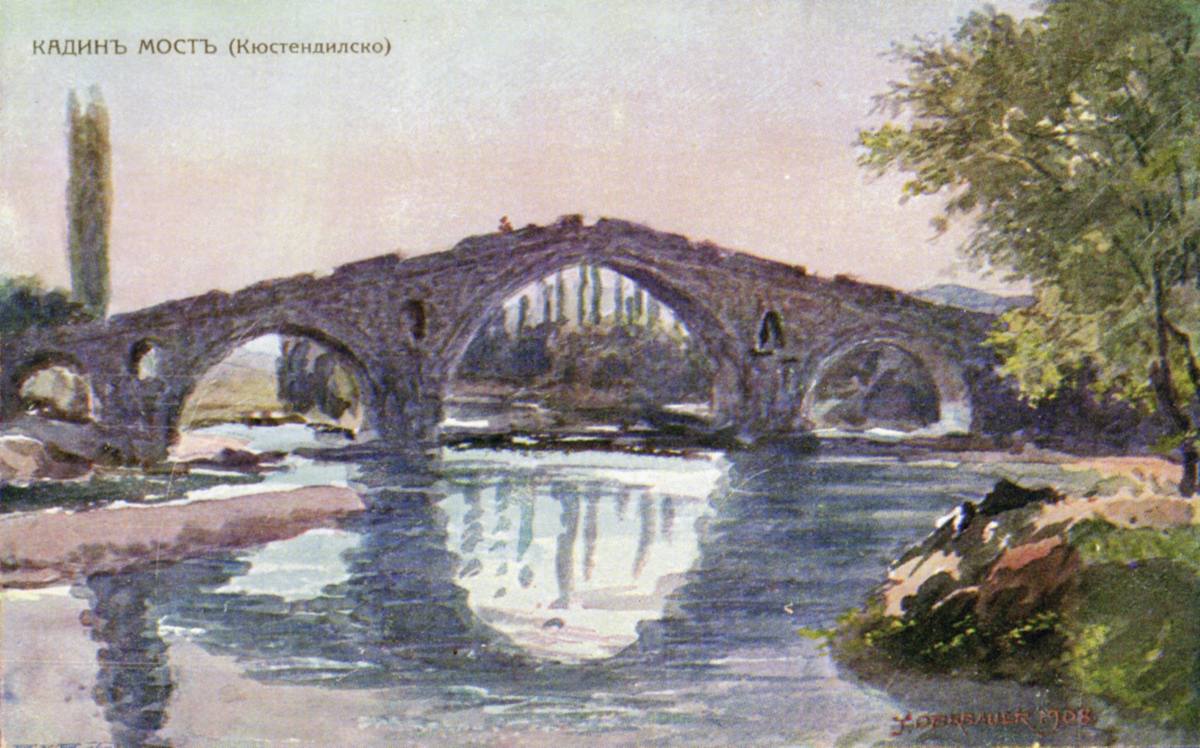
A stone bridge over the Struma at Nevestino, built in the Islamic year 874 (1469-1470) on the orders of Grand Vizier Ishak Pasha. It has five granite arches, the highest in the middle, and the local legend: the bride walled into the central arch. Travelers described it as early as the 16th century, and more than five centuries later cars still cross it.
Hours, admission, and directions ↓
You can see the bridge from far off: humpbacked, with five arches that step down toward the banks, the highest in the middle. The Struma flows beneath it. The legends told about it were written down by scholars 140 years ago and compared with the Serbian epic of Skadar and with the Bible.
Construction
↗The bridge is made of “large dressed granite blocks.” It is about 100 m long and about 5 m wide, with five round arches. The middle one, with a span of about 20 m, is the highest and widest. The Czech historian Konstantin Jireček wrote that the middle rises “about two men’s height above the ends.” [2]
- The piers have wedge-shaped cutwaters that split the current, and each is pierced by a small arched opening for floodwater.
- The decoration consists of stalactite ornaments and rosettes.
- The bridge sits at an angle to the current, so it looks asymmetric.
Its style is “a mix of ancient, medieval, and Renaissance forms.” The archaeologist Andrew Petersen calls it “one of the earliest and most impressive” Ottoman bridges in Bulgaria.
The bridge also carries older stones. Efrem Karanov wrote in 1884 that “on it there are old stones with Latin inscriptions.” On the cutwater of the easternmost pier, Jireček saw a stone with a clearly carved name: Παυταλίαν, Pautalia, the Roman city that stood where Kyustendil is now. The bridge itself, he notes, “is not an ancient work.” [1]
The inscription
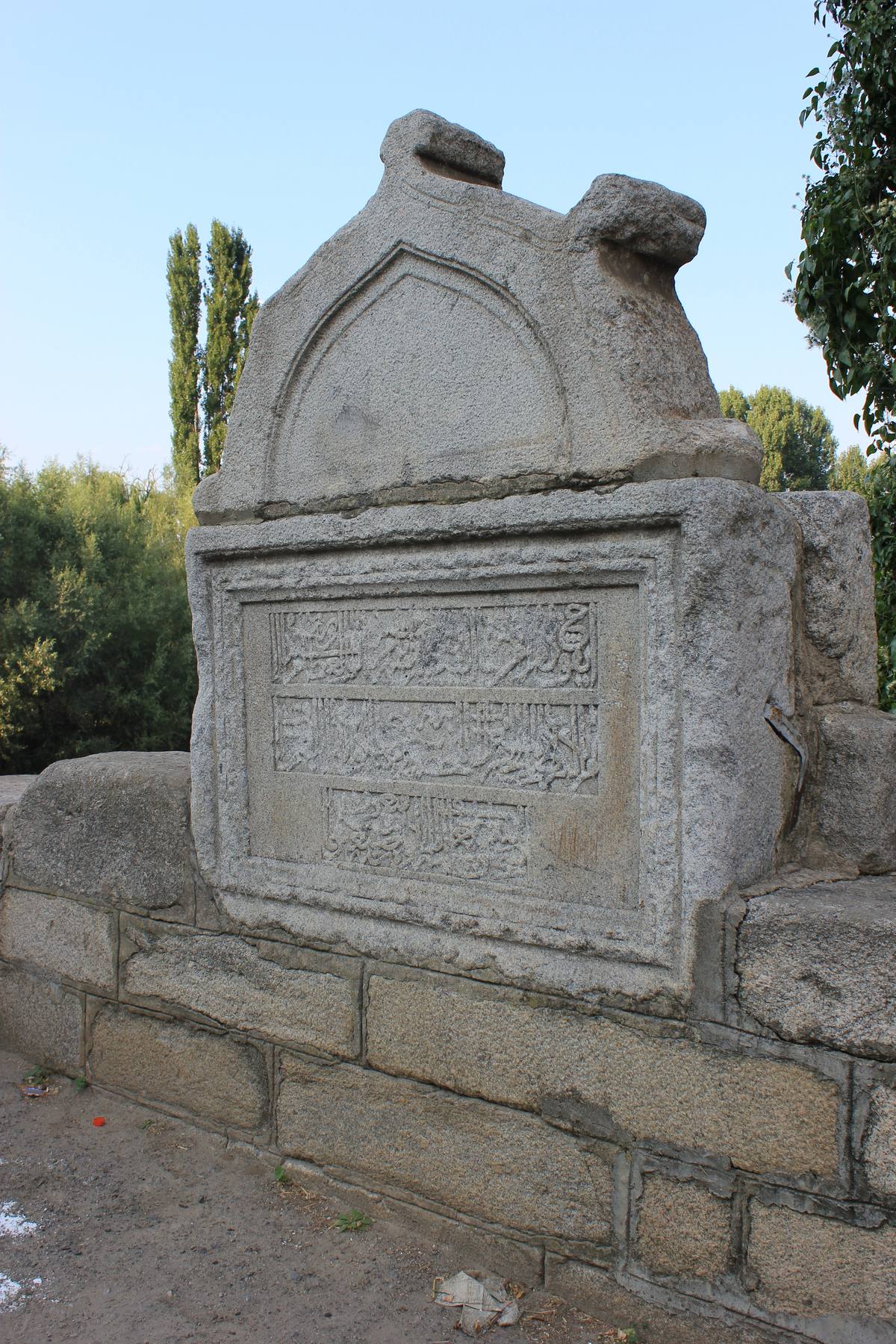
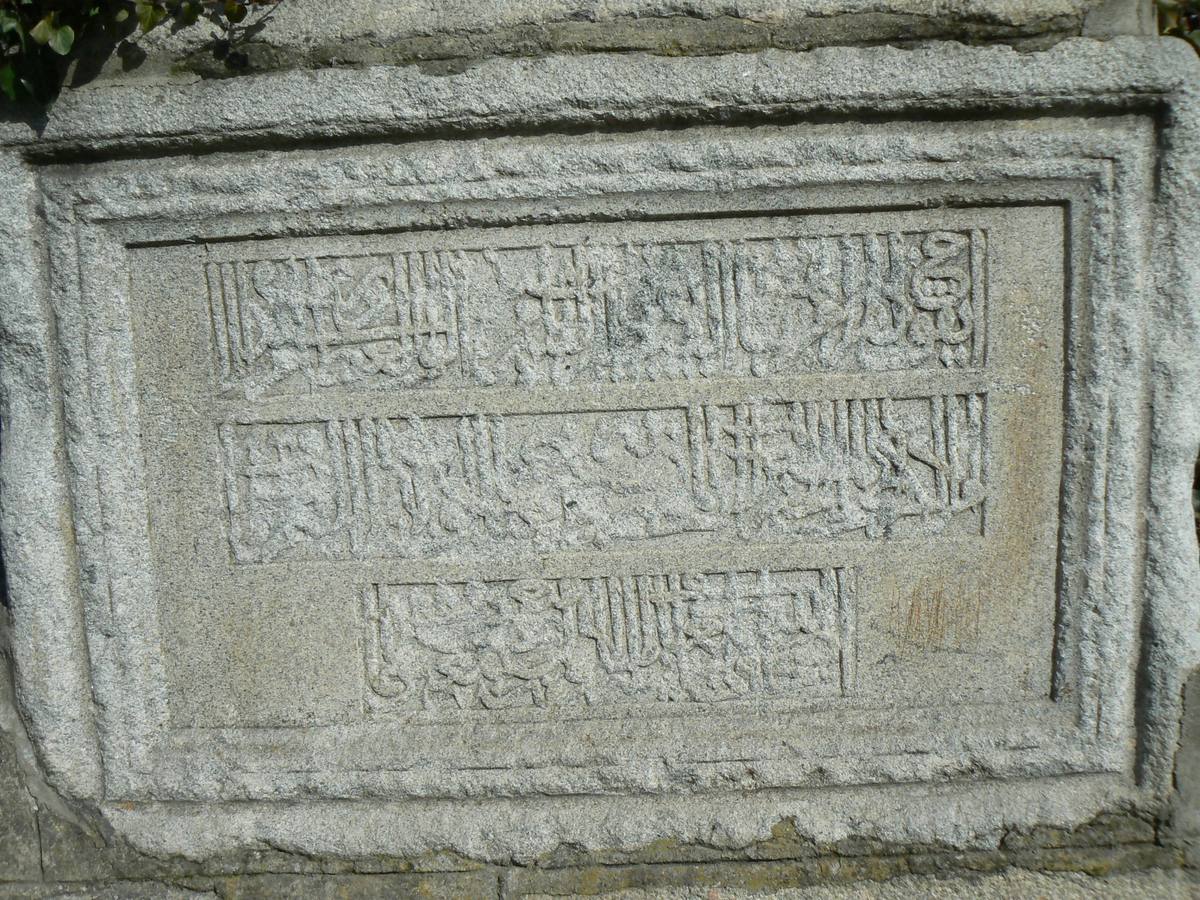
↗A granite slab with an inscription in Arabic script is set into the parapet. Modern sources place it in the eastern parapet, on the south side. Jireček, in the 1880s, described it in the southern parapet near the western end, so it’s worth checking on site.
The first translation was made for Jireček by the Viennese Orientalist Prof. Karabacek: “Our lord, the serdar, the exalted vizier, lord of the great emirs and founder of pious and good works… Ishak Pasha, whom God Almighty may preserve, ordered the building of this bridge, in the year 874.”
The Bulgarian translation in circulation today, by an unknown translator, reads: “By the high command of Ishak Pasha, one of the greatest viziers and noble commanders, who does good deeds from a pure motive of the soul… there was ordered to be built in this land this sacred bridge for the free passage of travelers. May God the Most High fill his life with joy and gladness. Year 874.”
The year 874 of the Hijra ran from July 11, 1469, to June 29, 1470. That is when the first grand vizierate of İnegöllü İshak Pasha began (1469-1472), under Sultan Mehmed II. Karanov thought the Turkish slab had been “brought in afterward,” but that is only his opinion.
A bridge on the road
↗The bridge stood on the old road from Kyustendil to Dupnitsa, “two hours from Kyustendil.” Travelers noted it as early as the 16th century:
- Around 1502 the Croatian humanist Felix Petančić wrote of “the baths of Velbazhd and the bridge of the Struma, which divides the Macedonians from the Triballi, or Bulgarians.”
- In January 1531 Benedikt Kuripešić, traveling with a Habsburg embassy, came to “a fine stone bridge.”
- Around 1559 an anonymous Venetian saw on the Struma “a large and fine bridge, built by a certain Mustafa Pasha.” Jireček thought he was confusing it with Mustafa Pasha’s bridge near Edirne.
The road stayed important later too. In 1885, before the Serbo-Bulgarian War, the Western Corps was stationed here. In 1902 an infantry battalion stood at Kadin Most, and during World War I there was a rear-area command post here.
The name
↗Two explanations of the name were already recorded in the 19th century:
- from kadı, a judge;
- from kadın, a woman or bride, hence “the Bride’s Bridge.”
Karanov, and the locals Jireček spoke to, preferred the second: the name comes “not from kadi but from kadin.” Karanov adds that the real “Kadiin most,” supposedly built by a judge, was a different, small bridge on a tributary of the Struma, on the road to Boboshevo through the village of Drumohar. By his time nothing was left of it.
In the 19th century townspeople said “Kadiin most” and villagers said “Kadin.” Karanov believed the bridge’s name passed to the village, which “in all likelihood” grew up beside the bridge after it was built.
Legends
↗The walled-in bride
The oldest record is Efrem Karanov’s, from 1884, made at Jireček’s request: [1]
“Three brothers, master builders, were making the bridge… but they could not finish it, because they could not close the middle arch at all.”
The bridge “wants a kurban, a sacrifice.” The brothers agreed to wall in whichever of their wives came first the next morning with their food. The two elder brothers warned their wives; the youngest said nothing. In the morning “the youngest daughter-in-law” came first. They walled her into the middle arch. She begged them to leave “her breasts and her eyes outside, so that she could nurse her child and watch over it, for it was a baby in swaddling clothes,” and the builders did so. “…and to this day, they say, she wails on certain nights.”
Karanov also records a belief: superstitious women from the villages around and from Kyustendil broke off bits of the middle stone, boiled them, and drank the water so they would have milk for their children. Jireček adds that her crying is heard “on certain windy nights.”
In the 19th-century records the bride and the builders have no names. The names “Struma” and “master Manol” appear only in modern retellings.
Scholars set the legend in a wide context. Karanov compared it with Norse myths, with the Serbian song “The Building of Skadar,” and with the Bible (1 Kings 16:34). Jireček wrote that it is the same as the legend at Hisarya and “widespread among all the peoples of the peninsula.” V. Nikolova studied the motif in “Theses on the Topic of the Immured Wife” (Literaturna misal, 1991). The same year the article also appeared in English in Études balkaniques, the journal of the Institute of Balkan Studies at the Bulgarian Academy of Sciences.
The stones that walked
Karanov also tells that the iron tool “that quarried the stones for the bridge by itself in the forests above Kyustendil” stuck fast in the rocks when the bridge was finished. The stones that had walked to the site on their own stopped on the road, “and to this day people point to such stones near the village of Bagrentsi.” Jireček places the iron in the rocks above Zhilentsi.
In the fields near Bagrentsi Jireček did see “several huge dressed stones” and the foundations of large buildings. The legend probably explains Roman remains, though that is our interpretation.
The sultan and the brave bride
A later legend says the army of Sultan Murad met a wedding party. Everyone fled except the bride, who bowed to the sultan. Asked what she wanted, she asked for “a bridge to join the two banks of the river, so she could visit her old mother.” “Her wish was granted that very year.” The inscription, however, names Ishak Pasha, under Mehmed II.
Walling in a shadow
Karanov also recorded an older belief: “Often, instead of the victim itself, it is the victim’s shadow that is walled into the foundation.” So people ran from building sites so their shadow wouldn’t be walled in, and if someone died soon after a foundation was laid, people said his shadow had been walled in. Jireček adds that builders could measure a passerby’s shadow; the man would die and become the building’s ghost. More often, a lamb or a rooster was sacrificed in the foundations.
Other traditions
- The girl named Struma. A popular legend tells of a beautiful girl named Struma who threw herself into the water rather than be forcibly converted. The river turned back and took her name.
- The founding of Chetirtsi. The neighboring village of Chetirtsi was founded, tradition says, by four settlers who came “from the old village by Kadin Most, after an Albanian raid.”
- The cart full of skulls. Jireček heard that near the ruined church of St. Spas, villagers had “recently” dug up a metal cart full of horse skulls. Nothing was kept.
Old Nevestino
↗“A hundred years ago,” Karanov wrote in 1884, in the time of lawless raids, old Nevestino on the left bank burned down. Jireček specifies that the kardzhali bandits burned it. The survivors rebuilt it on the right bank. At the old site the ruined church of St. Spas remained, where a fair was held on Ascension Day. In 1930 Kadin Most was declared a separate settlement, and in 1955 it was merged into Nevestino as a neighborhood.
Jireček at the bridge
↗On September 11, probably in 1883, Konstantin Jireček came from Kyustendil with two companions to survey the bridge. He measured it: 144 paces long, 7 wide, with five round arches. At the west end stood a small inn. The Struma ran along the right bank, leaving the two outer left arches “dry.” Heavy rain cut his survey short. [2]
Today
↗The bridge has been an architectural monument of national importance since 1968. In 2020 Nevestino Municipality contracted its repair under the Interreg Bulgaria-North Macedonia program, in the project Revival of Timeless Symbols of Dojran and Nevestino. The contract was for €197,181, with the Kyustendil firm Rila. According to Darik radio, repair and cleaning of the bridge began in 2020; we could not find what the repair covered or when it was finished.
Opposite the bridge stands the sculpture Struma the Bride by Mite Chudomirov. The bride holds apples, as in a painting by Maystora. Around it is a park with places to rest and fish, and a view toward Rila. Nearby are the restored Chetirski Inn and a tavern.
Every summer since 2006 Nevestino hosts the folk festival Struma Sings. In 2026 it was held on August 22-23.
Photos and related images
The image could not load. Its caption and source remain available.

The image could not load. Its caption and source remain available.

The image could not load. Its caption and source remain available.

Document or artwork related to this sight
The image could not load. Its caption and source remain available.

Sources
(21)
A date may refer to construction, renewal, or another stated stage. Legends are accounts recorded in sources, rather than established events. Bibliography links help locate the named author; no automatic reference is added where the match is ambiguous.
- Ефрем Каранов. Нѣколко думи за „Кадинъ мостъ“ и за вѣрвания при съгражданието нови здания, Периодическо списание, кн. 7, 1884 (Библиотека „Струмски“)Online source · Bulgarian · strumski.com↑1 ↑2
Source address
https://www.strumski.com/biblioteka/?id=288
If a link does not open, use its title, author, and address to search, or consult another listed source.
- Konstantin Jireček. Cesty po Bulharsku, 1888, archive.orgOnline source · Language not specified · archive.org↑1 ↑2
Source address
https://archive.org/details/cestypobulharsku00jire
If a link does not open, use its title, author, and address to search, or consult another listed source.
- İshak Paşa (İnegöllü), TDV İslâm AnsiklopedisiOnline source · Turkish · islamansiklopedisi.org.tr
Source address
https://islamansiklopedisi.org.tr/ishak-pasa
If a link does not open, use its title, author, and address to search, or consult another listed source.
- Kâzım Çeçen. Köprü, TDV İslâm Ansiklopedisi, c. 26, 2002Online source · Turkish · islamansiklopedisi.org.tr
Source address
https://islamansiklopedisi.org.tr/kopru
If a link does not open, use its title, author, and address to search, or consult another listed source.
- Kadın Köprüsü, Köstendil, Kültür EnvanteriOnline source · Turkish · kulturenvanteri.com
Source address
https://kulturenvanteri.com/yer/kadin-koprusu-kostendil/
If a link does not open, use its title, author, and address to search, or consult another listed source.
- Гражина Шват-Гълъбова. Българската научна мисъл в търсене на съгласуван разказ за фолклорния топос за вградената невеста, Palaeobulgarica, 2025PDF document · Bulgarian · palaeobulgarica.eu
Source address
https://palaeobulgarica.eu/sites/default/files/pdf-journal/Articles/2025/2025_5_a42_ft.pdf
If a link does not open, use its title, author, and address to search, or consult another listed source.
- История, Община НевестиноOnline source · Bulgarian · nevestino.bg
Source address
https://nevestino.bg/municipality/history
If a link does not open, use its title, author, and address to search, or consult another listed source.
- Проекти, Община НевестиноOnline source · Bulgarian · nevestino.bg
Source address
https://nevestino.bg/proekti
If a link does not open, use its title, author, and address to search, or consult another listed source.
- Култура, Община НевестиноOnline source · Bulgarian · nevestino.bg
Source address
https://nevestino.bg/kultura
If a link does not open, use its title, author, and address to search, or consult another listed source.
- Кадин мост, символ на вечността, 100obekta.com (Община Невестино)Online source · Bulgarian · 100obekta.com
Source address
https://100obekta.com/кадин-мост-символ-на-вечността/
If a link does not open, use its title, author, and address to search, or consult another listed source.
- Започна ремонт и почистване на Кадин мост, Дарик, 2020Online source · Bulgarian · darik.bg
Source address
https://darik.bg/zapochna-remont-i-pochistvane-na-kadin-most-edin-ot-nai-starite-mostove-v-balgaria
If a link does not open, use its title, author, and address to search, or consult another listed source.
- Зазидана в мост над река Струма кърмачка плаче нощем с глас, Труд, 2015Online source · Bulgarian · trud.bg
Source address
https://trud.bg/a/articles/article-4707633
If a link does not open, use its title, author, and address to search, or consult another listed source.
- Kadin bridge, Nevestino, No Frontiers 21 Century (IPA CBC)Online source · Language not specified · nf-21.com
Source address
https://nf-21.com/DC/en/material-assets/en/material-assets/kyustendil/112-medieval-bridge
If a link does not open, use its title, author, and address to search, or consult another listed source.
- Кадин мост, УикипедияEncyclopedia article · Bulgarian · bg.wikipedia.org
Source address
https://bg.wikipedia.org/wiki/Кадин_мост
If a link does not open, use its title, author, and address to search, or consult another listed source.
- OpenStreetMap: Кадин мостMap record · Bulgarian · openstreetmap.org
Source address
https://www.openstreetmap.org/way/1421731713
If a link does not open, use its title, author, and address to search, or consult another listed source.
- A. Petersen. “Under the Yoke”: The Archaeology of the Ottoman Period in Bulgaria, Journal of Islamic Archaeology, 2017 (excerpt in Google Scholar)Online source · English · scholar.google.com
Source address
https://scholar.google.com/scholar?q=%22Under+the+Yoke%22+%22Archaeology+of+the+Ottoman+Period+in+Bulgaria%22
If a link does not open, use its title, author, and address to search, or consult another listed source.
- Ishak Pasha, WikipediaEncyclopedia article · English · en.wikipedia.org
Source address
https://en.wikipedia.org/wiki/Ishak_Pasha
If a link does not open, use its title, author, and address to search, or consult another listed source.
- Марш маньовър на Българската армия през 1885 г., УикипедияEncyclopedia article · Bulgarian · bg.wikipedia.org
Source address
https://bg.wikipedia.org/wiki/Марш_маньовър_на_Българската_армия_през_1885_г.
If a link does not open, use its title, author, and address to search, or consult another listed source.
- Владимир Караманов, УикипедияEncyclopedia article · Bulgarian · bg.wikipedia.org
Source address
https://bg.wikipedia.org/wiki/Владимир_Караманов
If a link does not open, use its title, author, and address to search, or consult another listed source.
- Кадин мост, с. Невестино, e-Tours (маршрути за достъпен туризъм)Online source · Bulgarian · routes.e-tours.bg
Source address
https://routes.e-tours.bg/place/kadin-most-s-nevestino
If a link does not open, use its title, author, and address to search, or consult another listed source.
- Kadin Bridge in Nevestino, PhotomomentsOnline source · Language not specified · photomoments.bg
Source address
https://www.photomoments.bg/post/kadin-bridge-in-nevestino
If a link does not open, use its title, author, and address to search, or consult another listed source.