43Places of worship · Goranovtsi
St. Archangel Michael Church
15th-17th centuries, according to Angel Angelov
Dating stated in the sources: 15th-16th centuries, first phase
Your visit at a glance
- Address
- North of Goranovtsi, beside the Dragovishtitsa River
- Suggested time; scope not confirmed
- about 30 minutes
- Opening hours
- No verified information found
- Admission
- No verified information found
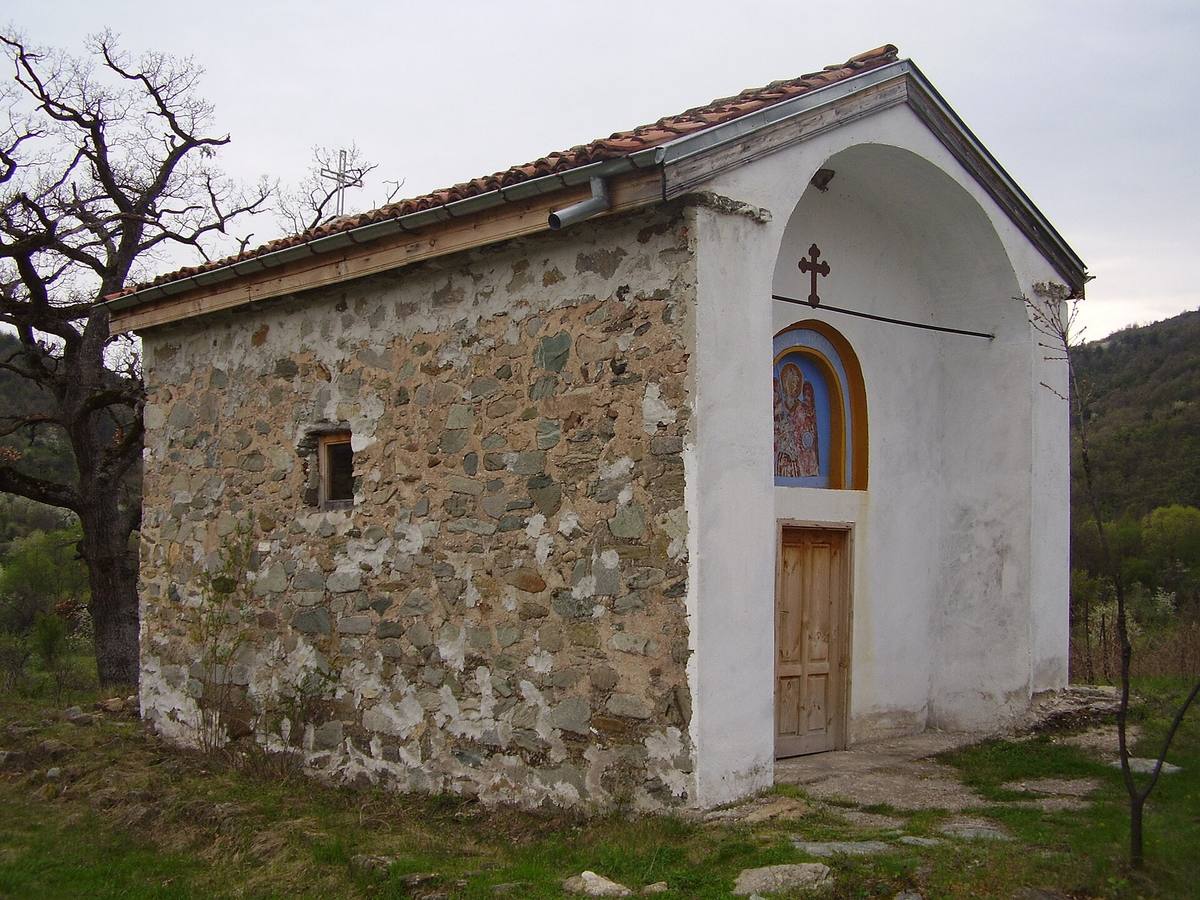
The image could not load. Its caption and source remain available.

The small church near Goranovtsi preserves traces of rebuilding and two layers of wall painting. Angel Angelov’s study in Archaeology (2003) dates its first construction phase to the 15th-16th centuries, later than the widely repeated 13th-century date.
Hours, admission, and directions ↓
The low stone church of St. Archangel Michael stands on the right bank of the Dragovishtitsa, about 2 km north of Goranovtsi. The locality is known as Manastircheto, “the little monastery.” Its small building preserves several stages of construction, painting, and restoration.
When it was built
↗The dating needs qualification. Bulgarian Wikipedia gives the 13th century, referring to nearby coin finds, and records differing dates proposed for the paintings. A coin found near a building, however, does not by itself date each of its walls.
Angel Angelov studied the church in Archaeology, published by the National Archaeological Institute with Museum at the Bulgarian Academy of Sciences, in 2003. The published English abstract distinguishes three construction phases. The first belongs to the 15th-16th centuries; rebuilding followed in the 17th; conservation and restoration took place in the second half of the 20th century. We follow this sequence here while acknowledging the earlier dates reported elsewhere.
The same author suggests that the original church may have had a dome. During rebuilding, it was removed and replaced by a barrel vault. Parts of the apse were renewed as well. The present roof therefore belongs to the history of alterations rather than establishing the building’s original silhouette.
Stone outside, brick inside
↗The church has a single nave and one apse. Angelov’s abstract gives dimensions of 6.50 by 4.30 m. Mortar binds the stone walls. Inside, three brick niches articulate each of the northern and southern sides, with additional brick facing above them.
The author draws attention to the construction joints between the niches and the stone walls. Such joins help identify different interventions in the building. When examining an old church, the shape of a niche can be as revealing as its roof or entrance.
Another feature is the masonry altar barrier discussed in the study. It separated the sanctuary from the main space and included arched openings. Angelov describes it as an unusual arrangement among Bulgaria’s single-nave churches. It was removed during the 17th-century rebuilding.
Two layers of painting
↗The surviving paintings are fragmentary. Angelov distinguishes earlier work on the lower walls, largely depicting Old Testament subjects, and a later layer on the northern part of the apse and the surviving western wall. The second layer is associated with the 17th-century rebuilding.
The layers differ in color, the modeling of figures, and clothing. These features allow the work of different painters to be traced even when entire compositions have disappeared. The surfaces seen today have also undergone intervention: 20th-century restoration gave the church its present appearance.
Manastircheto and visiting
↗Wikipedia connects the locality’s name with a former small monastery and reports an active monastery in the Ottoman register of 1570. This is separate evidence for religious life here; it does not settle the question of when the church began.
Hypothesis or unconfirmed claim Approach from Goranovtsi along the road toward Dolno Uyno. The church stands outside the village, beside the river. Allow about half an hour for the exterior and arrange interior access beforehand. Current opening hours and an admission fee have not been confirmed. The gallery photograph records the exterior in 2009 and does not establish present access.
Sources
(3)
A date may refer to construction, renewal, or another stated stage. Legends are accounts recorded in sources, rather than established events. Bibliography links help locate the named author; no automatic reference is added where the match is ambiguous.
- Google Maps: Черква „Св. Архангел Михаил“Online source · Bulgarian · maps.app.goo.gl
Source address
https://maps.app.goo.gl/wyvVfJk8CAcXGdB16
If a link does not open, use its title, author, and address to search, or consult another listed source.
- Ангел Ангелов, The Church of St. Archangel Michael near Goranovtsi, Археология, 2003, кн. 4, с. 41-50: английско резюме, НАИМ-БАНResearch publication · Bulgarian · naim.bg
Source address
https://naim.bg/contentFiles/ARH-4-2003-summary5.pdf
If a link does not open, use its title, author, and address to search, or consult another listed source.
- Свети Архангел Михаил (Горановци), УикипедияEncyclopedia article · Bulgarian · bg.wikipedia.org
Source address
https://bg.wikipedia.org/wiki/Свети_Архангел_Михаил_(Горановци)
If a link does not open, use its title, author, and address to search, or consult another listed source.